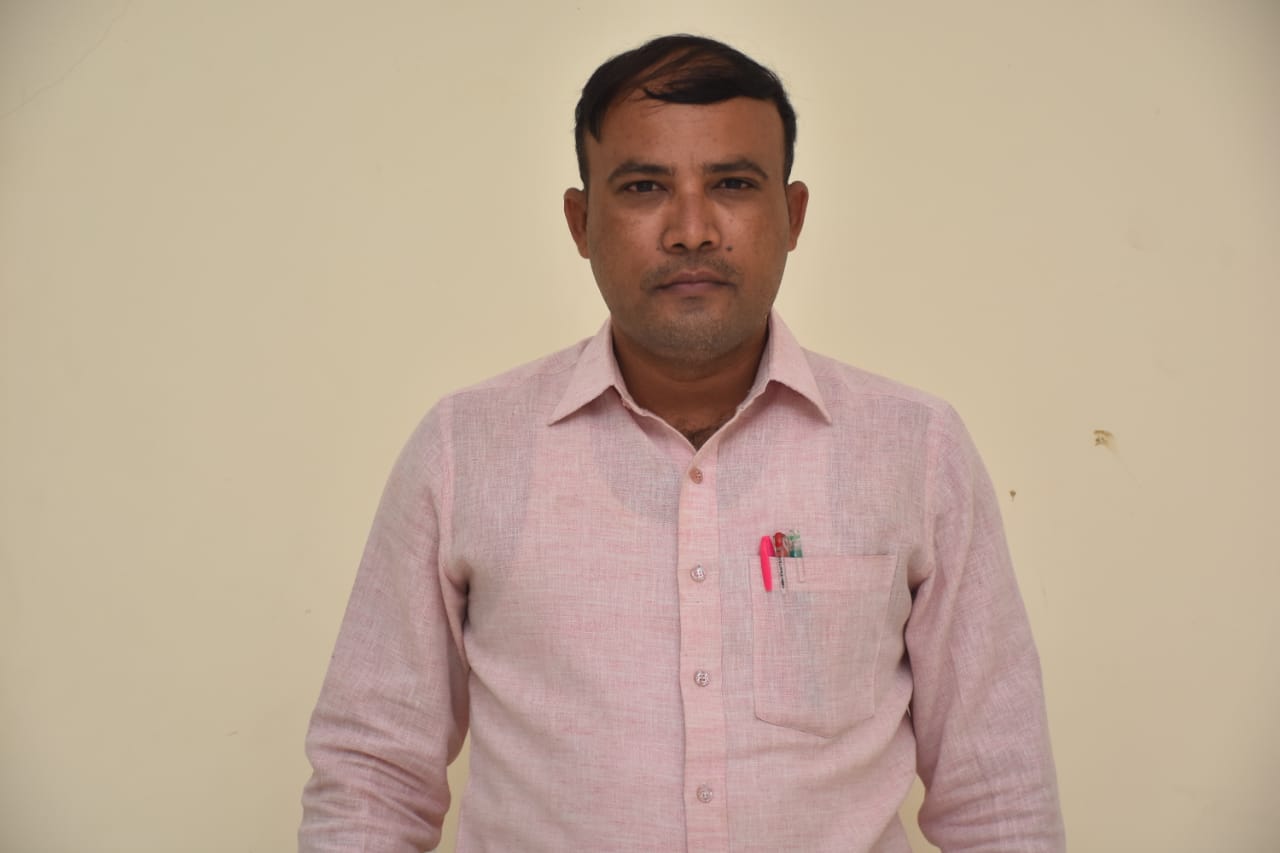
Dr. T. TIRUPAL received a B.Tech degree in Electronics and Communication Engineering from Jawaharlal Nehru Technological University, Hyderabad; an M.Tech degree in Communications & Signal Processing from Acharya Nagarjuna University, Guntur; and a Ph.D. degree in Electronics and Communication Engineering in the field of Medical Image Processing from Jawaharlal Nehru Technological University Kakinada, Kakinada. Currently working as a professor & HOD in the Department of ECE at G. Pullaiah College of Engineering and Technology, Kurnool, and has 20 years of experience in teaching and research.
RESEARCH, TEACHING, or OTHER INTERESTS
Biomedical Engineering, Signal Processing, Computer Vision and Pattern Recognition, Information Systems
33
Scopus Publications
541
Scholar Citations
11
Scholar h-index
13
Scholar i10-index
Scopus Publications
Design and Analysis of a Compact Multi Input Multi Output Truncated Circular Planar Antenna using Defected Ground Structure for Millimeter Applications Jyothirmai M, Tirupal T International Research Journal of Multidisciplinary Technovation, 2026 A novel planar multi-input multi output (MIMO) antenna operating at 28 GHz is proposed, featuring a four-elements with rotationally symmetric circular resonators with defected ground plane (DGP) to enhance performance of gain and isolation. The single element circular patch antenna design is extended into a MIMO configuration to improve gain and directivity, making it suitable for 5G. The proposed antenna is analyzed through simulated S-parameters, including S₁₁ (like the single-element antenna) and S₂₁, S₃₁ for the MIMO configuration for evaluate impedance matching and coupling effects using the commercially available CST microwave studio suite software. A very fine mesh size used in the simulation for better accuracy for getting the good simulation results. The radiation characteristics at the resonant frequency are examined using both polar and 3D radiation patterns, demonstrating the antenna directional behavior and effective radiation performance. The antenna structure overall size is 45 x 45 x 0.254 mm3. The Rogers 5880 with 2.2 dielectric constant is used as the substrate for the material. The defected ground plane (DGP) is used to improve the isolation between the ports in the MIMO structure. The proposed work examined in terms of the parameters like S11, S21, ECC (Envelope correlation coefficient), DG (Diversity Gain), CCL (Channel capacity Loss), TARC (Total Active Reflection Coefficient) and the radiation pattern. The mutual coupling/isolation is >25 dB and the MIMO parameters i.e., ECC <0.00033 with a DG >9.9 dB is achieved. The antenna is fabricated using photolithography techniques and validated using the vector network analyzer (VNA). Both the simulation and measured results are in good agreement in terms of S-parameters as well as radiation characteristics.
MIMO Antenna Design: An Inclusive Study of Antenna and Isolation Enhancement Techniques for 5G Communication M. Jyothirmai, T. Tirupal Cyber Physical Systems Applications Challenges and Research Directions, 2025 The Fifth Generation (5G) wireless technology lying in millimeter-wave band ranges from 30 to 300 GHz proves a better successor from its previous wireless communication in terms of data rates, geographical coverage, spectrum available, latency, multiapplication facility, and energy consumption. 5G has been given a specific range of band in the spectrum to be deployed globally. However, we all know the relation between the frequency and wavelength is inverse in nature. This is the major impact on the 5G communication, as the wavelength is shorter compared to 3G, 4G which were deployed at a lower microwave region. Fading and absorption are the main causes for the degradation in performance of 5G. To alleviate 92these drawbacks, multi-input multi-output (MIMO) seeks attraction by the researcher. As in MIMO, number of antennas will be deployed in both the transmitter and receiver sides which reduces the multipath fading and increases the channel capacity. But implementing the MIMO itself imposes diverse challenges in terms of design. This survey chapter provides an extensive study of various design approaches along with distinguished mutual coupling enhancement techniques which are present to improvise the performance parameters of MIMO antenna design such as envelope correlation coefficient (ECC), channel capacity loss (CCL), and so on for 5G communication.
Robotic Machine Design and Implementation of Noise Cancellation Techniques in Microphones T. Tirupal, T. Dheeraj, B. Dasharath, B. Hemanth, K. Jagadeep Cyber Physical Systems Applications Challenges and Research Directions, 2025 The active noise cancellation (ANC) system is composed of microphones that are capable of detecting both internal and external noise. Additionally, the device incorporates an ANC system, which effectively mitigates noise. Furthermore, an internal speaker is integrated into the device to counteract external noises by employing sound wave cancellation techniques. This process can be likened to the addition of a positive two externally and a negative two internally, resulting in a net sum of zero. The adaptive robotic machine utilizes microphones and speakers to automatically adjust its noise cancellation capabilities in response to the surrounding environment. This chapter investigates the existing and recent studies on adaptive filter techniques in ANC systems. Many applications demand adaptive algorithms that converge swiftly since the change in incoming signals might be quite fast. This study examines the application of robotic cyber machine adaptive least mean square (LMS) algorithms for 20noise reduction in voice signals. This leads to improved efficiency and decreased computational complexity. The normalized LMS (NLMS) approach provides a noise suppression of approximately 13 dB, resulting in significant improvement in speech quality. In contrast, the LMS technique only offers a noise suppression of up to 10 dB. Signal-to-noise ratio (SNR) was measured using several methods under various blockingkind matrices, step-sizes, and noise sources. The adaptive noise-canceling technology utilizes a configuration consisting of two microphones. Adaptive ANC is a technology that utilizes microphones and speakers to automatically adjust to the surrounding environment. This advanced form of ANC utilizes digital technology to adjust the level of noise cancellation based on the surrounding environment. ANC utilizes noise cancellation technology to eliminate unwanted background noise.
Smart Traffic Management and Emergency Vehicle Detection System Using IoT T. Tirupal, B. Uday Kiran Reddy, K. Sai Teja, Uday Kiran Dhane, M. Siva Prasad Cyber Physical Systems Applications Challenges and Research Directions, 2025 This chapter introduces the smart traffic management system which will help make roads less congested in big cities and give emergency vehicles a clear way. To prevent accidents and promote a smooth flow of traffic, the road dividers separate the road into two directions. A divider helps in preventing vehicles from colliding with each other. Due to traffic congestion, it will be difficult to clear the path and save time in cities. Using RFID it will provide a clear path for the ambulance or other emergency vehicle. Through the cloud, the traffic density at the dividers can be observed. The divider will be equipped with a buzzer and LCD display to indicate its movement automatically. The density of the vehicles can be counted using IR sensors. If a vehicle is found next to the divider, the ultrasonic sensor will detect it and emit a buzzing sound.
Efficacious Lung Cancer Detection Utilising Hybrid Deep Learning and Sophisticated Image Processing P Manikanta Simgamsetti, T Tirupal Proceedings of 6th International Conference on Iot Based Control Networks and Intelligent Systems Icicnis 2025, 2025 Lung cancer remains a leading cause of cancer-related mortality worldwide, underscoring the critical need for accurate and early detection methods. This study presents an innovative technique for lung cancer diagnostics that integrates hybrid deep learning algorithms with advanced image processing methods. The proposed methodology includes a thorough pipeline that begins with data collection and preprocessing, proceeds with noise reduction via filtering, segmentation through advanced clustering algorithms, feature extraction and selection, and concludes with classification utilising a hybrid deep learning model. Some important contributions are the creation of a complete preprocessing and filtering framework that enhances picture quality, the use of hybrid K-means and Fuzzy C-means clustering for precise segmentation, and the extraction of radiomic characteristics to pinpoint important patterns. We present a new hybrid classification model that uses 10-fold cross-validation to improve detection accuracy. This model combines Crow Search, Locust Assist, Boolean Grey Wolf, and Convolutional Neural Networks (CNNs). The findings indicate a significant improvement in detection precision and dependability relative to current techniques. The suggested hybrid method demonstrates enhanced performance, underscoring its applicability in lung cancer diagnostics. This discovery improves lung cancer detection and lays the groundwork for future investigations involving hybrid deep learning as well as image processing techniques.
A MIMO Antenna Design and Analysis for 5G millimeter Applications M. Jyothirmai, T. Tirupal 2025 IEEE International Conference on Intelligent Signal Processing and Effective Communication Technologies Inspect 2025, 2025 This study represents a new compact and low-profile MIMO (Multiple-Input Multiple-Output) antenna designed to operate at 28 GHz for 5 G applications. The offered antenna performs exceptionally well, featuring two circular slot radiating elements, all within a $40 \times 20 \times 0.254 \mathrm{~mm}^{3}$ footprint. Rogers RT/duroid 5880 is a substrate with low dielectric constant (2.2) at microwave and millimeter wave frequencies, making it preferable at high frequencies. A major goal of this design is to achieve low mutual coupling between the antenna elements, thereby maintaining high isolation and minimizing interference for optimal MIMO performance. which is critical in MIMO systems. The proposed antenna is shown to provide very good isolation performance with mutual coupling greater than 23 dB. Its performance has been rigorously evaluated on critical design parameters including return loss $\left(S_{11}\right)$, isolation $\left(S_{21}\right)$, envelope correlation coefficient (ECC), diversity gain (DG), and radiation patterns. The measurements obtained support the design with an ECC lower than 0.00033 and DG above 9.9 dB, which indicates strong MIMO ability. The results confirm the compact and highefficiency design for 5G mm-wave applications
Enhancing Electronic Circuit Analysis with the Portable Analog Discovery Kit B. Sulochana, T. Tirupal, Ajay Roy 2025 International Conference on Sustainability Innovation and Technology Icsit 2025, 2025 Some of you usually need a lot of various instruments to do experiments in an ordinary electronic lab. For instance, you'll require a function generator, a power supply, and an oscilloscope (CRO). These instruments are required for conducting tests and evaluating circuits made of electronics, yet they can be bulky, challenging to carry, and challenging to put together for each experiment. Installing up every piece of apparatus may require quite a while, yet it's challenging to transport a lot for devices to every experiment site. We You have to make use of the Waveform Forms application and the Analog Discovery Kit to find out a way to fix those issues. We would like to discover the way to make everything better. The exercises will assist us understand how to handle issues and arrive with the answers. There are quite a lot for various activities that the Analog Discovery Kit can do. It includes with an oscilloscope, a function generator, a power supply, and other instruments. It's additionally a good thing to have. You only require a single item of apparatus to use this tool, so it's simple to carry around. You can also use it for a lot of different things. This is because it only needs one tool. The Analog Discovery Kit makes it easier to do experiments because it has everything you need in one device. This was done to make things easier. This could help you save time and space.
Intelligent traffic management and identification of emergency vehicles T. Tirupal, B. Uday Kiran Reddy, K. Sai Teja, Uday Kiran Dhane, M. Siva Prasad, A.O. Salau Modelling of Virtual Worlds Using the Internet of Things, 2024 This chapter introduces the Smart Traffic Management System which will help make roads less congested in big cities and give emergency vehicles a clear way. To prevent accidents and promote a smooth flow of traffic, the road dividers separate the road into two directions. Dividers help in preventing vehicles from colliding with each other. Due to traffic congestion, it will be difficult to clear the path and save time in cities. Using Radio Frequency Identification (RFID) will provide a clear path for the ambulance or other emergency vehicles. Through the cloud, the traffic density at the dividers can be observed. The divider will automatically move by intimating the movement of the divider by using a buzzer and Liquid Crystal Display (LCD). The density of the vehicles can be counted using infrared (IR) sensors. If a vehicle is found next to the divider, the ultrasonic sensor will detect it and emit a buzzing sound.
Multimodal Medical Image Fusion Based on Intuitionistic Fuzzy Sets Berhan Oumer Adame, Ayodeji Olalekan Salau, Bangi Chinna Subbanna, Talari Tirupal, Shaik Fowzia Sultana Proceedings of 2020 IEEE International Women in Engineering Wie Conference on Electrical and Computer Engineering Wiecon Ece 2020, 2020
Multimodal medical image fusion based on undecimated wavelet transform and fuzzy sets International Journal of Innovative Technology and Exploring Engineering, 2019
Comparative analysis of digital image compression with different wavelets using ANN and RLE Journal of Electrical Engineering, 2015
RECENT SCHOLAR PUBLICATIONS
Extraction of visibility features by fusion of medical images based on type-2 fuzzy sets with OTLBO T Tirupal, KZ Mehreen Artificial Intelligence and Sustainable Innovation, 259-265 , 2026 2026
Efficacious Lung Cancer Detection Utilising Hybrid Deep Learning and Sophisticated Image Processing PM Simgamsetti, T Tirupal 2025 6th International Conference on IoT Based Control Networks and … , 2025 2025
Robotic Machine Design and Implementation of Noise Cancellation Techniques in Microphones T Tirupal, T Dheeraj, B Dasharath, B Hemanth, K Jagadeep Cyber-Physical Systems, 19-34 , 2025 2025
Smart Traffic Management and Emergency Vehicle Detection System Using IOT T Tirupal, BUK Reddy, KS Teja, UK Dhane, MS Prasad Cyber-Physical Systems, 291-305 , 2025 2025
Mimo Antenna Design: An Inclusive Study of Antenna and Isolation Enhancement Techniques for 5G Communication M Jyothirmai, T Tirupal Cyber-Physical Systems, 91-100 , 2025 2025 Citations: 2
A MIMO Antenna Design and Analysis for 5G millimeter Applications M Jyothirmai, T Tirupal 2025 IEEE International Conference on Intelligent Signal Processing and … , 2025 2025 Citations: 1
and Recognition System for Cricket Players Using FaceNet Algorithm AV Krishna, BHHK Reddy, T Tirupal, BS Ram, BV Kumar Web Intelligence and Human-Machine Interaction: Proceedings of ICWIHI 2025, 461 , 2025 2025
Enhancing Electronic Circuit Analysis with the Portable Analog Discovery Kit B Sulochana, T Tirupal, A Roy 2025 International Conference on Sustainability, Innovation & Technology … , 2025 2025
A Brief Study on MIMO Antenna Design and Isolation Enhancement Techniques for 5G Communications M Jyothirmai, T Tirupal International Conference on Smart Computing and Informatics, 483-490 , 2025 2025 Citations: 1
Multimodal Medical Image Fusion with the Swift Algorithm and Gaussian Filter K Mahendra, K Sai Charan, T Tirupal, K Lakshman International Conference on Web Intelligence and Human-Machine Interaction … , 2025 2025
Region-Based Pixel Interpolation Technique for Image Inpainting and Visual Data Recovery S Afrid, T Gangadhar, T Tirupal, SPK Reddy, YM Krishna, B Sulochana International Conference on Web Intelligence and Human-Machine Interaction … , 2025 2025
Advanced Face Detection and Recognition System for Cricket Players Using FaceNet Algorithm A Vijay Krishna, B Hari Hara Kumar Reddy, T Tirupal, BS Ram, BV Kumar International Conference on Web Intelligence and Human-Machine Interaction … , 2025 2025
Fusion of Natural, Medical, and Satellite Images Based on Convolutional Neural T Tirupal, J Divya, G Anjali, K Charitha, NG Deepika Proceedings of International Conference on Paradigms of Communication … , 2025 2025
Compact wideband MIMO antenna with orthogonal arrangement for 5G communication M Jyothirmai, T Tirupal 2024 Second International Conference on Microwave, Antenna and Communication … , 2024 2024 Citations: 5
AlexNet for Lung Cancer Detection: Leveraging Deep Learning for Diagnosis PM Simgamsetti, T Tirupal 2024 Second International Conference on Intelligent Cyber Physical Systems … , 2024 2024 Citations: 1
Intelligent traffic management and identification of emergency vehicles T Tirupal, BUK Reddy, KS Teja, UK Dhane, MS Prasad, AO Salau Modelling of Virtual Worlds Using the Internet of Things, 88-112 , 2024 2024 Citations: 4
Fusion of natural, medical, and satellite images based on convolutional neural networks T Tirupal, J Divya, G Anjali, K Charitha, N Grace Deepika International Conference on Paradigms of Communication, Computing and Data … , 2024 2024 Citations: 3
A Border Surveillance System Designed to Detect and Monitor Terrorist Activities Using Wireless Sensor Network T Tirupal, J Venkateswarlu, B Jagadeesh, B Ashok International Conference on Information and Communication Technology for … , 2024 2024
On the use of UDWT and fuzzy sets for medical image fusion T Tirupal, Y Pandurangaiah, A Roy, VV Kishore, A Nayyar Multimedia Tools and Applications 83 (13), 39647-39675 , 2024 2024 Citations: 15
Detection and Enhancement of Aqua Images Using Haze and YOLO Algorithms T Tirupal, P Anwar, KL Narayana, MN Babu 2024 International Conference on Distributed Computing and Optimization … , 2024 2024 Citations: 1
MOST CITED SCHOLAR PUBLICATIONS
Multimodal Medical Image Fusion Techniques–A Review T Tirupal, BC Mohan, SS Kumar Current Signal Transduction Therapy 15 (1), 1-22 , 2020 2020 Citations: 100
Multimodal medical image fusion based on Sugeno's intuitionistic fuzzy sets T Tirupal, BC Mohan, SS Kumar Etri Journal 39 (2), 173-180 , 2017 2017 Citations: 53
Multimodal Medical Image Fusion Based on Yager's Intuitionistic Fuzzy Sets SSK 1. T.Tirupal, B.Chandra Mohan Iranian Journal of Fuzzy Systems 16 (1), 33-48 , 2019 2019 Citations: 46
Smart blind stick using ultrasonic sensor T Tirupal, BV Murali, M Sandeep, KS Kumar, CU Kumar Journal of Remote Sensing GIS Technology 7 (2), 34-42 , 2021 2021 Citations: 40
Image Fusion of Natural, Satellite, and Medical Images using Undecimated Discrete Wavelet Transform and Contrast Visibility T Tirupal, B Chandra Mohan, S Srinivas Kumar National Conference on Recent Advances in Electronics & Computer Engineering … , 2015 2015 Citations: 23
LTE-Advanced Cellular Networks for D2D Communications ES Harsha, T Tirupal International Journal of Scientific Engineering and Technology Research," August , 2014 2014 Citations: 21
Multimodal medical image fusion based on interval-valued intuitionistic fuzzy sets T Tirupal, B Chandra Mohan, S Srinivas Kumar Machines, Mechanism and Robotics: Proceedings of iNaCoMM 2019, 965-971 , 2021 2021 Citations: 18
On the use of UDWT and fuzzy sets for medical image fusion T Tirupal, Y Pandurangaiah, A Roy, VV Kishore, A Nayyar Multimedia Tools and Applications 83 (13), 39647-39675 , 2024 2024 Citations: 15
Performance of Image Fusion Techniques for Satellite Images EG Krishna, T Tirupal International Journal for Technological Research in Engineering 2 (12), 3184 … , 2015 2015 Citations: 14
Fast and accurate content based image classification and retrieval using Gaussian Hermite moments applied to COIL 20 and COIL 100 BC Mohan, TK Chaitanya, T Tirupal 2019 10th international conference on computing, communication and … , 2019 2019 Citations: 13
Multimodal medical image fusion based on intuitionistic fuzzy sets BO Adame, AO Salau, BC Subbanna, T Tirupal, SF Sultana 2020 IEEE International Women in Engineering (WIE) Conference on Electrical … , 2020 2020 Citations: 12
Multimodal Medical Image Fusion Based on Fuzzy Sets with Orthogonal Teaching–Learning-Based Optimization T Tirupal, BC Mohan, SS Kumar Computational Intelligence: Theories, Applications and Future Directions … , 2019 2019 Citations: 11
Pixel-Level Multifocus Image Fusion based on Wavelet Transform & Principal Component Analysis T Tirupal, B Chandra Mohan Journal of Innovation in Electronics & Communication, JIEC 2 (2), 60-64 , 2012 2012 Citations: 11
Opencv based smart attendance system using facial recognition T Tirupal, MN Kumar, PM Basha, JM Babu, O Rathan 2023 4th international conference for emerging technology (INCET), 1-6 , 2023 2023 Citations: 9
Liver Cancer Detection Using Various Image Segmentation Approaches: A Review. G Mahalaxmi, T Tirupal, S Shanawaz IUP Journal of Telecommunications 13 (3) , 2021 2021 Citations: 9
Multimodal medical image fusion based on undecimated wavelet transform and fuzzy sets PK Peruru, K Madhavi, T Tirupal International Journal of Innovative Technology and Exploring Engineering 8 … , 2019 2019 Citations: 9
Detection of Lung Cancer Using Binarization Technique G Mahalaxmi, T Tirupal IUP Journal of Information Technology 13 (4), 7-19 , 2017 2017 Citations: 9
Multifocus Medical Image Fusion based on Fractional Lower Order Moments and Modified Spatial Frequency T Tirupal, B Chandra Mohan, S Srinivas Kumar International Conference on Advances in Biotechnology (BioTech). Proceedings … , 2015 2015 Citations: 9
Multimodal Medical Image Fusion based on Type-1 Fuzzy Sets K Gayathri, T Tirupal Journal of Applied Science and Computations 5 (10), 1329-1341 , 2018 2018 Citations: 8
A comparison and survey on brain tumour detection techniques using MRI images G Mahalaxmi, T Tirupal, S Shanawaz, S Swarnakar, SV Krishna Current Signal Transduction Therapy 18 (1), 14-23 , 2023 2023 Citations: 6