PhD in Mechanical Engineering (2009) Instituto Superior Técnico, Lisboa
RESEARCH INTERESTS
Crashworthiness
Impact Biomechanics
Multibody Systems Dynamics
Finite Element Analysis
Optimization
38
Scopus Publications
788
Scholar Citations
16
Scholar h-index
21
Scholar i10-index
Scopus Publications
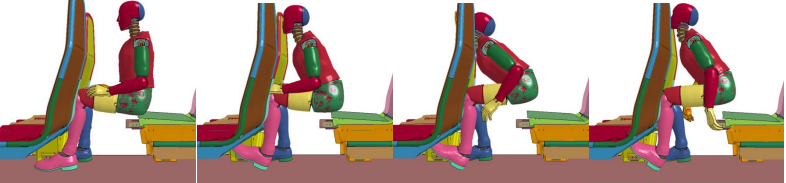
Reclined Seating Postures on Passive Safety Performance in Automotive Seats: A Review Nuno Carmo, João Milho, Marta Carvalho Machines, 2026 The increasing adoption of reclined seating postures in modern vehicle interiors challenges the assumptions underpinning current passive safety systems and occupant protection assessment frameworks. While restraint technologies and certification protocols have historically been developed for upright configurations, emerging trends in autonomous driving and comfort-oriented designs promote relaxed postures that fundamentally alter occupant kinematics, loading path, and consequently the injury mechanisms. This review critically synthesizes experimental and numerical studies addressing occupant biomechanics, restraint system performance, and injury risk in reclined seating. Evidence from crash tests using Anthropomorphic Test Devices and Post-Mortem Human Surrogates, alongside high-fidelity numerical Human Body Models, is analyzed to identify consistent trends and methodological limitations. The results highlight increased forward excursion, elevated submarining propensity, and posture-dependent abdominal and lumbar loading as critical consequences of increased seatback recline. Furthermore, this review discusses the effectiveness of adaptive restraint strategies, including active repositioning and modified airbag–belt integration. By identifying existing research gaps and regulatory limitations, this work aims to provide a roadmap for the development of future safety systems that ensure robust protection for all occupants in the era of automated mobility.
Simulation–Driven Design of Ankle–Foot Orthoses Using DoE Optimization and 4D Visualization Marta Carvalho, João Milho Biomechanics Switzerland, 2025 Background/Objectives: The simulation of human movement offers transformative potential for the design of medical devices, particularly in understanding the cause–effect dynamics in individuals with neurological or musculoskeletal impairments. This study presents a simulation-driven framework to determine the optimal ankle–foot orthosis (AFO) stiffness for mitigating the risk of ankle sprains due to excessive subtalar inversion during high-impact activities, such as landing from a free fall. Methods: We employed biomechanical simulations to assess the influence of translational stiffness on subtalar inversion control, given that inversion angles exceeding 25 degrees are strongly correlated with injury risk. Simulations were conducted using a musculoskeletal model with and without a passive AFO; the stiffness varied in three anatomical directions. A Design of Experiments (DoE) approach was utilized to capture nonlinear interactions among stiffness parameters. Results: The results indicated that increased translational stiffness significantly reduced inversion angles to safer levels, though direction–dependent effects were noted. Based on these insights, we developed a 4D visualization tool that integrates simulation data with an interactive color–coded interface to depict ”safe design” zones for various AFO stiffness configurations. This tool supports clinicians in selecting stiffness values that optimize both safety and functional performance. Conclusions: The proposed framework enhances clinical decision-making and engineering processes by enabling more accurate and individualized AFO designs.
Smart piezoelectric composite: impact of piezoelectric ceramic microparticles embedded in heat-treated 7075-T651 aluminium alloy Pedro M. Ferreira, David Caçador, Miguel A. Machado, Marta S. Carvalho, Pedro Vilaça, et al. International Journal of Mechanics and Materials in Design, 2025 Significant advances have been made in material synthesis in the last two decades, with a focus on polymers, ceramics, metals, and smart materials. Piezoelectric-based smart materials generate an electric voltage in response to loads, enabling distributed monitoring in critical structural parts. Friction stir processing (FSP) is a versatile approach that can enhance material performance in various engineering fields. The primary objective of the current research is to examine the sensorial properties of heat-treated AA7075-T651 aluminium plates that have been included with Lead Zirconate Titanate (PZT) and Barium Titanate (BT) particles via FSP. This study includes a comparative analysis of sensitivities with AA5083-H111 self-sensing material, metallographic and physicochemical characterization, and an assessment of the mechanical properties impacted by the incorporation of piezoelectric particles. The sensitivity of AA7075-PZT was found to be significantly higher than that of AA7075-BT. AA7075-PZT achieved a maximum sensitivity of 15.27 × 10⁻⁴ μV/MPa while AA7075-BT had a sensitivity of only 7.28 × 10⁻⁴ μV/MPa, which is 52% lower. Microhardness and uniaxial tensile tests demonstrated that the presence of particles has an influence on both mechanical strength and electrical conductivity of aluminium components, as opposed to those that do not have particles. The complete investigation intends to give significant insights into the performance and prospective uses of these innovative smart materials, therefore advancing materials science and engineering. Graphical abstract
Enabling electrical response through piezoelectric particle integration in AA2017-T451 aluminium parts using FSP technology Pedro M Ferreira, David Caçador, Miguel A Machado, Marta S Carvalho, Pedro Vilaça, et al. Smart Materials and Structures, 2024 In the field of structural engineering, the integration of smart materials and structural health monitoring (SHM) has given rise to self-sensing materials (SSM), leading to a paradigm shift in SHM. This paper focuses on the interplay between self-sensing capabilities and the piezoelectric properties of lead zirconate titanate (PZT) and barium titanate (BT) in aluminium components. Leveraging Friction Stir Processing (FSP), the study explores the synthesis and performance of SSMs with embedded piezoelectric particles, potentially transforming structural engineering. The paper highlights FSP as a key methodology for incorporating piezoelectric particles into structural materials, showcasing its potential in developing SSMs with enhanced functionalities. A specific focus is placed on integrating PZT and BT particles into AA2017-T451 aluminium parts using FSP, with metallographic assessments and mechanical property evaluations conducted to analyse particle distribution and concentration. This study shows how BT and PZT particles are incorporated into AA2017-T451 aluminium to create a SSM that responds to external stimuli. Under cyclic loading, the SSMs exhibit a linear load-electrical response correlation, with sensibility increasing at lower frequencies. Metallographic analysis shows homogeneous particle distribution, while PZT induces increased brittleness and brittle fractures. Yield strength remains relatively stable, but ultimate strength decreases post-FSP. Hardness variations indicate weaker bonding with PZT particles. Eddy’scurrent testing aligns with hardness profiles, and sensorial characterization reveals a non-linear frequency-sensibility relationship, showcasing the SSMs’ suitability for low-frequency applications, particularly with PZT embedment.
Efficient 2D Neck Model for Simulation of the Whiplash Injury Mechanism Diamantino Henriques, Ana P. Martins, Marta S. Carvalho Bioengineering, 2024 Whiplash injuries, mainly located in the neck, are one of the most common injuries resulting from road collisions. These injuries can be particularly challenging to detect, compromising the ability to monitor patients adequately. This work presents the development and validation of a computationally efficient model, called Efficient Neck Model—2D (ENM-2D), capable of simulating the whiplash injury mechanism. ENM-2D is a planar multibody model consisting of several bodies that model the head and neck with the same mass and inertia properties of a male occupant model in the 50th percentile. The damping and non-linear spring parameters of the kinematic joints were identified through a multiobjective optimization process, solved sequentially. The TNO-Human Body Model (TNO-HBM), a validated occupant model for rear impact, was simulated, and its responses were used as a reference for validation purposes. The root mean square (RMS) of the deviations of angular positions of the bodies were used as objective functions, starting from the bottom vertebra to the top, and ending in the head. The sequence was repeated until it converged, ending the optimization process. The identified ENM-2D model could simulate the whiplash injury mechanism kinematics and accurately determine the injury criteria associated with head and neck injuries. It had a relative deviation of 8.3% for the head injury criteria and was 12.5 times faster than the reference model.
Tracheal Automatic Hexahedral Mesh Generation Jairson C. Dinis, João Brites Pinto, Carlos A. Campos, Mário S. Correia, Henrique Almeida, et al. Lecture Notes in Bioengineering, 2023
Double active transient thermography Miguel A. Machado, Maria I. Silva, Ana P. Martins, Marta S. Carvalho, Telmo G. Santos NDT and E International, 2022
Reliability and NDT Methods Telmo G. Santos, J. P. Oliveira, Miguel A. Machado, Patrick L. Inácio, Valdemar R. Duarte, et al. Advanced Structured Materials, 2020
Inspection of composite parts produced by additive manufacturing: Air-coupled ultrasound and thermography 58th Annual Conference of the British Institute of Non Destructive Testing NDT 2019, 2019
RECENT SCHOLAR PUBLICATIONS
Development and evaluation of numerical models of an aircraft seat assembly and occupant for the simulation of dynamic certification tests AP Martins, MS Carvalho, G Olivares, H Lankarani Mechanism and Machine Theory 208, 105940 , 2025 2025 Citations: 6
Smart piezoelectric composite: impact of piezoelectric ceramic microparticles embedded in heat-treated 7075-T651 aluminium alloy PM Ferreira, D Caçador, MA Machado, MS Carvalho, P Vilaça, G Sorger, ... International Journal of Mechanics and Materials in Design 21 (1), 155-180 , 2025 2025 Citations: 6
Evaluation of self-sensing material behaviour: Insights from cyclic and pulse load testing PM Ferreira, A Meireles, C Vidal, MS Carvalho, MA Machado Measurement 234, 114878 , 2024 2024 Citations: 8
Modelling electro-mechanical behaviour in piezoelectric composites: Current status and perspectives on homogenisation PM Ferreira, MA Machado, C Vidal, MS Carvalho Advances in Engineering Software 193, 103651 , 2024 2024 Citations: 39
Enabling electrical response through piezoelectric particle integration in AA2017-T451 aluminium parts using FSP technology PM Ferreira, D Caçador, MA Machado, MS Carvalho, P Vilaça, G Sorger, ... Smart Materials and Structures 33 (6), 065037 , 2024 2024 Citations: 12
Nondestructive testing of 3D printed fiber-reinforced polymeric composites: an experimental critical comparison HV Silva, NP Catapirra, MS Carvalho, TG Santos, MA Machado 3D Printing and Additive Manufacturing 11 (3), 1196-1208 , 2024 2024 Citations: 21
Development of a multibody model of an aircraft seat assembly and occupant for the simulation of dynamic certification tests AP Martins, MS Carvalho, G Olivares, HM Lankarani The 7th International Conference on Multibody System Dynamics , 2024 2024 Citations: 1
Efficient 2D neck model for simulation of the whiplash injury mechanism D Henriques, AP Martins, MS Carvalho Bioengineering 11 (2) , 2024 2024 Citations: 7
TRATAMENTO CIRÚRGICO DA HIPERTENSÃO INTRACRANIANA RG AGUILA, T AMORIM, PAB SILVA, LHC SOUZA, M SILVA, ... CONTRIBUCIONES A LAS CIENCIAS SOCIALES 17 (13), e13355 , 2024 2024
Self-sensing metallic material based on piezoelectric particles PDM Ferreira PQDT-Global , 2024 2024 Citations: 10
Self-sensing metallic material based on PZT particles produced by friction stir processing envisaging structural health monitoring applications PM Ferreira, MA Machado, MS Carvalho, P Vilaça, G Sorger, JV Pinto, ... Materials Characterization 205, 113371 , 2023 2023 Citations: 20
Double active thermographic inspection of additive manufacturing composites: numerical modelling and validation HV Silva, AP Martins, MA Machado, TG Santos, MS Carvalho Measurement 218, 113212 , 2023 2023 Citations: 18
Inspection benchmarking of fiber reinforced polymers produced by additive manufacturing MA Machado, H Silva, J Pazadinhas, MS Carvalho, TG Santos 2023 Citations: 3
Tracheal Automatic Hexahedral Mesh Generation JC Dinis, JB Pinto, CA Campos, MS Correia, H Almeida, H Cordeiro, ... Congress of the Portuguese Society of Biomechanics, 169-176 , 2023 2023
Influence of uniform temperature variations on hybrid bonded joints with a circular or tubular cross-sectional area HC Biscaia, AP Martins, WY Gao, MS Carvalho Mechanics of Materials 179, 104600 , 2023 2023 Citations: 6
Granting sensorial properties to metal parts through friction stir processing PM Ferreira, MA Machado, MS Carvalho, C Vidal Measurement 207, 112405 , 2023 2023 Citations: 33
Development and Simulation of Calibration tests of Multibody Head-neck Models for the Hybrid-II and Hybrid-III ATDs AP Martins, MS Carvalho, H Lankarani, G Olivares 11th ECCOMAS Thematic Conference on Multibody Dynamics (MULTIBODY2023) , 2023 2023 Citations: 1
Embedded sensors for structural health monitoring: methodologies and applications review PM Ferreira, MA Machado, MS Carvalho, C Vidal Sensors 22 (21), 8320 , 2022 2022 Citations: 179
Development of a Cohesive Model for CFRP-To-Steel Bonded Joints for Low and High Temperatures H Biscaia, M Machado, M Carvalho, T Santos, Y Yang International Conference on Testing and Experimentation in Civil Engineering … , 2022 2022 Citations: 1
Interfacial failure of circular or tubular hybrid bonded joints: A theoretical description HC Biscaia, MS Carvalho, AP Martins, R Micaelo Engineering Failure Analysis 132, 105936 , 2022 2022 Citations: 11
MOST CITED SCHOLAR PUBLICATIONS
Embedded sensors for structural health monitoring: methodologies and applications review PM Ferreira, MA Machado, MS Carvalho, C Vidal Sensors 22 (21), 8320 , 2022 2022 Citations: 179
Simulation and validation of thermography inspection for components produced by additive manufacturing MS Carvalho, AP Martins, TG Santos Applied thermal engineering 159, 113872 , 2019 2019 Citations: 52
Identification of validated multibody vehicle models for crash analysis using a hybrid optimization procedure M Carvalho, J Ambrósio, P Eberhard Structural and Multidisciplinary Optimization 44 (1), 85-97 , 2011 2011 Citations: 45
Modelling electro-mechanical behaviour in piezoelectric composites: Current status and perspectives on homogenisation PM Ferreira, MA Machado, C Vidal, MS Carvalho Advances in Engineering Software 193, 103651 , 2024 2024 Citations: 39
Railway occupant passive safety improvement by optimal design M Carvalho, J Milho, J Ambrosio, N Ramos International journal of crashworthiness 22 (6), 624-634 , 2017 2017 Citations: 36
Implications of the inline seating layout on the protection of occupants of railway coach interiors M Carvalho, J Ambrosio, J Milho International Journal of Crashworthiness 16 (5), 557-568 , 2011 2011 Citations: 36
Reliability and NDT methods TG Santos, JP Oliveira, MA Machado, PL Inácio, VR Duarte, ... Additive Manufacturing Hybrid Processes for Composites Systems, 265-295 , 2020 2020 Citations: 35
Identification of multibody vehicle models for crash analysis using an optimization methodology M Carvalho, J Ambrósio Multibody System Dynamics 24 (3), 325-345 , 2010 2010 Citations: 34
Granting sensorial properties to metal parts through friction stir processing PM Ferreira, MA Machado, MS Carvalho, C Vidal Measurement 207, 112405 , 2023 2023 Citations: 33
Double active transient thermography MA Machado, MI Silva, AP Martins, MS Carvalho, TG Santos NDT & E International 125, 102566 , 2022 2022 Citations: 31
A validated railway vehicle interior layout with multibody dummies and finite element seats models for crash analysis J Ambrosio, M Carvalho, J Milho, S Escalante, R Martin Multibody System Dynamics 54 (2), 179-212 , 2022 2022 Citations: 26
Railway seat design for injury mitigation in crash scenario MS Carvalho, AP Martins, J Milho International Journal of Rail Transportation 8 (3), 215-233 , 2020 2020 Citations: 26
Validation of a railway inline seating model for occupants injury biomechanics M Carvalho, A Martins, J Milho International journal of crashworthiness 23 (3), 328-335 , 2018 2018 Citations: 22
Nondestructive testing of 3D printed fiber-reinforced polymeric composites: an experimental critical comparison HV Silva, NP Catapirra, MS Carvalho, TG Santos, MA Machado 3D Printing and Additive Manufacturing 11 (3), 1196-1208 , 2024 2024 Citations: 21
Self-sensing metallic material based on PZT particles produced by friction stir processing envisaging structural health monitoring applications PM Ferreira, MA Machado, MS Carvalho, P Vilaça, G Sorger, JV Pinto, ... Materials Characterization 205, 113371 , 2023 2023 Citations: 20
Double active thermographic inspection of additive manufacturing composites: numerical modelling and validation HV Silva, AP Martins, MA Machado, TG Santos, MS Carvalho Measurement 218, 113212 , 2023 2023 Citations: 18
Development of generic road vehicle multibody models for crash analysis using an optimisation approach M Carvalho, J Ambrosio International Journal of Crashworthiness 16 (5), 537-556 , 2011 2011 Citations: 15
Inspection of composite parts produced by additive manufacturing: Air-coupled ultrasound and thermography MA Machado, PL Inácio, RA Santos, AF Gomes, AP Martins, MS Carvalho, ... 58th Annual Conference of the British Institute of Non-Destructive Testing, NDT , 2019 2019 Citations: 14
Enabling electrical response through piezoelectric particle integration in AA2017-T451 aluminium parts using FSP technology PM Ferreira, D Caçador, MA Machado, MS Carvalho, P Vilaça, G Sorger, ... Smart Materials and Structures 33 (6), 065037 , 2024 2024 Citations: 12
Interfacial failure of circular or tubular hybrid bonded joints: A theoretical description HC Biscaia, MS Carvalho, AP Martins, R Micaelo Engineering Failure Analysis 132, 105936 , 2022 2022 Citations: 11