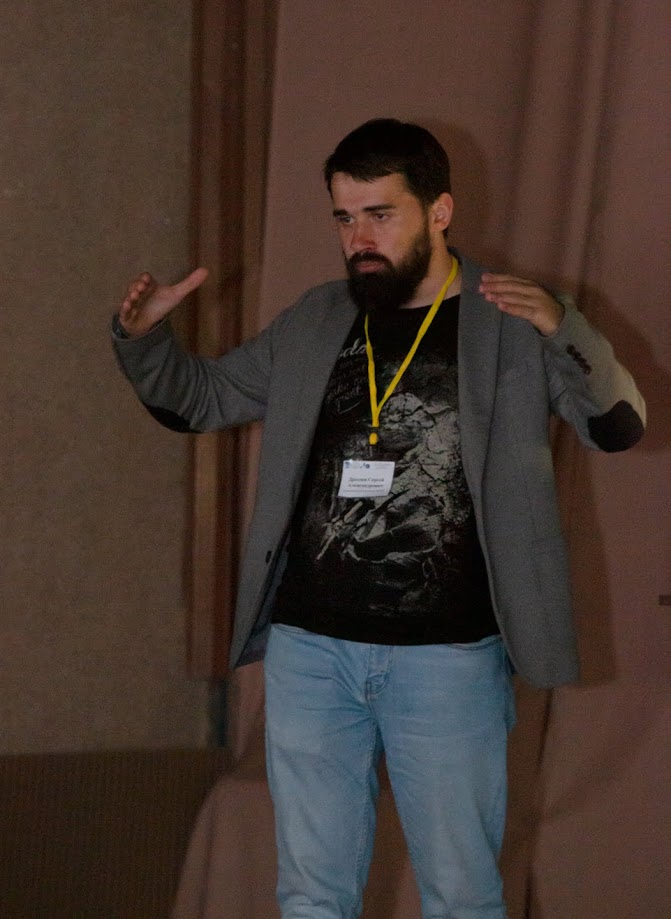
Sergey Drozdov

@asc-lebedev.ru

Department Theoretical astrophysics and cosmology
Astro Space Center of PN Lebedev Physics Institute

EDUCATION

Moscow State University, Faculty of Physics

RESEARCH, TEACHING, or OTHER INTERESTS

Astronomy and Astrophysics
11

Scopus Publications

Scopus Publications

  • Interstellar Medium in Extremely High Star-Formation Regions: A Prospect of Observations on the Millimetron Space Observatory
    E. O. Vasiliev, S. A. Drozdov, P. V. Baklanov, O. P. Vorobyov, S. Yu. Dedikov, M. S. Kirsanova, T. I. Larchenkova, N. N. Shakhvorostova
    Astronomy Reports, 2025
    Abstract High star-formation rate and emission from the active galactic nucleus can significantly transform the interstellar medium. In ultra-luminous infrared galaxies, in which the star-formation rate reaches thousands of solar masses per year, the gas and dust are considerably affected by the ionizing radiation, cosmic rays and shock waves, that can be about a factor of 100–1000 larger than typical values in quiet star-forming galaxies. In these conditions, the emissivity of the gas and dust changes: in dense gas, high ionic and molecular transitions become excited, while dust grains are heated to high temperatures. In this paper, we analyze the possibilities for studying the interstellar medium in extreme conditions of ultra-luminous infrared galaxies at redshifts of ~0–3, utilizing the atomic and molecular lines, and dust continuum in far infrared range of 100–500 μm. We discuss the prospect of observations using the instruments of the Millimetron Space Observatory.
  • Far-Infrared Emission from a Late Supernova Remnant in an Inhomogeneous Medium
    S. A. Drozdov, S. Yu. Dedikov, E. O. Vasiliev
    Astrophysical Bulletin, 2025
    Interstellar dust particles are swept up during the expansion of a supernova (SN) remnant, penetrate behind the shock wave front, where they are heated and destroyed in the hot gas. This leads to a change in the emission properties of such particles. The paper considers the evolution of the infrared (IR) luminosity of an SN remnant expanding in an inhomogeneous interstellar medium with a lognormal distribution of density perturbations. The IR luminosity of the swept up interstellar dust increases rapidly during the first few thousand years after the SN explosion and reaches a maximum. It then decreases due to the destruction of particles in the hot gas and a drop in their emissivity in the cooling gas of the shell. The dependence of the evolution of the IR luminosity of the dust in the remnant on the gas density dispersion ahead of the shock wave front from the SN is shown. It was found that the band centered at 70 $$\mu$$ m can be considered as the most optimal for studying late remnants, since the maximum IR luminosity is located within its limits for a significant time (40–50 kyr). During the evolution, the dust temperature changes from 70 to 20 K and weakly depends on the level of inhomogeneity of the medium. During the radiative phase, strong lines of metal ions appear in the remnant spectra against the dust continuum. Their luminosity grows rapidly and exceeds the luminosity of dust in the continuum under the line by approximately 10–10 $${}^{3}$$ times. The moment of achieving high luminosity in the lines depends significantly on the inhomogeneity of the medium. The possibilities of observing IR emission both in the dust continuum and in the lines are discussed. It is expected that their ratios will allow us to estimate the magnitude of inhomogeneity of the medium in which the remnant is expanding.
  • Origin and transport of water in the Universe
    Maria S. Kirsanova, P.V. Baklanov, Evgeniy O. Vasiliev, Anton I. Vasyunin, Dmitry Z. Wiebe, S.A. Drozdov, Tatiana I. Larchenkova, Sergey F. Likhachev, A.V. Moiseev, Ya.N. Pavlyuchenkov, P.S. Sozinova, A.P. Topchieva, Igor V. Tret'yakov, G.S. Fedoseev, Andrei V. Khudchenko, Nadezhda N. Shakhvorostova
    Physics Uspekhi, 2025
    Origin and transport of water in the Universe, Kirsanova M.S., Baklanov P.V., Vasiliev E.O., Vasyunin A.I., Wiebe D.S., Drozdov S.A., Larchenkova T.I., Likhachev S.F., Moiseev A.V., Pavlyuchenkov Ya.N., Sozinova P.S., Topchieva A.P., Tret’yakov I.V., Fedoseev G.S., Khudchenko A.V., Shakhvorostova N.N.
  • Galaxies at and New Opportunities for Testing Cosmological Models
    S. V. Pilipenko, S. A. Drozdov, M. V. Tkachev, A. G. Doroshkevich
    Astrophysical Bulletin, 2024
    The initial power spectrum of density perturbations, generated during the inflationary epoch, is now constrained by observations on scales of $$\lambda>5$$ Mpc and has a power-law form. The peculiarities of the inflationary process can lead to the appearance of non-power-law contributions to this spectrum, such as peaks. The exact size and shape of the peak cannot be predicted in advance. In this paper, we propose methods for searching for such peaks in the region of the spectrum with $$\lambda<5$$ Mpc. Perturbations on these scales enter the nonlinear stage at $$z\gtrsim 10$$ , which is now becoming accessible to observations. Our studies of numerical models of the large-scale structure with peaks in the initial spectrum have shown that spectral features on scales of $$\lambda>0.1$$ Mpc manifest in the clustering of galaxies, as well as affect their mass function, sizes, and density. Studying these characteristics of distant galaxies will allow us to constrain cosmological models with peaks.
  • Dust-free starburst galaxies at redshifts z > 10
    Biman B Nath, Evgenii O Vasiliev, Sergey A Drozdov, Yuri A Shchekinov
    Monthly Notices of the Royal Astronomical Society, 2023
    One of the most distant galaxies GN-z11 was formed when the Universe was ≤400 Myr old, and it displays a burst-like star formation rate ∼25 M⊙ yr−1 with a metallicity Z ∼ 0.2 ± 0.1 Z⊙. It resembles z = 2–3 galaxies (at ‘cosmic noon’) except for the fact that the measured reddening E(B − V) = 0.01 ± 0.01 indicates the presence of little or no dust. This marked absence of dust hints towards violent dynamical events that destroy or evacuate dust along with gas out of the galaxy on a relatively short time-scale and make it transparent. We apply a 3D numerical model to infer possible physical characteristics of these events. We demonstrate that the energetics of the observed star formation rate is sufficient to tear apart the dusty veil on time-scales of 20–25 Myr. This can explain the apparent lack of evolution of ultraviolet luminosity function of galaxies between z ≥ 10 and z ∼ 7, by compensating for the lower galaxy masses at higher redshift by the absence of dust. We show, however, that this is a temporary phenomenon and soon after the last of the supernovae explosions have taken place, the expanding shell shrinks and obscures the galaxy on time-scales of ≈5–8 Myr.
  • Disc-halo gas outflows driven by stellar clusters as seen in multiwavelength tracers
    Evgenii O Vasiliev, Sergey A Drozdov, Biman B Nath, Ralf-Jürgen Dettmar, Yuri A Shchekinov
    Monthly Notices of the Royal Astronomical Society, 2023
    We consider the dynamics of and emission from growing superbubbles in a stratified interstellar gaseous disc driven by energy release from supernovae explosions in stellar clusters with masses Mcl = 105 − 1.6 × 10⁶ M⊙. Supernovae are spread randomly within a sphere of rc = 60 pc, and inject energy episodically with a specific rate $1/130~\\mathrm{M}_\\odot ^{-1}$ proportional to the star formation rate (SFR) in the cluster. Models are run for several values of SFR in the range 0.01 to 0.1 M⊙ yr−1, with the corresponding average surface energy input rate ∼0.04–0.4 erg cm−2 s−1. We find that the discrete energy injection by isolated SNe are more efficient in blowing superbubbles: Asymptotically they reach heights of up to 3 to 16 kpc for Mcl = 105 − 1.6 × 10⁵ M⊙, correspondingly, and stay filled with a hot and dilute plasma for at least 30 Myr. During this time, they emit X-ray, Hα and dust infrared emission. X-ray luminosities LX∝SFR3/5 that we derive here are consistent with observations in star-forming galaxies. Even though dust particles of small sizes a ≤ 0.03 μm are sputtered in the interior of bubbles, larger grains still contribute considerably ensuring the bubble luminosity $L_{\\rm IR}/{\\rm SFR}\\sim 5\\times 10^7 \\, \\mathrm{L}_\\odot \\, \\mathrm{M}_\\odot ^{-1} ~{\\rm yr}$. It is shown that the origin of the North Polar Spur in the Milky Way can be connected with activity of a cluster with the stellar mass of ∼105 M⊙ and the SFR ∼ 0.1 M⊙ yr−1 some 25–30 Myr ago. Extended luminous haloes observed in edge-on galaxies (NGC 891 as an example) can be maintained by disc spread stellar clusters of smaller masses M* ≲ 105 M⊙.
  • Hα emission from gaseous structures above galactic discs
    Evgenii O. Vasiliev, Sergey A. Drozdov, Yuri A. Shchekinov
    Open Astronomy, 2022
    Extraplanar structures of ionized gas are detected in numerous edge-on galaxies. Whether HII regions or supernovae (SNe) responsible for its ionization is still debated. Here, we consider the H α {\\rm{H}}\\alpha emissivity from shells of superbubbles driven by SNe explosions in a stellar cluster located either in the midplane or above the midplane of the disc. We found that these shells form filamentary structures emitting brightly in H α {\\rm{H}}\\alpha line at height of ∼ 0.6 \\sim 0.6 – 1.6 kpc 1.6\\hspace{0.33em}{\\rm{kpc}} above the disc depending on cluster location and gas metallicity. The H α {\\rm{H}}\\alpha surface brightness ranges within ∼ 1 0 − 17 \\sim 1{0}^{-17} – 1 0 − 16 erg s − 1 cm − 2 arcsec − 2 1{0}^{-16}\\hspace{0.33em}{\\rm{erg}}\\hspace{0.33em}{{\\rm{s}}}^{-1}\\hspace{0.33em}{{\\rm{cm}}}^{-2}\\hspace{0.33em}{{\\rm{arcsec}}}^{-2} are close to the values observed in edge-on galaxies. We conclude that the H α {\\rm{H}}\\alpha emission of extraplanar structures can be explained by recombination in collisionally ionized gas of unstable shells driven by multiple SNe.
  • Bubbles and OB associations
    Sergey A. Drozdov, Evgenii O. Vasiliev, Marina V. Ryabova, Yuri A. Shchekinov, Biman B. Nath
    Open Astronomy, 2022
    Supernovae explosions (SNe) in a stratified interstellar disc can create large scale structures and outflows perpendicular to the disc. Their morphology and emission characteristics depend on interrelations between the number of exploded SNe, the ISM vertical scale height, the height above the ISM disc at which SNe are located, and the mid-plane density of ambient gas. When observed such out-of-plane gas structures do characterize properties of the driving SNe and reveal the presence of underlying stellar clusters. Even though the morphology and emission properties of such structures are sensitive to characteristics of ambient gas they might be used for rough estimates of the clusters’ mass.
  • Dust Destruction in Hot Gas Dynamic Flows
    S. A. Drozdov, E. O. Vasiliev
    Bulletin of the Lebedev Physics Institute, 2021
    An approximate method for estimating the influence of the destruction of polydisperse dust grains in hot gas flows on its emissivity in the infrared range is proposed. The method is based on the relation between characteristic times of dust destruction and keeping the gas temperature high during the starburst. As an example, the maps of dust emission without and with destruction of grains in hot gas of a galactic wind driven by cumulative supernova explosions are calculated. The mass fraction of destructed dust is estimated.
  • Emission Spectrum of Dust in a Cooling Gas
    S. A. Drozdov
    Astrophysics, 2021
  • Temperature of Dust in Hot Plasmas
    S. A. Drozdov, Yu. A. Shchekinov
    Astrophysics, 2019