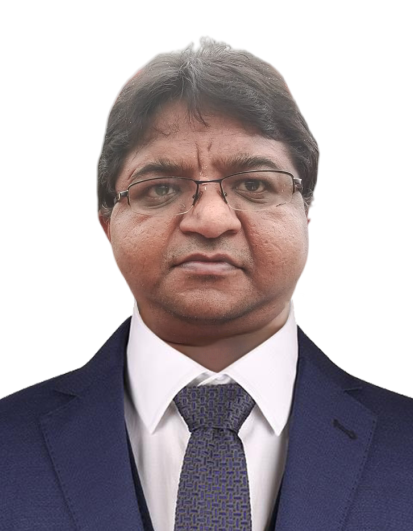
BDS ( Bachelor of Dental Surgery), MBA, Ph.D.. UGC-NET, KSET
RESEARCH, TEACHING, or OTHER INTERESTS
Business and International Management, Organizational Behavior and Human Resource Management, Organizational Behavior and Human Resource Management, Marketing
Neural Futures, AGI, Brain-Computer Interfaces, and the Speculative Morality of Education L. B. Muralidhar, V. Lavakumar, V. S. Vainik, Y. Santhosh, N. Sathyanarayana AI Powered Transformations for Ethical Education, 2026 This chapter examines the convergence of Artificial General Intelligence (AGI) and Brain-Computer Interfaces (BCIs) in education, exploring their transformative potential and the profound ethical challenges they present. It critically analyses how these emerging technologies reshape cognition, pedagogy, and agency, drawing on neuroethics, educational theory, and global policy discourse. Through speculative and interdisciplinary perspectives, it interrogates issues of autonomy, equity, and cognitive liberty while offering strategies for responsible implementation. The chapter proposes a framework for ethically integrating artificial general intelligence (AGI) and brain-computer interfaces (BCIs), striking a balance between innovation and human values in future learning ecosystems.
Smart Ecosystems and Intelligent Enterprises: The Role of IoT in Reshaping Operational Agility Varanasi Rahul, N. Sathyanarayana, A. Arunprakash, L. B. Muralidhar, B. U. Muthamma Iot Driven Business Transformation Strategy Data Trust and Security, 2026 This chapter explores the transformative role of the Internet of Things (IoT) in reshaping operational agility within smart ecosystems and intelligent enterprises. As businesses confront dynamic market demands and technological disruptions, IoT emerges as a critical enabler of real-time responsiveness, automation, and adaptive decision-making. Anchored in Dynamic Capabilities Theory, Systems Theory, and Sociotechnical Systems Design, the chapter conceptualizes operational agility through the integration of sensor networks, AI-driven analytics, edge computing, and interconnected infrastructures. Through empirical case studies spanning manufacturing, healthcare, logistics, energy, and urban governance, the chapter illustrates how IoT fosters capabilities such as sensing, learning, and self-adjustment. It also addresses key implementation challenges, including data security, interoperability, cost, and regulatory compliance. The chapter concludes by identifying future trends, including AIoT, digital twins, and green IoT
D3-Transdisciplinary Framework for Public Health in the Post-Platform Era L. B. Muralidhar, S. Madhu, Raji Rajan, K. P. Sheeba, N. Sathyanarayana Marketing Public Health in A Digital Age, 2026 This chapter explores the shift from platform capitalism to post-platform health infrastructures, emphasizing the role of digital innovation in reimagining public health systems. It introduces a transdisciplinary framework that integrates health sociology, critical data studies, and science and technology studies (STS), exploring the structural disruptions caused by data monopolies and the emergent capabilities enabled by digital health technologies. Focusing on decentralization, data sovereignty, and open protocols, the chapter examines case studies like India's Ayushman Bharat and Estonia's e-Health system. Ethical, political, and epistemological tensions, such as algorithmic bias and digital divides, are critically analysed. The chapter concludes by offering a transdisciplinary model for equitable, participatory, and resilient digital public health systems in a post-platform era.
Optimizing Pedagogical Integrity Through AI Governance in Educational Ecosystems A. Arunprakash, L. B. Muralidhar, N. Sathyanarayana, Pooja Kumari, R. Shilpa AI Powered Transformations for Ethical Education, 2026 This chapter explores the integration of Artificial Intelligence (AI) within education and its implications for pedagogical integrity, ethics, and governance. It examines how algorithmic systems influence learning processes, teacher agency, and educational equity. Drawing on theoretical traditions such as humanism, constructivism, and critical pedagogy, the study proposes the Ethical-AI Pedagogy Nexus (EAPN) framework to balance innovation with moral accountability. Through comparative policy analysis and global case studies, it highlights best practices and failures across diverse educational systems. The chapter concludes that sustainable AI adoption requires participatory governance, ethical literacy, and continuous reflexivity to preserve autonomy, authenticity, and accountability in teaching and learning.
Unveiling AI's Dual Impact: Analyzing Creativity, Application, and Decision-Making Skills in Education Varanasi Rahul, Y. Fathima, L. B. Muralidhar, R. Manju Priya, N. Sathyanarayana, et al. Value of Icts in Facilitating Educational Development and Reform, 2026 Integrating Artificial Intelligence (AI) tools, such as ChatGPT, into education is transforming learning paradigms. This chapter investigates AI's dual impact on students' creativity, application, and decision-making skills through an experimental study involving control and experimental groups. Results highlight that while AI can significantly enhance learning outcomes, improper usage risks cognitive laziness and dependence. This chapter provides an in-depth discussion on fostering responsible AI engagement, ethical considerations, and strategies to harness its potential for education. This study contributes to the discourse on sustainable AI integration in academia by bridging theoretical frameworks with empirical findings.
Impact Evaluation of Institutional Research Strategies: A Longitudinal Perspective From ASEAN Universities Varnasi Rahul, V. Lava Kumar, N. Sathyanarayana, L. B. Muralidhar, Santha Ganesh Iyer Implementing Research Management Policies in Asean Higher Education Institutions, 2025 This chapter explores the long-term impact evaluation of institutional research strategies within ASEAN universities, focusing on the critical role of research-policy-performance dynamics in shaping the region's higher education landscape. It presents a comprehensive framework for understanding and assessing research governance, using a longitudinal approach to evaluate how strategies have evolved across different institutions. The chapter discusses various conceptual models like the Theory of Change and Results-Based Management, adapted to the context of ASEAN universities. Through comparative case studies from institutions such as the National University of Singapore and Universiti Malaya, it highlights key metrics including research output, funding growth, international collaboration, and community impact. The findings underscore the importance of leadership commitment, institutional learning, and performance-based funding mechanisms. The chapter concludes with policy recommendations aimed at strengthening research governance, promoting regional collaboration, in the ASEAN region.
The Emergence and Role of AI-Powered Influencers and Virtual Brand Ambassadors L. B. Muralidhar, N. Sathyanarayana, Y. Santhosh, R. Shilpa, R. Arun AI Virtualization and the Future of Marketing, 2025 AI-powered influencers and virtual brand ambassadors are transforming digital marketing through artificial intelligence, machine learning, and computer-generated imagery, enhancing consumer engagement. Scalability, consistency, and budget-friendliness, combined with a reduced risk of human interaction, make virtual entities a preferred option for brands. AI influencers leverage big data and predictive analysis to provide hyper-personalised messaging, fostering increased interaction and loyalty among the target audience. As AI-powered influencers are increasingly adopted in the retail, fashion, and healthcare sectors, concerns regarding authenticity, transparency, and the responsible use of AI must be addressed through legislation. Furthermore, as AI-powered influencers penetrate these sectors, the psychological impact, data security concerns, and legal uncertainties must be continuously monitored and analysed. Integrating AI with augmented reality, virtual reality, and blockchain will propel future innovation in influencer marketing, striking a balance between technology and ethics.
Toward Carbon-Neutral Culture: Integrating Renewable Energy and Smart Systems in Museums Varanasi Rahul, V. Lavkumar, L. B. Muralidhar, N. Sathyanarayana, Simi Anto Multidimensional Perspectives and Approaches to Museum Sustainability, 2025 This paper explores the integration of renewable energy and smart systems in museums to achieve carbon neutrality. Museums, as significant cultural and educational institutions, are increasingly adopting sustainable practices to mitigate their environmental impact. This study investigates the potential of renewable energy sources, such as solar and wind power, combined with smart energy management systems, to optimize energy consumption and reduce carbon footprints. By analyzing current trends and case studies, the paper highlights effective strategies for the transition to carbon-neutral operations, fostering a sustainable cultural environment while maintaining the preservation and educational objectives of museums.
The Quantum Advantage in Future Technologies for Supply Chain Optimization L. B. Muralidhar, R. Shilpa, V. Lava Kumar, Y. Santhosh, V. S. Vainik Transforming Sustainability and Value Creation with Logistics and Supply Chain Management, 2025 Globalization, fluctuating demand, and the need for real-time responses have stretched global supply chains to their limits, which the traditional systems cannot handle. Quantum computing, through superposition, entanglement, and parallelism, offers transformational solutions to route optimization, inventory balancing, demand forecasting, and risk mitigation. Advanced quantum algorithms unlock unprecedented processing of vast datasets, predictive precision, and unparalleled efficiency in decision-making. However, high costs, limited access, and integration issues hamper this adoption. This chapter, therefore, focuses on how these challenges can be overcome through collaboration among technology providers, logistics experts, and academia. It follows with a proposed roadmap for integrating quantum computing into supply chain systems, followed by practical use cases and future research directions.
IoT-Enabled Office Space Management Keerthi Shetty, Megha Mudholkar, Pankaj Mudholkar, Muralidhar L B, Swamy TN, et al. 2024 2nd International Conference Computational and Characterization Techniques in Engineering and Sciences Ic3tes 2024, 2024
IoT-Enabled Consumer Behavior Tracking L. Priyadharshini, Kamlesh Kumar Gautam, Shital Agrawal, D N Murali Krishna Rao, Sundarapandiyan Natarajan, et al. 2024 2nd International Conference Computational and Characterization Techniques in Engineering and Sciences Ic3tes 2024, 2024
Machine Learning Models for Predictive Marketing Analytics R. Satheeskumar, Er. Vandana Dutt, Ch. Srinivasa Reddy, Zatin Gupta, Sundarapandiyan Natarajan, et al. 2024 2nd International Conference Computational and Characterization Techniques in Engineering and Sciences Ic3tes 2024, 2024
Cognitive Computing for Marketing Decision Support Harshitha G M, Pawan Madanan, Shital Agrawal, Muralidhar L B, Sundarapandiyan Natarajan, et al. 2024 2nd International Conference Computational and Characterization Techniques in Engineering and Sciences Ic3tes 2024, 2024
Machine Learning Strategies for Business Process Optimization Jitendra Kumar Chaudhary, Mohd Aarif, N. Raghava Rao, Rajeev Sobti, Suresh Kumar M.V, et al. 2023 10th IEEE Uttar Pradesh Section International Conference on Electrical Electronics and Computer Engineering Upcon 2023, 2023