Lucas Takeshi Siqueira Ito

@unesp

PhD student/ aDepartment of Clinical Medicine, Surgery and Animal Reproduction, São Paulo State University (UNESP), School of Veterinary MedicineaDepartment of Clinical Medicine, Surgery and Animal Reproduction, São Paulo State University (UNESP), School of Veterinary Medicine
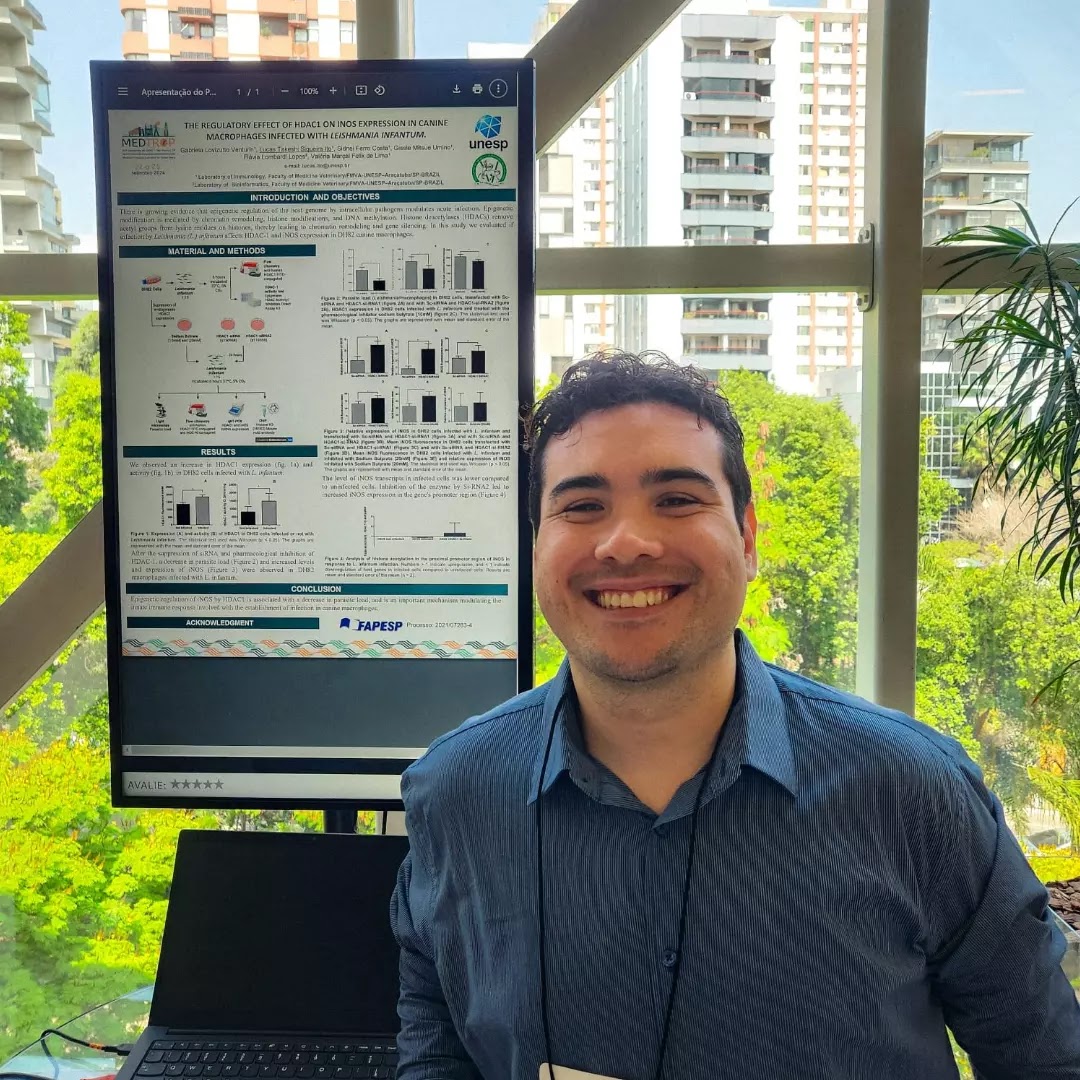
PhD student in Animal Science with a focus on Immunology, Epigenetics and Bioinformatics

EDUCATION

Bachelor's Degree in Veterinary Medicine
Advanced Training in Small Animal Surgical Clinic
Master's Degree in Animal Science with a focus on Immunology and Leishmaniasis

RESEARCH, TEACHING, or OTHER INTERESTS

Immunology, Molecular Biology, Parasitology, Veterinary
4

Scopus Publications

14

Scholar Citations

1

Scholar h-index

1

Scholar i10-index

Scopus Publications

  • The Regulatory Effect of Histone Deacetylase (HDAC) 1 and 2 on iNOS, IL-6, TNF-α and IL-10 Expression in Canine Macrophages Infected With Leishmania infantum
    Gabriela Lovizutto Venturin, Lucas Takeshi Siqueira Ito, Gisele Mitsue Umino, Gabriela Torres Rebech, Flávia Lombardi Lopes, Valéria Marçal Felix de Lima
    Parasite Immunology, 2026
    Zoonotic visceral leishmaniasis is caused by Leishmania (Leishmania) infantum . Dogs are considered the most critical urban reservoirs of L. (L.) infantum due to their high infection rate and direct transmission to humans. The parasite has developed mechanisms to evade the host's defence system by inhibiting macrophage activation, thereby allowing it to replicate and survive. Pathogens such as viruses and bacteria can modify the host's epigenome, thereby facilitating their survival. Cellular reprogramming leads to epigenetic alterations that modulate chromatin, modify histones and DNA methylation, disrupt normal progression and compromise the continuity of cell differentiation. Histone deacetylases (HDACs) remove lysine acetyl groups from histones, resulting in chromatin alteration and gene silencing. Histone acetyltransferases regulate their function. In this study, we analysed the involvement of HDAC‐1 in the defen mechanisms of DH82 macrophages infected with L. infantum . We observed that L. infantum infection increases HDAC1 levels and expression. Silencing HDAC1 with siRNA and the pharmacological inhibitor NaB decreased parasite load and increased iNOS expression, associated with increased histone acetylation at the iNOS promoter. The pharmacological inhibitor NaB also decreased IL‐6, IL‐10 and TNF‐α levels in the culture supernatant of DH82 macrophages infected with L. infantum . Together, these findings indicate that L. infantum ‐induced HDAC1 upregulation modulates the expression of key innate immune response genes, contributing to the establishment of infection in canine macrophages.
  • Cortisol Regulates PD-1 and IL-12 in Canine Leishmaniasis
    Lucas Takeshi Siqueira Ito, Gisele Mitsue Umino, Mayla Abbas Guimarães, Bianca Maciel Marques de Souza, Sofia Furrier Soares, Luiz Eduardo Amador Loiola Pereira, Valéria Marçal Felix de Lima
    Parasite Immunology, 2026
    Canine visceral leishmaniasis (CanL) is a tropical zoonosis caused by Brazil's protozoan Leishmania ( L .) infantum . Disorders in the hypothalamic–pituitary–adrenal (HPA) axis have been reported in human and experimental visceral leishmaniasis, but not yet in canine leishmaniasis. Cortisol is a steroid hormone that regulates several processes, including immune responses. This study investigated HPA axis disorders in dogs with visceral leishmaniasis and their link to clinical and immunological parameters. ELISA quantified serum levels of cortisol and adrenocorticotrophic hormone (ACTH) in 12 healthy dogs and 13 dogs with leishmaniasis. The expression of the enzymes inducible nitric oxide synthase (iNOS) and arginase‐1 and programmed cell death protein‐1 (PD‐1) were evaluated by flow cytometry in peripheral blood mononuclear cells (PBMC). Additionally, serum levels of the cytokines interleukin (IL)‐1β, IL‐6, IL‐10, IL‐12, interferon‐gamma (IFN‐γ), tumour necrosis factor‐alpha (TNF‐α), and transforming growth factor‐beta (TGF‐β) were quantified by capture Enzyme‐Linked Immunosorbent Assay (ELISA). Parasite load was quantified in peripheral blood and conjunctival swabs by real‐time polymerase chain reaction (qPCR). All parameters evaluated were correlated with serum cortisol. We observed an increase in cortisol, while ACTH levels were reduced in dogs with leishmaniasis. The expression of iNOS, arginase‐1 and PD‐1 was higher in the PBMC of dogs with leishmaniasis. Serum levels of the cytokines IL‐10, IL‐6, IL‐12, and IFN‐γ were increased in dogs with leishmaniasis. Cortisol showed a negative correlation with PD‐1 and IL‐12. Our findings suggest that infection natural with L. infantum in dogs may induce dysregulation of the HPA axis, leading to elevated serum cortisol levels and modulation of the immune response, as it is associated with immunological markers involved in disease pathogenesis. These results contribute to a better understanding of the pathogenic mechanisms of the disease.
  • IL-12 and IFN-γ in Response to Leishmania Infantum Antigens in Felines From an Endemic Area for Visceral Leishmaniasis
    João Victor Lé Lode, Lucas Takeshi Siqueira Ito, Gisele Mitsue Umino, Valéria Marçal Felix de Lima
    Parasite Immunology, 2025
    Visceral leishmaniasis is a potentially fatal zoonosis with an increasing incidence. Most infected felines present the disease in its subclinical form and demonstrate greater resistance to parasitemia than dogs. However, the role of cellular immunity in felines is still poorly understood. This study measured serum levels of interleukin (IL)‐12 and interferon‐gamma (IFN‐γ) in asymptomatic cats naturally infected with antibodies against Leishmania spp. and in uninfected cats. IL‐12 and IFN‐γ were measured in serum samples by ELISA. Parasite load quantification was performed on DNA from bone marrow samples using qPCR. Cats naturally infected by Leishmania spp. showed significantly higher serum levels of IL‐12 and IFN‐γ compared to control animals. IL‐12 showed a positive correlation with IFN‐γ suggesting a regulatory role of IL‐12 in activating the Th1 immune response, which enhances macrophage function and promotes intracellular parasite elimination. Additionally, IL‐12 showed a moderate negative correlation with parasite load, indicating a protective effect of IL‐12 in feline leishmaniasis. These findings suggest that IL‐12 and IFN‐γ play critical roles in modulating the feline immune response against parasitic infection, possibly contributing to the control of parasite replication and in the prevention of clinical signs. The immune response observed in felines could be explored for future immunotherapeutic approaches, helping to mitigate the progression of leishmaniasis in cats and reducing the risk of transmission in endemic regions.
  • Interleukin-27 Regulates Adaptative Immune Responses Associated With Control of Parasite Replication in Canine Leishmaniasis
    Marilene Oliveira dos Santos, Sidnei Ferro Costa, Gabriela Torres Rebech, Jéssica Henrique de Freitas, Jaqueline Poleto Bragato, Matheus Fujimura Soares, Lucas Takeshi Siqueira Ito, Flavia de Rezende Eugênio, Paulo Sérgio Patto dos Santos, Valéria Marçal Felix de Lima
    Parasite Immunology, 2024
    Interleukin 27 (IL‐27) is a cytokine that regulates susceptibility to Leishmania infantum infection in humans and experimental models. This cytokine has not yet been described in canine leishmaniasis (CanL). Therefore, we investigated whether IL‐27 has a regulatory role in CanL. The EBI3 and p28 subunits of IL‐27 were measured in splenic leukocytes culture supernatant from dogs with CanL and compared to control dogs. We also correlated EBI3 and p28 levels with IL‐21, anti‐L. infantum antibodies and parasite loads. We performed functional assays followed by IL‐27 blockade and measured parasite loads, production of cytokines in splenic leukocytes culture supernatant, and the expression of PD‐1, CTLA‐4, phospho‐Stat‐1/3, T‐bet, GATA3 and nitric oxide production (NO). Both IL‐27 subunits increased in the supernatant of dogs with CanL compared to control dogs. EBI3 and p28 levels showed a moderate positive correlation with IL‐21 (r = 0.67, p < 0.0001 and r = 0.45, p < 0.012, respectively), and the EBI3 subunit was positively associated with anti‐L. infantum IgG antibodies (r = 0.38, p < 0.040) and parasite load (r = 0.47, p < 0.009). IL‐27 and IL‐21 participate of immune responses in CanL. IL‐27 may be associated with the failure of immunity to control parasite replication via upregulation of the expression of PD‐1, CTLA‐4, T‐bet and NO in splenic leukocytes from dogs with CanL. These findings suggest that the pathways regulated by IL‐27 are involved in CanL pathogenesis in the host, and may be targets for new therapies.

RECENT SCHOLAR PUBLICATIONS

  • The Regulatory Effect of Histone Deacetylase (HDAC) 1 and 2 on iNOS, IL‐6, TNF‐α and IL‐10 Expression in Canine Macrophages Infected With Leishmania infantum
    GL Venturin, LTS Ito, GM Umino, GT Rebech, FL Lopes, VMF De Lima
    Parasite Immunology 48 (4), e70078 , 2026
    2026
  • Cortisol Regulates PD‐1 and IL‐12 in Canine Leishmaniasis
    LTS Ito, GM Umino, MA Guimarães, BMM de Souza, SF Soares, ...
    Parasite Immunology 48 (2), e70062 , 2026
    2026
  • IL‐12 and IFN‐γ in Response to Leishmania Infantum Antigens in Felines From an Endemic Area for Visceral Leishmaniasis
    JVL Lode, LTS Ito, GM Umino, VMF de Lima
    Parasite Immunology 47 (8), e70021 , 2025
    2025
    Citations: 1
  • Relação do cortisol com IL-12, TGF-β e PD-1 na leishmaniose canina
    LTS Ito
    Universidade Estadual Paulista (Unesp) , 2025
    2025
  • Interleukin‐27 Regulates Adaptative Immune Responses Associated With Control of Parasite Replication in Canine Leishmaniasis
    MO Dos Santos, SF Costa, GT Rebech, JH de Freitas, JP Bragato, ...
    Parasite Immunology 46 (10), e13063 , 2024
    2024
  • PD-1 regulates leishmanicidal activity and IL-17 in dogs with leishmaniasis
    GT Rebech, GL Venturin, LTS Ito, JP Bragato, BS de Carvalho Fonseca, ...
    Veterinary immunology and immunopathology 219, 109970 , 2020
    2020
    Citations: 13

MOST CITED SCHOLAR PUBLICATIONS

  • PD-1 regulates leishmanicidal activity and IL-17 in dogs with leishmaniasis
    GT Rebech, GL Venturin, LTS Ito, JP Bragato, BS de Carvalho Fonseca, ...
    Veterinary immunology and immunopathology 219, 109970 , 2020
    2020
    Citations: 13
  • IL‐12 and IFN‐γ in Response to Leishmania Infantum Antigens in Felines From an Endemic Area for Visceral Leishmaniasis
    JVL Lode, LTS Ito, GM Umino, VMF de Lima
    Parasite Immunology 47 (8), e70021 , 2025
    2025
    Citations: 1
  • The Regulatory Effect of Histone Deacetylase (HDAC) 1 and 2 on iNOS, IL‐6, TNF‐α and IL‐10 Expression in Canine Macrophages Infected With Leishmania infantum
    GL Venturin, LTS Ito, GM Umino, GT Rebech, FL Lopes, VMF De Lima
    Parasite Immunology 48 (4), e70078 , 2026
    2026
  • Cortisol Regulates PD‐1 and IL‐12 in Canine Leishmaniasis
    LTS Ito, GM Umino, MA Guimarães, BMM de Souza, SF Soares, ...
    Parasite Immunology 48 (2), e70062 , 2026
    2026
  • Relação do cortisol com IL-12, TGF-β e PD-1 na leishmaniose canina
    LTS Ito
    Universidade Estadual Paulista (Unesp) , 2025
    2025
  • Interleukin‐27 Regulates Adaptative Immune Responses Associated With Control of Parasite Replication in Canine Leishmaniasis
    MO Dos Santos, SF Costa, GT Rebech, JH de Freitas, JP Bragato, ...
    Parasite Immunology 46 (10), e13063 , 2024
    2024