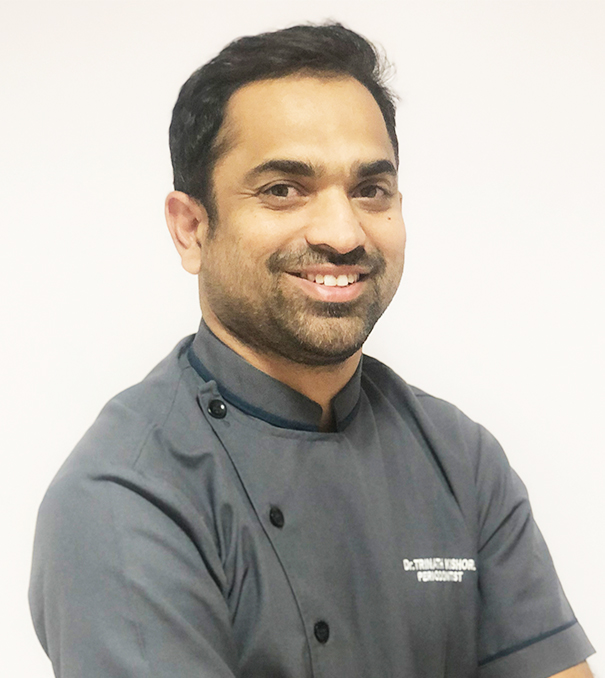
Affiliated with Associate fellowship in Laser dentistry, WCLI, USA in the year 2025. Trained in Hard tissue and soft tissue management in Periodontics and Peri-implant conditions under Tarun Kumar and Anjan Sha in the year 2023.
Received 4 awards in ISP National level essay competition (2004, 2007, 2009 and 2024). Presented 28 guest lectures at state and National level. 20 Publications in National, Scopus and Pub Med journals.
Member of Indian Society of Periodontology (ISP) and Indian association of oral implantology (IAOI).
Executive Committee member of Indian society of Periodontology - 2023-24 and 2024-25. Member secretary, Institutional Ethics Committee, GITAM Dental College and Hospital.
Founder of ISP Visakhapatnam study group, currently serving as President for the same. He is active in periodontal research, clinical and outreach activities.
Areas of interest are Periodontal and Peri-implant Regenerative surgeries, Implants and Soft Tissue Lasers.
EDUCATION
Completed under graduation (2002) from Krishnadevaraya dental college and hospital, Bangalore and Masters in Periodontology (2005) from Bapuji dental college and hospital, Davangere, active academician (since 2006), presently working as professor, Department of Periodontics, GITAM Dental College & Hospital, Visakhapatnam.
RESEARCH, TEACHING, or OTHER INTERESTS
Dentistry, Periodontics, General Dentistry
11
Scopus Publications
83
Scholar Citations
4
Scholar h-index
4
Scholar i10-index
Scopus Publications
Periodontal health knowledge and preventive practices among young educated adults: a cross-sectional study Tejaswi Kodem, Anusha Boddeda, Trinath Kishore Damera, K. Raja V. Murthy Discover Public Health, 2026 Periodontal health literacy is a key determinant of oral hygiene behaviours and periodontal disease prevention. Despite broad research, comparative data across different professional student streams within the same setting are limited. To assess and compare periodontal health-related knowledge and preventive practices among medical, engineering, and business undergraduate students and to identify associated factors, without implying causal relationships. A descriptive cross-sectional study was conducted among 300 undergraduate students from three professional colleges. Stratified random sampling was used. A pilot-tested 15-item questionnaire with acceptable internal consistency (Cronbach’s α = 0.82) evaluated knowledge, practices, and limited motivational items. Descriptive statistics, Chi-square tests, Kruskal–Wallis tests with Dunn’s post-hoc analyses, effect sizes (Cramer’s V, η²) and multivariable logistic regression (adjusted for age, gender, and socioeconomic status) were applied. Results: Among 300 participants, 202 (67.3%) were female and 98 (32.7%) were male, with a mean age of 20.36 ± 1.93 years. Only 88 (29.3%) reported correct brushing technique, 37 (12.3%) were aware of dental floss, and 27 (9.0%) reported regular preventive dental visits. Engineering students had higher compliance with toothbrush replacement (84%; p < 0.001), and medical students showed greater systemic–oral health awareness. After adjustment, academic discipline remained independently associated with brushing frequency (OR = 1.82, 95% CI: 1.21–2.74). Periodontal knowledge and preventive practices were suboptimal among young educated adults. These findings provide baseline evidence for structured educational interventions; future longitudinal and interventional studies are recommended.
Evaluation of titanium-prepared platelet-rich fibrin incorporated with amoxiclav, metronidazole, and neem gel on bone regeneration in Wistar rats: a pilot study Shiva Shankar Gummaluri, Trinath Kishore Damera, Viswa Chandra Rampalli, Anusha Boddeda, Naveen Vital Kumar Gidijala, Ramanarayana Boyapati, Kaarthikeyan Gurumoorthy Journal of the Korean Association of Oral and Maxillofacial Surgeons, 2026 Objectives: Titanium platelet-rich fibrin (T-PRF) usage as sustained drug delivery system (SDDS) has been recently started. Hence present study aimed to evaluate hard tissue regenerative efficacy of T-PRF clots incorporated with amoxiclav (AMX)/metronidazole (MET)/neem (NE) gels individually in osseous defects created in Wistar rats. Materials and Methods: -test were used for conducting the statistical analysis. Results: <0.001) higher alkaline phosphatase and bone morphogenetic protein-2 levels were recorded for T-PRF+NE Group (7.60±3.04, 10.85±1.28) followed by MET (4.65±1.52, 4.64±0.45)>AMX (2.47±0.84, 1.89±0.18)>T-PRF plain (1.00±0.00, 1.00±0.00). Conclusion: Research results showed that T-PRF can be a SDDS and addition of antibiotics or herbal extract didn't alter the hard tissue healing property of T-PRF and resulted in new bone formation.
Indian Society of Periodontology Good Clinical Practice Recommendations for dental pain management and use of analgesics Vishakha Grover, Ashish Kumar, Anurag Satpathy, Ashish Jain, Neeraj Deshpande, Harpreet Singh Grover, Manish Khatri, Tanya Nandkeoliar, Ajit Nair, Amit Benjamin, Ashish Sham Nichani, Baljeet Singh, Bela Dilip Dave, Girish Bhutada, Gurparkash Singh Chahal, Kuldip Singh Sangha, Tirthankar Debnath, Trinath Kishore Damera, Vaibhav Karemore, Vidushi Sheokand, Vivek Kumar Bains Journal of Indian Society of Periodontology, 2026 Pain is one of the most frequent reasons for seeking dental care and significantly influences patient comfort, treatment acceptance, and clinical outcomes. Effective management of dental pain requires accurate diagnosis, timely intervention, and the rational use of analgesics supported by evidence-based clinical decision-making. Recognizing the need for structured guidance for everyday dental practice, the Indian Society of Periodontology has developed Good Clinical Practice Recommendations on Pain Management and the Use of Analgesics in Dental Clinics. These recommendations were formulated by a panel of nineteen subject matter experts from across the country following a comprehensive review of the available literature and structured consensus discussions. The document is organized into three key sections: Dental Pain – Diagnosis and Assessment, focusing on the clinical evaluation and characterization of dental pain; Multimodal Strategies for Pain Management in Dentistry, outlining pharmacological and non-pharmacological approaches for optimal pain control; and Clinical Decision Making in Dental Pain Management, which provides practical guidance on the rational and safe use of analgesics in routine clinical scenarios. The recommendations aim to support clinicians in selecting appropriate pain management strategies, encourage responsible prescribing practices, and promote patient-centred care. This document is intended to serve as a concise reference for dental practitioners and contribute to improving the quality and consistency of pain management in dental practice.
Evaluating the antimicrobial efficacy, growth factor release drug kinetics of titanium platelet-rich fibrin loaded with amoxiclav, metronidazole and neem gel: an in vitro study Shiva Shankar Gummaluri, Trinath Kishore Damera, Viswa Chandra Rampalli, Ramanarayana Boyapati, Kaarthikeyan Gurumoorthy Journal of the Korean Association of Oral and Maxillofacial Surgeons, 2025 Objectives: The use of titanium platelet-rich fibrin (T-PRF) as a sustained drug delivery system (SDDS) has been limited. Hence present study aimed to evaluate the antimicrobial efficacy, drug kinetics and growth factor release of T-PRF injected with amoxicillin+clavulanic acid (amoxiclav gel), metronidazole (MTZ) and neem (NE) gels separately. Materials and Methods: analysis. Drug kinetics were monitored at 0, 2, 24, 48, and 72 hours. Antimicrobial efficacy was assessed at 48 hours post inoculation in culture plates and growth factor release was measured at 3, 7 and 10 days. Kruskal- Wallis test, Dunn's Post hoc test, Bonferroni's correction and Mann-Whitney U test were used to compare the drug release over time frames, inhibition zone diameters (IZDs) and growth factor release were expressed in (mean and standard deviations) millimetres, pico g/mL and nano g/mL. Results: In terms of drug kinetics, both T-PRF clots and collagen sponges when injected with antibiotic/ herbal gels individually there was a sustained drug release up to 72 hours and there was a greater release observed in collagen sponge. IZDs were recorded for T-PRF injected with amoxiclav/MTZ/NE gel for anti-microbial efficacy. Growth factor release was also observed for T-PRF plain and T-PRF injected with gels, with levels were numerically higher in T-PRF plain. Conclusion: Within the limitations of the study T-PRF demonstrated sustained drug release with superior antibacterial activity. Growth factor release was not compromised, aiding in the preservation of regenerative capacity. Therefore, T-PRF can be used as a SDDS.
Estimation of the salivary levels of monocyte chemoattractant protein-1 and macrophage inflammatory protein-1α in periodontitis patients with and without diabetes in comparison to systemically and periodontally healthy individuals Sahithi Sunkara, Sandhya Pavankumar, Trinath Kishore Damera, Durga Bhavani Kundrapu Journal of Indian Society of Periodontology, 2025 Background: Early identification of periodontal disease, mainly in diabetic patients, is crucial for the prognosis and treatment planning. Biochemical signaling during periodontal disease involves the production of cytokines. Chemokines belong to the group of chemotactic cytokines that are able to activate and migrate a variety of cells, like bone cells and leukocytes, which stimulate inflammatory events. Chemotactic chemokines, monocyte chemoattractant protein-1 (MCP-1), and macrophage inflammatory protein-1 alpha (MIP-1α) are secreted by different types of cells. These salivary biomarkers might be of use in assessing periodontal disease presence, risk and progression, especially in diabetic patients. Materials and Methods: Thirteen milliliters of unstimulated whole saliva were collected from five groups: Systemically and periodontally healthy individuals, gingivitis patients without diabetes, periodontitis patients without diabetes, periodontitis patients with diabetes, and periodontally healthy diabetic individuals. The samples were then centrifuged at 2600 rpm for 15 min at 4°C, and the supernatant was kept at − 80°C until additional analysis. The enzyme-linked immunosorbent assay was used to examine the amounts of MCP-1 and MIP-1α in the saliva. Results: Levels of MCP-1 and MIP-1α were significantly higher in periodontitis with diabetes group (P = 0.000) than in other groups. Receiver operating curve showed 95% specificity and 100% sensitivity for MCP-1 and MIP-1α, respectively, in detecting periodontitis, especially in diabetic individuals.” Conclusion: The present study illustrates that salivary biomarkers MCP-1 and MIP-1α might be promising biomarkers in differentiating periodontal disease from health, especially in diabetic individuals.
COMPARATIVE EVALUATION OF AZADIRACHTIN, VITAMIN C AND INSULIN LIKE GROWTH FACTOR 1 RELEASE IN TITANIUM PLATELET RICH FIBRIN INFUSED WITH NEEM AND TRIPHALA INDICA GEL EXTRACTS: AN INVITRO STUDY Shiva Gummaluri, Kaarthikeyan Gurumoorthy, Trinath Damera, Viswachandra Rampalli, Shrushti Nagar, Ramanarayana Boyapati Bulletin of Stomatology and Maxillofacial Surgery, 2025 Background: Herbal extract gel addition to Titanium -Platelet Rich Fibrin (T-PRF) clots was started very recently. Their release from the T-PRF clots has not been performed. Hence present study aimed to evaluate the release of Azadirachtin (Az) from T-PRF+Neem gel group, Vitamin C release from T- PRF+ Triphala Indica group and Insulin like growth factor 1 (IGF 1) from T-PRF alone along with the mentioned test groups. Methods and Materials:Present invitro study utilized 6 subject’s blood and subjected to centrifugation. T-PRF clots were prepared and TI/ NE gel extracts were injected and compared with T-PRF alone to check the release of Vit C, Az and IGF 1 release at 6hours, 72 hours (3rd), 7th and 14th day. For statistical analysis, paired t test and ANOVA was performed. P value <0.05 was considered statistically significant. Results: Az release there was decreased levels reported between 6 hrs and the 7th day and it was statistically significant (p = 0.045*). Whereas, all other time frame comparisons values were non-significant (p>0.05) Regarding Vit C release from T-PRF clot there was a decrease in the amount released when compared at 6hrs & 7th day (p=0.008*) and 72hrs and 7th day (p=0.037*). IGF 1 release in all the three groups and at different time frames was non-significant (p>0.05). Conclusion: Added herbal extracts didn’t alter the release of IGF 1 that proves the surety of GF release. T-PRF also showed the timely release of the Az and Vit C confirming the name of sustained drug delivery system (SDDS)
Evaluating the regenerative efficacy of titanium-prepared platelet-rich fibrin in the treatment of gingival recession: a systematic review and meta-analysis Shiva Gummaluri, Kaarthikeyan Gurumoorthy, Trinath Damera, Karthikeyan Sai, Sandhya Kumar, Naveen Gidijala Vojnosanitetski Pregled, 2025 Background/Aim. Titanium-prepared platelet-rich fibrin (PRF) ? T-PRF was considered a new platelet concentrate that is now frequently used in dentistry. The aim of this study was to examine T-PRF?s regenerative effectiveness in treating gingival recession (GR). Methods. The present study is a systematic review and meta-analysis. A comprehensive search was performed in PubMed, Scopus, Embase, Web of Science, Google Scholar, and Cochrane databases. Medical Subject Headings terms like ?platelet-rich fibrin?, ?platelets?, ?gingival recession?, ?titanium?, and ?root coverage? were used to identify the final included studies. Review Manager software was used to perform the statistical analysis. The value of p ? 0.05 was considered statistically significant. Results. A total of six studies were included in the systematic review, three of which qualified for meta-analysis. The systematic review suggested that T-PRF is a superior biomaterial in the treatment of GR and showed comparable results to those of the gold standard connective tissue graft (CTG). However, in the meta-analysis at six-month follow-up, for mean root coverage width, the combined effect size across three studies with 272 participants was a standardized mean difference of 0.07 (-0.17, 0.31), indicating no significant difference between the interventions. For mean root coverage depth, the combined effect size was 0.50 (-0.71, 1.70), also showing a non-significant trend favoring one intervention over the other. Conclusion. Within the limitations, the present systematic review suggests clinically improved outcomes with T-PRF. In contrast, the meta-analysis did not show any significant advantage of T-PRF over CTG or PRF.
COMPARATIVE ASSESSMENT OF T-PRF ALONE AND T-PRF INJECTED WITH ANTIBIOTIC GELS, HERBAL PRODUCT SEPARATELY: A HISTOLOGICAL STUDY Shiva Gummaluri1, Kaarthikeyan Gurumoorthy, Trinath Damera, Divya Uppala, Anusha Boddeda, Ramanarayana Boyapati Bulletin of Stomatology and Maxillofacial Surgery, 2025 Background: Antibiotics and herbal product incorporation into T-PRF are scant. Hence present study aimed to assess the fibrin network pattern, cellularity, cell distribution for T-PRF injected with metronidazole gel (MTZ), amoxicillin+ clavuanic acid (Amox-clav) gel and Neem (N) gel with T-PRF alone histologically through light microscope (LM) and scanning electron microscope (SEM). Materials and Method: Present histological study utilizes 24 healthy volunteers where 20 ml of blood was drawn; transferred to titanium tubes; centrifuged; T-PRF clots prepared; MTZ, Amox-clav and Neem gels were incorporated, compared with T-PRF alone by preparing histological slides and observed under LM and SEM. Data was subjected to statistical analysis using one-way anova, fishcer test, chi-square test and frequency distribution analysis for all the group comparisons. Results: all the groups in the present study showed non-significant results. For fibrin network pattern MTZ and Amox-clav group had shown greater percentages of thick and dense but values were non-significant (p=0.555#), cell distribution shown wide range pattern, presence of cells, all showed non-significance. Regarding mean score of cell distribution there was a range of 26- 50% (score 1-2) with non-significance (p=0.386#). Values were non-significant for SEM examination for all groups (p>0.05) Conclusion Thus within limitations T-PRF can be a sustained a drug delivery carrier system by incorporating antibiotics or herbal extract because of its thicker fibrin meshwork and greater cellular entrapment. This opens a gateway to give a new treatment protocol for treating a periodontal disease
EFFECT OF TETRACYCLINE, DOXYCYCLINE AND TRIPHALA ON COLLAGEN MEMBRANE DEGRADATION: AN IN VITRO STUDY Sukanya Ampili, Naveen Gidijala, Tejaswin Polepalle, Shiva Gummaluri, Trinath Kishore Damera Trinath Kishore Damera, Bhargavi Vedula Bulletin of Stomatology and Maxillofacial Surgery, 2025 Background: Collagen membranes are widely used in periodontal regeneration. However, strategies to enhance membrane stability include the incorporation of antimicrobial agents or natural inhibitors of collagenase activity. Hence, present study aimed to evaluate and compare the efficacy of tetracycline hydrochloride, doxycycline hyclate, and Triphala in delaying collagen membrane degradation at varying concentrations in an in vitro model. Methods: Present invitro analysis used Healiguide collagen membranes. They were treated with tetracycline (TTC), doxycycline (DOX), and Triphala (TRI) at concentrations of 25 mg/ml, 50 mg/ml, 75 mg/ml, and 100 mg/ml. Collagenase enzyme (Clostridial collagenase, HiMedia Laboratories, India) was used to induce degradation. A total of 48 specimens were used, with collagen degradation assessed at 4-time intervals (Days 2, 7, 14, and 21) using spectrophotometric analysis. Statistical analysis was performed using ANOVA with post hoc Tukey’s tests to compare among the groups and p < 0.05 considered significant. Results: All tested agents significantly reduced collagen degradation compared to the control group (p < 0.05). Doxycycline at 25 mg/ml and 75 mg/ml exhibited the most pronounced inhibition of collagen breakdown, showing statistically significant differences from the control. Tetracycline was also effective, particularly at 75 mg/ml, while Triphala at 50 mg/ml and 75 mg/ml demonstrated moderate inhibition but did not surpass the efficacy of doxycycline. Conclusion: Present study concludes doxycycline as the most effective in delaying collagen membrane degradation, followed by tetracycline and Triphala. The given growing concern over antibiotic resistance, Triphala may serve as a promising natural alternative for membrane stabilization in periodontal applications.
Comparative evaluation of titanium-prepared platelet-rich fibrin with and without herbal extract: a histological study Shiva Gummaluri, Kaarthikeyan Gurumoorthy, Trinath Damera, Anusha Boddeda, Tejaswi Kodem, Sivaram Lekkala Vojnosanitetski Pregled, 2024 Background/Aim. Injecting herbal extract into platelet concentrates is one of the newer treatment protocols, which enables platelet concentrates to act as sustained drug delivery (DD) systems. Histological analysis of titanium-prepared platelet-rich fibrin (T-PRF) injected with herbal extract, could help assess the appearance (pattern) and structural changes of T-PRF. The aim of the study was to evaluate the appearance of the fibrin network, cellularity, and fibrin border area of T-PRF alone and T-PRF injected with herbal extract. Methods. A total of 40 histological slides were prepared from 10 mL of blood from each patient, 20 with T-PRF alone and 20 with T-PRF+herbal extract. The slides were divided into a group consisting of T-PRF injected with neem gel (test group) and a group consisting of T-PRF alone (control group). The preparation protocol was made according to Bank-roft?s manual adapted for light microscopy. Results. Regarding the fibrin network features (dense vs. loose), no statistical significance was found among the studied groups (p = 0.172). A statistically significant difference was shown in the packeting (p = 0.018) and layered (p = 0.028) patterns of the fibrin network, and there was no statistically significant difference in the scattered (p = 0.749) pattern among the examined groups. Cellularity and cell pattern values were not statistically significantly different for both groups (p = 1.00, p = 0.3111, respectively). Moreover, the values determined for red blood cells, white blood cells, and platelets were not statistically significantly different (p = 0.147), as well as for the fibrin border area between cells and meshwork (p = 0.206). Conclusion. The obtained results could be useful for the development of a new treatment strategy in dentistry, by utilizing T-PRF with incorporated herbal extracts or antibiotics, as a local sustained DD system.
Novel surgical approach for root coverage using coronally advanced flap in conjunction with transposition of periosteal pedicle graft S Swathi, KRV Murthy, DT Kishore, YSP Kumar, GNV Kumar Clinical Advances in Periodontics 11 (4), 195-200 , 2021 2021 Citations: 2
A Novel Modified‐Vista Technique With Connective Tissue Graft in the Treatment of Gingival Recession: A Case Report PC Chowdary, YS Pavan Kumar, KRV Murthy, DT Kishore Clinical Advances in Periodontics 12 (2), 75-79 , 2020 2020 Citations: 14
Periodontal awareness in medical students of Andhra Pradesh, India - A Survey. SPK Charishma Chowdary Ponugubati, Raja V Murthy K, Trinath Kishore D ... International Journal of Periodontology and Implantology 5 (2), 68-73 , 2020 2020 Citations: 2
Oral Hygiene and Gingival Health among Dental Students KVSPG M.V. Mrudula, Trinadh Kishore Dammera, K. Raja V. Murthy, Y.V. Sashikanth Journal of Research and Advancement in Dentistry 8 (1), 87-92 , 2018 2018
IOT Based Water Quality Monitoring System BB Reddy, K Tarun, D Kishore, SN Yadav IEEE Conference , 2018 2018 Citations: 1
Regenerative potential of platelet rich fibrin (PRF) along with Bio-gen putty in the treatment of periodontal intrabony defect-A case report SGT Kishore D Journal of Contemporary Medicine and Dentistry 4 (1), 57-60 , 2016 2016
A comparative evaluation of bovine-derived xenograft (Bio-Oss Collagen) and type I collagen membrane (Bio-Gide) with bovine-derived xenograft (Bio-Oss Collagen) and fibrin … D Palachur, KVP Rao, KRV Murthy, DT Kishore, MN Reddy, A Bhupathi Journal of Indian Society of Periodontology 18 (3), 336-343 , 2014 2014 Citations: 37
Evaluation of relative efficacy of β-tricalcium phosphate with and without type I resorbable collagen membrane in periodontal infrabony defects: a clinical and radiographic study R Padma, DT Kishore, T Bandiwadekar, S Debunath, A Reddy The Journal of Contemporary Dental Practice 14 (2), 193-201 , 2013 2013 Citations: 16
Effect of various concentrations of tetracycline hydrochloride demineralization on root dentin surface: A scanning electron microscopic study T Penmatsa, S Varma, KP Rao, T Kishore, H Bindu Journal of Pharmacy and Bioallied Sciences 5 (Suppl 1), S48-S53 , 2013 2013 Citations: 11
Gingival pigmentation – An aesthetic view T Kishore D Journal of the Marthandam Indian Dental Association 1 (2), 38-41 , 2012 2012
Assessment of risk factors for periodontal disease TKDDS Mehta Dentistry Today 4 (II), 6 - 9 , 2005 2005
MOST CITED SCHOLAR PUBLICATIONS
A comparative evaluation of bovine-derived xenograft (Bio-Oss Collagen) and type I collagen membrane (Bio-Gide) with bovine-derived xenograft (Bio-Oss Collagen) and fibrin … D Palachur, KVP Rao, KRV Murthy, DT Kishore, MN Reddy, A Bhupathi Journal of Indian Society of Periodontology 18 (3), 336-343 , 2014 2014 Citations: 37
Evaluation of relative efficacy of β-tricalcium phosphate with and without type I resorbable collagen membrane in periodontal infrabony defects: a clinical and radiographic study R Padma, DT Kishore, T Bandiwadekar, S Debunath, A Reddy The Journal of Contemporary Dental Practice 14 (2), 193-201 , 2013 2013 Citations: 16
A Novel Modified‐Vista Technique With Connective Tissue Graft in the Treatment of Gingival Recession: A Case Report PC Chowdary, YS Pavan Kumar, KRV Murthy, DT Kishore Clinical Advances in Periodontics 12 (2), 75-79 , 2020 2020 Citations: 14
Effect of various concentrations of tetracycline hydrochloride demineralization on root dentin surface: A scanning electron microscopic study T Penmatsa, S Varma, KP Rao, T Kishore, H Bindu Journal of Pharmacy and Bioallied Sciences 5 (Suppl 1), S48-S53 , 2013 2013 Citations: 11
Novel surgical approach for root coverage using coronally advanced flap in conjunction with transposition of periosteal pedicle graft S Swathi, KRV Murthy, DT Kishore, YSP Kumar, GNV Kumar Clinical Advances in Periodontics 11 (4), 195-200 , 2021 2021 Citations: 2
Periodontal awareness in medical students of Andhra Pradesh, India - A Survey. SPK Charishma Chowdary Ponugubati, Raja V Murthy K, Trinath Kishore D ... International Journal of Periodontology and Implantology 5 (2), 68-73 , 2020 2020 Citations: 2
IOT Based Water Quality Monitoring System BB Reddy, K Tarun, D Kishore, SN Yadav IEEE Conference , 2018 2018 Citations: 1
Oral Hygiene and Gingival Health among Dental Students KVSPG M.V. Mrudula, Trinadh Kishore Dammera, K. Raja V. Murthy, Y.V. Sashikanth Journal of Research and Advancement in Dentistry 8 (1), 87-92 , 2018 2018
Regenerative potential of platelet rich fibrin (PRF) along with Bio-gen putty in the treatment of periodontal intrabony defect-A case report SGT Kishore D Journal of Contemporary Medicine and Dentistry 4 (1), 57-60 , 2016 2016
Gingival pigmentation – An aesthetic view T Kishore D Journal of the Marthandam Indian Dental Association 1 (2), 38-41 , 2012 2012
Assessment of risk factors for periodontal disease TKDDS Mehta Dentistry Today 4 (II), 6 - 9 , 2005 2005