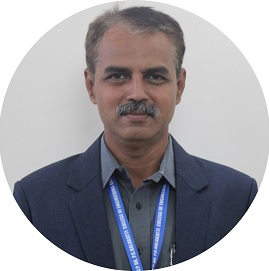
Chidanand S Kusur

@bldeacet.ac.in

Assistant Professor Department of Computer Science and Engineering
BLDEAs CET, Dept of CSE

EDUCATION

M.Tech. in Computer Science and Engineering
4

Scopus Publications

15

Scholar Citations

1

Scholar h-index

1

Scholar i10-index

Scopus Publications

  • An Efficient Parallel Barcode Recognition System
    Chidanand S. Kusur, M. S. Shirdhonkar, M. M. Bachalapur
    Cognitive Science and Technology, 2025
  • Barcode Recognition using Sequential and Parallel Approach
    Chidanand S. Kusur, M. S. Shirdhonkar
    2024 International Conference on Innovation and Novelty in Engineering and Technology Innova 2024 Proceedings, 2024
    In a computer vision and image processing, the barcode detection and recognition systems play very important role for the interpretation of the encoded information for the system automation and inventory management. Hence, we proposed an enhanced approach to barcode recognition from video frames by extending our previous work focused on barcode detection in static images i.e. for the detection and recognition of barcodes from the videos of racks of books. The proposed system showed that, the parallel approach is time efficient in comparison with sequential approach.
  • Congestion Control Enhancement in TCP
    Vishwanath Chikkareddi, Vinaykumar Chikaraddi, Santosh Chinchali, Chidanand Kusur
    Lecture Notes in Networks and Systems, 2024
  • Analysis of performance enhancement on graphic processor based heterogeneous architecture: A CUDA and MATLAB experiment
    Vilas H. Naik, Chidanand S. Kusur
    2015 National Conference on Parallel Computing Technologies Parcomptech 2015, 2015
    Today multiprocessors, multicores, clusters and heterogeneous computing are becoming the most popular architectures to achieve high performance computing. The different approaches are made by system designers to enhance the system performance such as increasing clock frequency of CPUs from MHz to GHz and addition of more number of CPU cores i.e from single core processor to dual core, quad core, hexa core, octo core, ten core and more processors. Still, multicore processing creates some challenges of its own. The extra core results into increased processor size and also high power consumption. Meanwhile, General Purpose Graphics Processing Units (GPGPUs) are designed and implemented that contain hundreds of cores with more number of Arithmetic and Logic Units and Control Units. These GPGPUs can be used in addition to CPU for heterogeneous computing for the enhancement of system performance for selected applications by data parallelism. The heterogeneous programming environment that includes other processors like GPGPU in addition to CPU can be used to enhance the execution performance of computational intensive programs. So, it is necessary for the programmer to run and analyze the selected computational intensive programs on both homogeneous and heterogeneous programming platform. The homogeneous programming environment makes the use of multi core CPU, where as the heterogeneous programming environment makes the use of different processors such as General Purpose Graphics Processing Unit (GPGPUs), Field Programmable Gate Arrays (FPGAs), Digital Signal Processors (DSPs) in addition to CPU. Hence, the programmer needs to write the code that makes the use of both CPU and other processors by using heterogeneous software environment such as parallel MATLAB with GPU enabled functions, MATLAB supported CUDA kernels and CUDA C for the execution of parallel code to achieve high performance in heterogeneous programming environment in comparison with homogeneous (sequential) programming approach with only CPU.

RECENT SCHOLAR PUBLICATIONS

  • An Efficient Parallel Barcode Recognition System
    MSSMMB Chidanand S. Kusur
    Third International Conference on Cognitive and Intelligent Computing … , 2025
    2025
    Citations: 1
  • Barcode Recognition using Sequential and Parallel Approach
    MSS Chidanand S. Kusur
    2024 International Conference on Innovation and Novelty in Engineering and … , 2024
    2024
  • Analysis of Combustion Characteristics’ of CI DI VCR Engine using Blends of Mixture of two Biodiesel and Diesel with Artificial Neural Network
    S Doddi, BR Hosamani, C s Kusur, P Puthani, K Mangond
    Preprints , 2023
    2023
  • Congestion Control Enhancement in TCP
    V Chikkareddi, V Chikaraddi, S Chinchali, C Kusur
    International Conference on Network Security and Blockchain Technology, 229-239 , 2023
    2023
  • Analysis of performance enhancement on graphic processor based heterogeneous architecture: A CUDA and MATLAB experiment
    VH Naik, CS Kusur
    2015 National Conference on Parallel Computing Technologies (PARCOMPTECH), 1-5 , 2015
    2015
    Citations: 14

MOST CITED SCHOLAR PUBLICATIONS

  • Analysis of performance enhancement on graphic processor based heterogeneous architecture: A CUDA and MATLAB experiment
    VH Naik, CS Kusur
    2015 National Conference on Parallel Computing Technologies (PARCOMPTECH), 1-5 , 2015
    2015
    Citations: 14
  • An Efficient Parallel Barcode Recognition System
    MSSMMB Chidanand S. Kusur
    Third International Conference on Cognitive and Intelligent Computing … , 2025
    2025
    Citations: 1
  • Barcode Recognition using Sequential and Parallel Approach
    MSS Chidanand S. Kusur
    2024 International Conference on Innovation and Novelty in Engineering and … , 2024
    2024
  • Analysis of Combustion Characteristics’ of CI DI VCR Engine using Blends of Mixture of two Biodiesel and Diesel with Artificial Neural Network
    S Doddi, BR Hosamani, C s Kusur, P Puthani, K Mangond
    Preprints , 2023
    2023
  • Congestion Control Enhancement in TCP
    V Chikkareddi, V Chikaraddi, S Chinchali, C Kusur
    International Conference on Network Security and Blockchain Technology, 229-239 , 2023
    2023

Publications

Analysis of performance enhancement on graphic processor based heterogeneous architecture: A CUDA and MATLAB experiment
VH Naik, CS Kusur
2015 National Conference on Parallel Computing Technologies (PARCOMPTECH), 1-5