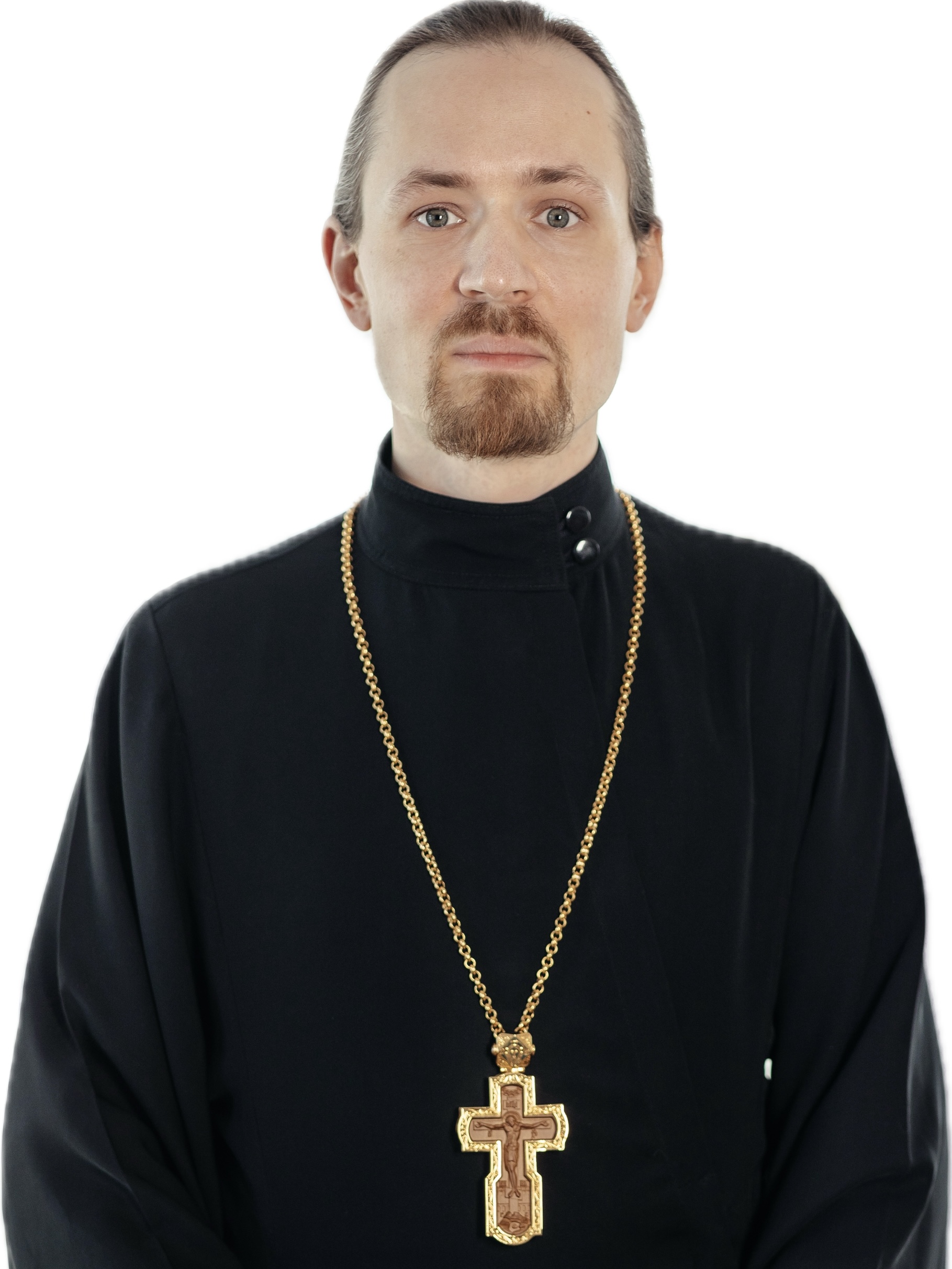
Master's student of the General Church Postgraduate and Doctoral Studies named after Saints Cyril and Methodius General Church Postgraduate and Doctoral Studies named after Saints Cyril and Methodius
Chairman of the Department of Missionary Work and Youth Affairs of the Kolomna Diocese of the Moscow Metropolitan of the Russian Orthodox Church. Rector of the Church of the Exaltation of the Cross in Kolomna. Chairman of social institutions for orphans and adults with mental health disorders (GASUSO MO "Kolomoisky Dobry Dom"). In 2021, he completed training in "Family Psychology" (RUDN University) and a postgraduate course with the qualification of "Researcher. Teacher-Researcher of Psychological Sciences" (GSGU). In 2022, he completed training in "Clinical (Medical) Psychologist" at Lomonosov Moscow State University. In 2023, he completed professional retraining at the Faculty of Law of Moscow State University. In 2023, I completed professional retraining at the Faculty of Law of Lomonosov Moscow State University, specializing in forensic examination, and, at the invitation of the faculty of Moscow State University, became a member of the International Association of Experts in Psych
RESEARCH, TEACHING, or OTHER INTERESTS
Philosophy, Religious studies, Psychiatry and Mental health, Multidisciplinary
5
Scopus Publications
Scopus Publications
Spiritual Well-Being and Basic Individual Values at Different Stages of Maturity Ivan A. Bakushkin, Regina V. Ershova Religions, 2026 The study of human well-being and its contributing factors is becoming increasingly important for psychologists. However, the authors of previous studies have primarily focused on hedonic and eudaimonic well-being; in comparison, the value correlates of spiritual well-being remain insufficiently studied, particularly across developmental stages. In the present study, we examined associations between spiritual well-being and basic individual values in a Russian-speaking convenience sample and compared these associations in adolescents/emerging adults and adults. Materials and methods: The study involved 197 respondents aged 14–21 (72 women (17.8 ± 1.7 years) and 125 men (17.9 ± 1.3 years)) and 762 respondents aged 22–72 (689 women (44.4 ± 10.1 years) and 73 men (40.6 ± 10.4 years)). Data were collected in 2024 within a cross-sectional study using an online self-report questionnaire distributed via Russian-language VKontakte and Telegram communities. Spiritual well-being was assessed using the adapted Spiritual Well-Being Scale, and values were assessed using the adapted Portrait Value Questionnaire, combined with standard statistical procedures. Results: Interpersonal conformity exhibited the strongest positive association with spiritual well-being, particularly in the younger group at the bivariate level and in the full-sample multivariable model. Face/reputation and openness to change were negative multivariable correlates of spiritual well-being. Compared with adolescents and emerging adults, adults exhibited weaker positive links between spiritual well-being and conservation-related values and more clearly negative links with hedonism, achievement, face/reputation, and self-enhancement. Conclusion: Spiritual well-being in this Russian-speaking online sample was most consistently associated with interpersonal harmony and was inversely associated with face/reputation and openness to change. These patterns should be interpreted as associative, context-bound, and developmentally sensitive rather than causal or population-representative, especially given the marked sex imbalance between the developmental groups.
Linking Basic Beliefs and Spiritual Well-Being: Evidence From Russia Ivan A. Bakushkin, Regina V. Ershova Changing Societies and Personalities, 2026 Well-being and mental health are considered to be fundamentally influenced by implicit, global, and stable beliefs about the world and oneself. These beliefs shape a person’s perception of certain life situations, their attitudes toward these situations, and the behavioral strategies they choose. This study aims to ascertain the precise nature of the relationship between spiritual well-being and its components and basic beliefs. A total of 959 Russian-speaking respondents aged 14 to 72 were included in the study sample. Spiritual well-being that includes two subscales—religious and existential well-being—was assessed using the Spiritual Well-Being Scale by Paloutzian and Ellison, as adapted by Bakushkin and Ershova (2025). Basic beliefs—Benevolence of the World, Luck, Justice, Beliefs about Control, Self-Worth—were assessed using the World Assumptions Scale by Janoff-Bulman, as adapted by Padun and Kotelnikova (2008). Along with these scales, mathematical and statistical data processing methods were employed. For religious well-being, Luck showed the greatest predictive power. In the multivariate model, the negative influence of Beliefs about Control increased. For existential well-being, the Luck, Benevolence of the World, and Justice subscales served as positive predictors, explaining 51.9% of the variance in the dependent variable. For spiritual well-being, these same predictors explained 42.4% of the variance. Results showed that the Beliefs about Control subscale was a negative predictor of spiritual well-being. Meanwhile, the Self-Worth scale tended to be negatively associated with spiritual well-being. The models demonstrated the greatest explanatory power for existential (29.2%) and spiritual (26.9%) well-being, while the contribution to religious well-being (19.2%) was less pronounced. These findings could inform the development of spiritually integrated counselling and meaning-centered interventions for Russian-speaking clients.
Spiritual well-being and “dark” personality traits: Machiavellianism, narcissism, psychopathy, and sadism Ivan Bakushkin, Regina Ershova Frontiers in Psychology, 2026 Introduction The study of human well-being and its contributing factors remains a central concern in psychological science. One under-researched area involves the relationship between spiritual well-being—an integrative indicator of health and life satisfaction—and “Dark Personality” traits: Machiavellianism, psychopathy, narcissism, and sadism. No prior studies have explored this relationship within the Russian population, largely due to the absence of a validated instrument for assessing spiritual well-being. The present study attempts to address this empirical void. The aim of the study was to examine the relationship between spiritual well-being and Dark Tetrad traits in a Russian-speaking sample. Materials and methods The empirical sample consisted of 959 Russian-speaking participants (761 women and 198 men; M age = 38.6, SD = 14). Spiritual well-being was assessed using the Spiritual Well-Being Scale . The Dark Tetrad traits were measured with the Short Dark Tetrad Questionnaire . Data analysis was conducted using R version 4.5.1 (R Foundation for Statistical Computing). Descriptive statistics, Spearman’s rank correlation coefficient ( ρ ), as well as univariate and multivariate linear regression analyses were applied. Results The correlational analysis supported the hypothesis of a negative association between spiritual well-being and Machiavellianism, psychopathy, narcissism, and sadism. However, univariate and multivariate regression analyses revealed more complex interactions. For the RWB subscale measured by the SWBS, analysis indicated a significant shift in the association with psychopathy: from negative ( β = −0.44 [95% CI: −0.61; −0.28]) to positive ( β = 0.38 [95% CI: 0.21; 0.55], p < 0.001) after controlling for sadism. Narcissism was demonstrated to be a strong positive predictor of existential well-being and overall spiritual well-being ( β = 0.32 [95% CI: 0.22; 0.42], p < 0.001 and β = 0.26 [95% CI: 0.07; 0.46], p = 0.009, respectively). Conclusion The spiritual well-being is systematically and negatively associated with the common core of dark personality (D-core). Sadism emerges as the most potent negative predictor, underscoring a fundamental incompatibility between pleasure in cruelty and spiritual health. While Psychopathy and Machiavellianism also reflect this harmful core, Narcissism presents a nuanced picture: its negative association is attributable to its shared variance with the D-core, whereas its residual, agentic components can positively support existential and spiritual well-being. These findings highlight that spiritual well-being is particularly sensitive to the underlying motivational core of dark traits, being eroded by configurations centered on callous self-interest but capable of integrating more adaptive, self-assured qualities.
Peculiarities of the relationship between spiritual and psychological well-being of a modern person at different stages of maturity , Ivan A. Bakushkin, Regina V. Ershova, and Perspektivy Nauki I Obrazovania, 2025 Introduction. The issue of human well-being and the factors that ensure it is becoming increasingly important for psychologists and educators. The least studied area remains the issue of the nature of the relationship between different types of well-being, in particular spiritual and psychological. The study reveals insufficient study of spiritual well-being, where spirituality is often considered as a value category, and not as a component of mental health. This emphasizes the need to integrate the spiritual dimension into psychological research and the implementation of its results in pedagogical practice, which determines the novelty and theoretical significance of this study. The purpose of this study is to determine the specific relationship between spiritual and psychological well-being at different stages of maturity. Materials and methods. The study was conducted on a Russian-speaking sample of 959 respondents (761 women and 198 men, average age (38.6 ± 14 years). Spiritual well-being was studied using the «Spiritual Well-Being Scale» as adapted by I.A. Bakushkin and R.V. Ershova, 2025, and psychological well-being was studied using the «Psychological Well-Being Scale» by C. Ryff, as adapted by N.N. Lepeshinsky, 2007, methods of mathematical and statistical data processing. KEYWORDS Results. The study revealed age-related differences in indicators of spiritual and psychological well-being. The younger group was characterized by a moderate level of spiritual (74.1%) and religious well-being (56.3%), with no correlation between religious well-being and the subscales «Autonomy» 0.06 [-0.08; 0.2] p=0.413 and «Environmental management» 0.1 [-0.04; 0.24] p=0.146. The older group demonstrated high indicators of spiritual (59.6%) and religious well-being (80.1%), as well as a more pronounced positive attitude towards others (p<0.001), personal growth (p<0.001) and a purpose in life (p=0.047). Age, having children, and having a purpose in life are highlighted as significant predictors of spiritual well-being. Conclusion. Spiritual well-being, especially through the existential component, is closely related to psychological well-being through such components as «Self-acceptance», «Purpose in life», «Positive attitudes towards others», «Environment management» and the general indicator of psychological well-being. The study confirmed the hypothesis of a close connection between spiritual and psychological well-being, it enriches the understanding of spiritual well-being as a multidimensional construct integrating religious and existential aspects, and its connection with psychological well-being in the context of the Russian-speaking sample.
Russian-language adaptation of the questionnaire «Scale of spiritual Well-Being» (Spiritual Well-Being Scale) , Ivan A. Bakushkin, Regina V. Ershova, and Perspektivy Nauki I Obrazovania, 2025 Introduction. Spiritual well-being affects the ability to cope with life stresses, study and work productively, develop and maintain positive psychological functioning. In the English-speaking segment of scientific literature, there is a fairly large number of studies devoted to spiritual well-being, in the Russian-speaking field there are few of them, and spirituality is rather studied as a value category, rather than spiritual well-being, as one of the components of a person's mental health. One of the reasons is the lack of a reliable and valid instrument for measuring it. The aim of the study was to present the results of the adaptation of the questionnaire «Spiritual Well-Being Scale» (SWBS), R. F. Paloutzian and C. W. Ellison, 1982) on a Russian-speaking sample. Materials and methods. The questionnaire was tested on a Russian-speaking sample of 959 respondents (761 women and 198 men average age (38.6 ± 14 years). The following methods were used in the testing process: The questionnaire «Scale of spiritual well-being» (Paloutzian & Ellison, 1982), the Scale of psychological well-being K. Riff, the Portrait value questionnaire Sh. Schwartz (PVQ-R), methods of mathematical and statistical data processing. KEYWORDS Results. The RMSEA of the model was 0.091, AIC – 922, CFI – 0.88, GFI – 0.83, χ2(169)=840, p<0.001. All components of the adapted questionnaire «Scale of spiritual well-being» were statistically significantly associated with the factors of the original SWBS scale. The third factor discovered in the process of exploratory and confirmatory analyses is of an auxiliary nature, since the questions included in it are included in the first and second factors and showed a more significant factor load, according to the content of the questions included in it. The results of the verification of the convergent validity of the questionnaire «Scale of spiritual well-being», in particular, significant correlations of the subscales of religious (RWBS) and existential (EWBS) well-being with the scores on the subscales of the «Portrait Value Questionnaire». The significant positive correlations with all components and the overall score of the «Riff Psychological Well-being Scale», speak in favor of the reliability of the studied methodology. Conclusion. The results of the approbation showed a high level of reliability, internal consistency and internal validity of the questionnaire. During the testing, the two-factor structure of the questionnaire was confirmed, including subscales of religious and existential well-being. The proven tool can be used to study spirituality in a religious, confessional, and non religious sense.