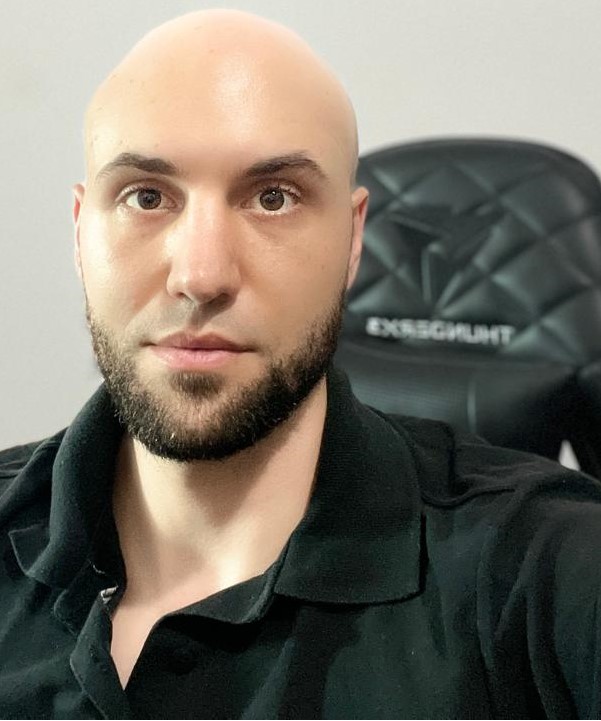
Estefan Gemas Neto
Verified @usp.br
RESEARCH, TEACHING, or OTHER INTERESTS
Multidisciplinary
Scopus Publications
- The spatial and spatiotemporal interpersonal coordinations in aikido’s jiyu waza
Estefan Gemas Neto, Marcelo Tadeu Fernandes Silva, Marcos Antônio Mattos dos Reis, Umberto Cesar Corrêa
Revista De Artes Marciales Asiaticas, 2026
Over the past few years, interpersonal coordination has been increasingly recognised as an important concept in understanding sports performance. It refers to the interactions between individuals. The present study aimed to investigate the interpersonal coordination in jiyu waza. Specifically, it sought to identify the spatial and spatiotemporal measures that characterised interpersonal coordination in jiyu waza. Twenty aikido practitioners participated in the study, with a mean age of 30 years (± 5 years), with a minimum rank of shodan (1st degree black belt) and a minimum of 8 years of aikido practice. The task was jiyu waza, which consisted of a defending aikido practitioner avoiding being surrounded and/or hit by three opponents. Triangular area, triangular shape/type, and interpersonal distance, together with their respective measures of change rates (variability and velocity) were used as measures of interpersonal coordination. The x and y coordinates of the participants' displacement were obtained from 30-second filming (1800 frames at 60 fps) using the semi-automatic tracking software Kinovea 0.9.5. The filming was performed from above, considering the top of each participant's head as the tracking point. Results revealed that: (1) the attackers' interpersonal coordination’s in the form of scalene and obtuse triangles, with more variable areas, as well as the greater interpersonal distances between the defender and the triangles characterised the defenses; (2) the attacks in which the defender was attacked from the front, but was unable to neutralise it, were characterised by greater interpersonal distances that emerged with greater positive velocities; (3) the defender consistently failed to neutralise attacks from behind; these situations were characterised by the interpersonal coordination represented by the scalene and obtuse triangles. The findings of this study suggest that the triangular measures (area and shape/type) were able to capture the interpersonal coordination of cooperation between the attackers, and the interpersonal distance enabled access to the interpersonal coordination relative to the opposition in jiyu waza. - The role of head movement in capoeira's armada performance
Gabriela Bonifácio da Costa Oliveira, Flávio Henrique Bastos, Estefan Gemas Neto, Julio Cerca Serrão, Umberto Corrêa
Revista De Artes Marciales Asiaticas, 2026
During armada performance, capoeira player breaks the visual coupling with the opponent because of the turning movement. This study investigated if a phenomenon named “head marking” would characterize as a potential strategy for capoeira player deal with such a break in the informational coupling. The head marking refers to the act of, in turning movements, the head being the last part of the body to move, but the first to finish. Forty experienced volunteers, [male (n = 10) and female (n = 10) beginners, and male (n = 10) and female (n = 10) advanced capoeira players], with an average age of 24.0 ±5.0 years took part in this experiment. The head marking was analysed in relation to armada speed (slow and fast), opponent (with and without), attacking leg (preferred and non-preferred) and learning phase (beginner and advanced). The latter classification was based on the cordon graduations of the Brazilian Capoeira Confederation. Head movement time was smaller than armada movement time (758.8 ms vs. 1916.6 ms, respectively, p < 0.01). Head movement occurred within the armada movement, since it involved negative (-330.47 ms) and positive (806.66 ms) average values for the starting and ending of the head movement, respectively. It was observed that the armadas performed with the preferred lower member had greater average value of head movement time than those performed with non-preferred member (740.41 ms vs. 678.72 ms, respectively, p < 0.05). And, when armadas were performed against a virtual opponent, they involved greater head movement time than those performed without a virtual opponent (758.58 ms vs. 669.43 ms, respectively, p < 0.05). The findings of this study suggest that head movement had functioned as a head marking phenomenon as an armada’s critical component, which vary depending on performers’ lateral dominance and presence of an opponent. They also contribute to the comprehension of motor skill functioning and the elucidation of its underlying mechanisms. - EFFECTS OF SMALL-SIDED AND CONDITIONED GAMES OF PASSING IN SPORT OF FOOTBALL: A SYSTEMATIC REVIEW
Journal of Physical Education Maringa, 2026 - Gaze Behavior of Experts and Novices in Aikido’s Choku Tsuki
Estefan Gemas Neto, Thiago Augusto Costa de Oliveria, Sérgio Tosi Rodrigues, Alexandre Moreira, Umberto Cesar Corrêa
Perceptual and Motor Skills, 2025
We investigated where and how expert and novice aikido practitioners fixate their gaze to achieve success in choku tsuki performance. Participants were 20 right-handed aikido male practitioners (black belts = 10; white belts = 8; yellow belts = 2), with an average age of 33.5 years ( SD = 7.4). Participants performed a choku tsuki, aiming to hit with a stick (jo) the center of a target on the chest of a virtual opponent attacking them with a wooden sword (bokken). Dependent variables included performance success (absolute frequency of target hits while the attacking opponent was holding the bokken above his head) and gaze behavior (number, variability, and durations of gaze fixations on specific interest areas). The results showed that the experts have fewer and longer fixations than novices; and, whereas experts focused on the target, novices varied their fixations on the opponent’s head and feet, and the target and sword. We concluded that the experts were able to set the target as a functional point of gaze fixation, which allowed them to hit it while they monitored the sword’s movement for a choku tsuki successful performance. - Null Effects on Learning the Basketball Free Throw From a Self-Controlled Demonstration With Different Amounts of Practice
Rafaela Cindy de Souza Silva, Davi Pereira Monte Oliveira, Ricardo Giglio Amadio, Estefan Gemas Neto, Umberto Cesar Corrêa
Perceptual and Motor Skills, 2025
We investigated the effects of the amount of practice on motor learning with a self-controlled demonstration. Participants were 60 volunteers (32 men; 28 women), with an average age of 26.91 years ( SD = 4.11) who practiced basketball free-throw shooting. They were randomly distributed into four 15-person groups: (a) self-control 30 – in which they watched a demonstration whenever and as often as they wished and took 30 acquisition trials; (b) self-control 120 in which they watched a demonstration whenever and as often as they wished and took 120 acquisition trials; (c) a yoked group to the 30 trial group who watched the demonstration only when the self-control group chose; and (d) a yoked group to the 120 trial group who watched the demonstration only when the self-control group chose. The transfer test consisted of 10 trials without demonstration. Dependent variables were free-throw successes and errors and kinematics of the free-throw movement pattern. Results showed that all groups improved performance accuracy and consistency, but there were no group differences. We concluded that neither the amount of practice defined by 30 or 120 trials nor self-control over watching a demonstration affected learning basketball free-throw shooting. - The amount of practice affects the tennis forehand performance but not the perceived competence
Ricardo G. Amadio, Rafaela C. S. Silva, Davi P. M. Oliveira, Estefan G. Neto, Umberto C. Corrêa
Brazilian Journal of Motor Behavior, 2025
BACKGROUND: If practice makes it possible for individuals to become competent in performing motor skills, it seems logical to expect that they will come to perceive themselves as such. Although this is a widely accepted hypothesis, the limited evidence on this subject has not supported it. AIM: To investigate whether perceived competence would change due to the amount of practice. METHODS: Twenty-four individuals between 18 and 35 years of age, right-handed, of both sexes and inexperienced in sport of tennis participated in this study. They were randomly divided into two groups according to the amount of practice: (1) G180 (180 trials) and (2) G360 (360 trials). They were also subdivided into high (G180A and G360A) and low (G180B and G360B) perceived competence. The task was the open stance forehand. Perceived competence was assessed before and after practice using the Physical Self Perception profile questionnaire, a Brazilian version adapted to field tennis. Performance was assessed through scores related to the hitting zones. RESULTS: Both groups improved their performances over practice and, in the last block, the G360 group performed better than the G180 group. The global perceived competence did not change with practice. Gains in the perceived competence were found only in relation to the physical strength (all groups) and physical fitness (except for the G180B group) subscales. INTERPRETATION: The greater amount of practice provided greater gains in forehand performance, i.e., motor competence; however, it did not influence the level of perceived competence. - THE LEVEL OF INFORMATIONAL DEPENDENCE BETWEEN GAZE BEHAVIORS IN DECISION-MAKING ON SHOOTING THROUGHOUT A FUTSAL GAME
Davi Pereira Monte Oliveira, Matheus Maia Pacheco, Rafaela Cindy de Souza Silva, Thiago Augusto Costa Oliveira, Estefan G. Neto, Umberto C. Corrêa
Kinesiologia Slovenica, 2025
Purpose: This study investigated whether gaze fixation behaviors during shooting situations influence subsequent visual behaviors throughout a futsal game. Methods: A total of thirty shots from seven futsal players who wore an unobtrusive eye tracking device during matches of futsal were analyzed using the Kinovea software. The visual information were analyzed from the moment a teammate passed the ball to the shooter (initial moment) until the moment the shot was performed (final moment). The analyses employed normalized mutual information (NMI). Results: The results showed that the NMI values were close to zero, suggesting minimal dependence between gaze fixation behaviors in consecutive shots. Discussion and Conclusions: These findings indicate significant variability in players' gaze fixation behaviors during shooting situations, which may reflect their adaptive responses to the game's dynamic conditions. The identification of multiple gaze fixation patterns among players suggests that different strategies may be employed to optimize performance in response to varying game contexts, offering new insights into the role of visual information in futsal. - AIKIDO’S CHOKU TSUKI MOTOR SKILL: VALIDATION CHECKLIST
Estefan Gemas, Fábio Gomes, Umberto Cesar Corrêa
Kinesiologia Slovenica, 2023
Assessment is an essential procedure for any professional intervention, including in physical education and sports contexts. It concerns a process of collecting information that allows accessing the state of practitioners in relation to desired teaching-learning or training behaviors. Recently, the focus on assessment instruments has been extended to the martial arts contexts, whose studies have shown that the assessment instruments have been recognized by experts of different martial arts not only in relation to access of specific performances, but also as a means of promoting the practitioner's knowledge and motivation. The present study sought to develop and validate a checklist for an aikido’s motor skill: the choku tsuki. For content validation, the evaluators were 17 aikido experts, with at least 7 years of experience, all black belts (n = 6 (6th dan); n = 2 (5th dan); n = 3 (3rd dan); n = 5 (2nd dan); n = 2 (1st dan)). And, for the reliability test, there were four participants (n = 1 (5th dan); n = 2 (2nd dan); n = 1 (1st dan)). Ten adolescents, all inexperienced in the practice of jo, male (n = 7) and female (n = 3), whose ages ranged from 14 to 16 years old also participated as performers. At least 70% of the aikido experts evaluated the items as clear, adequate and technically viable for application in research contexts. The intra and inter-rater correlation indexes reached at least 0.90. It can be concluded that the choku tsuki assessment instrument is reliable, since it reached significant values in the reliability and objectivity indices. - The anticipatory and reaction time behaviors of the futsal goalkeeper
Silvia Leticia Da Silva, Estefan Gemas Neto, Gisele Carla Dos Santos Palma, Antonio Sabino Silva Filho, Umberto Cesar Corrêa
Journal of Physical Education Maringa, 2021
This study aimed to investigate the goalkeeper’s anticipatory and reaction time behaviors. For this purpose, 50 kicks performed by male futsal players were analyzed. The time of goalkeeper’s response to a kick was analyzed in relation to the kick outcome, court zone and distance between the goalkeeper and player who performed the kick. The goalkeeper’s anticipation and reaction time behaviors were those below and above 200 ms as the time criterion, respectively, by considering the moment the player began the preparation for kicking to the moment the goalkeeper began to respond to it. Results showed that the goalkeeper performed anticipatory behaviors predominantly when (i) goals were attained and (ii) kicks were performed in the center and attack court’s zones (iii) at a distance ranging from 5.97 to 7.84 meters. In these conditions, the goalkeepers’ anticipatory behaviors implied ineffective performances. - A perceptual cue on a moving opponent improves the learning of a motor skill from aikido
, Estefan Gemas Neto, Sergio Roberto Silveira, , Marcos Antônio Mattos dos Reis,, Umberto Cesar Corrêa
Journal of Physical Education Maringa, 2021
The effect of different instructional foci on the learning of a motor skill of aikido was investigated. Sixty participants from both sexes with an average age of 14 practiced choku tsuki task, which consisted of hitting a target on the chest of an attacking opponent with a stick. They were divided into four groups: relaxation, with a cue about the relaxed way in which the task should be performed; low hip, with a cue about maintaining hip displacement as low as possible; perceptive, with a cue at the circular target located on the chest of the opponent as they raised their sword to attack; and control, without cues. The dependent variables included measures related to the task goals, movement pattern relative to the task components and kinematic features. Only the perceptive and low hip groups learned the motor skill. The perceptive group obtained better overall performance than the other groups. Learning choku tsuki was improved by the instructional cue “strike target as soon as sword is raised”, establishing the learner’s perceptive attunement to the moving opponent. Learning was also enhanced by the cue "keep hips as low as possible"; however, at a lower level than that of the perceptive cue.
RECENT SCHOLAR PUBLICATIONS
- Effects of small-sided and conditioned games of passing in sport of football: a systematic review
MAM Reis, DPM Oliveira, E Gemas, UC Corrêa
Journal of Physical Education 37, e3703 , 2026
2026 - Dicas instrucionais nos contextos do ensino e da aprendizagem de habilidades motoras
AS Silva Filho, E Gemas Neto, UC Corrêa
Comportamento motor: pesquisa e intervenção , 2026
2026 - EFEITOS DOS JOGOS REDUZIDOS E CONDICIONADOS DE PASSE NO FUTEBOL: UMA REVISÃO SISTEMÁTICA
MAM Reis, DPM Oliveira, E Gemas Neto, UC Corrêa
Journal of Physical Education 37, e3703 , 2026
2026 - The role of head movement in capoeira's armada performance
GBC Oliveira, BF Henrique, E Gemas Neto, JC Serrão, UC Corrêa
Revista de Artes Marciales Asiáticas 21 (1), 95-105 , 2026
2026 - The spatial and spatiotemporal interpersonal coordinations in aikido’s jiyu waza
EG Neto, MTF Silva, MAM dos Reis, UC Corrêa
Revista de Artes Marciales Asiáticas (RAMA) 26 (1), 65-79 , 2026
2026 - The amount of practice affects the tennis forehand performance but not the perceived competence
RG Amadio, RCS Silva, DPM Oliveira, EG Neto, UC Corrêa
Brazilian Journal of Motor Behavior 19 (1), e482-e482 , 2025
2025
Citations: 1 - Gaze Behavior of Experts and Novices in Aikido’s Choku Tsuki
E Gemas Neto, TAC Oliveria, ST Rodrigues, A Moreira, UC Corrêa
Perceptual and Motor Skills 132 (4), 705-720 , 2025
2025 - Null effects on learning the basketball free throw from a self-controlled demonstration with different amounts of practice
RCS Silva, DPM Oliveira, RG Amadio, EG Neto, UC Corrêa
Perceptual and Motor Skills 132 (4), 646-662 , 2025
2025
Citations: 2 - The level of informational dependence between gaze behaviors in decision-making on shooting throughout a futsal game
DPM Oliveira, MM Pacheco, RC de Souza Silva, TAC Oliveira, EG Neto, ...
Kinesiologia Slovenica: scientific journal on sport 31 (2), 51-64 , 2025
2025 - As coordenações interpessoais espaciais e espaciotemporais no jiyu waza
E Gemas Neto
Universidade de São Paulo , 2024
2024 - AIKIDO'S CHOKU TSUKI MOTOR SKILL: VALIDATION CHECKLIST.
E Gemas Neto, FR Ferreira Gomes, UC Corrêa
Kinesiologia Slovenica 29 (1), 88 , 2023
2023
Citations: 2 - The anticipatory and reaction time behaviors of the futsal goalkeeper
SL Silva, E Gemas Neto, GCS Palma, AS Silva Filho, UC Corrêa
Journal of Physical Education 32, e3218 , 2021
2021
Citations: 6 - THE ANTICIPATORY AND REACTION TIME BEHAVIORS OF THE FUTSAL GOALKEEPER.
S Leticia da Silva, E Gemas Neto, GC dos Santos Palma, AS Silva Filho, ...
Journal of Physical Education (24482455) 32 (1) , 2021
2021 - OS COMPORTAMENTOS ANTECIPATÓRIO E DE TEMPO DE REAÇÃO DO GOLEIRO DO FUTSAL
SL Silva, E Gemas Neto, GCS Palma, AS Silva Filho, UC Corrêa
Journal of Physical Education 32, e3218 , 2021
2021 - Uma dica perceptiva sobre um oponente em movimento melhora a aprendizagem de uma habilidade motora do aikido
E Gemas Neto, SR Silveira, MAM Reis, UC Corrêa
Journal of Physical Education 32, e3244 , 2021
2021
Citations: 1 - A perceptual cue on a moving opponent improves the learning of a motor skill from aikido
E Gemas, SR Silveira, MAM Reis, UC Corrêa
Journal of Physical Education 32, e3244 , 2021
2021
Citations: 3 - Efeito das dicas especificas na aprendizagem de uma habilidade motora do aikido.
EG Neto, UC Correa
Brazilian Journal of Motor Behavior 14 (4), 95-96 , 2020
2020 - Efeito das dicas específicas na aprendizagem de uma habilidade motora do aikido
E Gemas Neto
Universidade de São Paulo , 2019
2019
MOST CITED SCHOLAR PUBLICATIONS
- The anticipatory and reaction time behaviors of the futsal goalkeeper
SL Silva, E Gemas Neto, GCS Palma, AS Silva Filho, UC Corrêa
Journal of Physical Education 32, e3218 , 2021
2021
Citations: 6 - A perceptual cue on a moving opponent improves the learning of a motor skill from aikido
E Gemas, SR Silveira, MAM Reis, UC Corrêa
Journal of Physical Education 32, e3244 , 2021
2021
Citations: 3 - Null effects on learning the basketball free throw from a self-controlled demonstration with different amounts of practice
RCS Silva, DPM Oliveira, RG Amadio, EG Neto, UC Corrêa
Perceptual and Motor Skills 132 (4), 646-662 , 2025
2025
Citations: 2 - AIKIDO'S CHOKU TSUKI MOTOR SKILL: VALIDATION CHECKLIST.
E Gemas Neto, FR Ferreira Gomes, UC Corrêa
Kinesiologia Slovenica 29 (1), 88 , 2023
2023
Citations: 2 - The amount of practice affects the tennis forehand performance but not the perceived competence
RG Amadio, RCS Silva, DPM Oliveira, EG Neto, UC Corrêa
Brazilian Journal of Motor Behavior 19 (1), e482-e482 , 2025
2025
Citations: 1 - Uma dica perceptiva sobre um oponente em movimento melhora a aprendizagem de uma habilidade motora do aikido
E Gemas Neto, SR Silveira, MAM Reis, UC Corrêa
Journal of Physical Education 32, e3244 , 2021
2021
Citations: 1 - Effects of small-sided and conditioned games of passing in sport of football: a systematic review
MAM Reis, DPM Oliveira, E Gemas, UC Corrêa
Journal of Physical Education 37, e3703 , 2026
2026 - Dicas instrucionais nos contextos do ensino e da aprendizagem de habilidades motoras
AS Silva Filho, E Gemas Neto, UC Corrêa
Comportamento motor: pesquisa e intervenção , 2026
2026 - EFEITOS DOS JOGOS REDUZIDOS E CONDICIONADOS DE PASSE NO FUTEBOL: UMA REVISÃO SISTEMÁTICA
MAM Reis, DPM Oliveira, E Gemas Neto, UC Corrêa
Journal of Physical Education 37, e3703 , 2026
2026 - The role of head movement in capoeira's armada performance
GBC Oliveira, BF Henrique, E Gemas Neto, JC Serrão, UC Corrêa
Revista de Artes Marciales Asiáticas 21 (1), 95-105 , 2026
2026 - The spatial and spatiotemporal interpersonal coordinations in aikido’s jiyu waza
EG Neto, MTF Silva, MAM dos Reis, UC Corrêa
Revista de Artes Marciales Asiáticas (RAMA) 26 (1), 65-79 , 2026
2026 - Gaze Behavior of Experts and Novices in Aikido’s Choku Tsuki
E Gemas Neto, TAC Oliveria, ST Rodrigues, A Moreira, UC Corrêa
Perceptual and Motor Skills 132 (4), 705-720 , 2025
2025 - The level of informational dependence between gaze behaviors in decision-making on shooting throughout a futsal game
DPM Oliveira, MM Pacheco, RC de Souza Silva, TAC Oliveira, EG Neto, ...
Kinesiologia Slovenica: scientific journal on sport 31 (2), 51-64 , 2025
2025 - As coordenações interpessoais espaciais e espaciotemporais no jiyu waza
E Gemas Neto
Universidade de São Paulo , 2024
2024 - THE ANTICIPATORY AND REACTION TIME BEHAVIORS OF THE FUTSAL GOALKEEPER.
S Leticia da Silva, E Gemas Neto, GC dos Santos Palma, AS Silva Filho, ...
Journal of Physical Education (24482455) 32 (1) , 2021
2021 - OS COMPORTAMENTOS ANTECIPATÓRIO E DE TEMPO DE REAÇÃO DO GOLEIRO DO FUTSAL
SL Silva, E Gemas Neto, GCS Palma, AS Silva Filho, UC Corrêa
Journal of Physical Education 32, e3218 , 2021
2021 - Efeito das dicas especificas na aprendizagem de uma habilidade motora do aikido.
EG Neto, UC Correa
Brazilian Journal of Motor Behavior 14 (4), 95-96 , 2020
2020 - Efeito das dicas específicas na aprendizagem de uma habilidade motora do aikido
E Gemas Neto
Universidade de São Paulo , 2019
2019