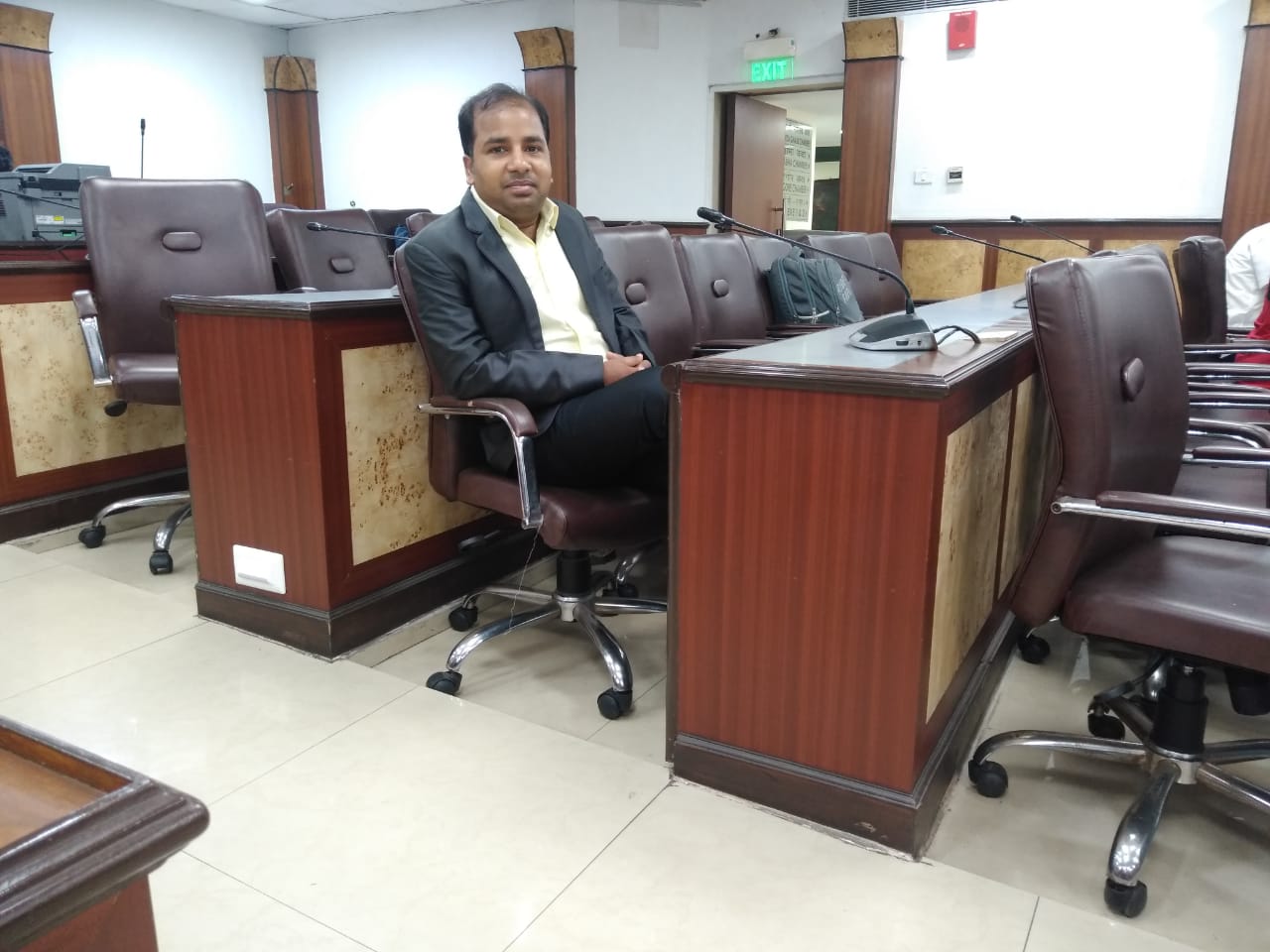
Priyavrat Tiwary

@vksuexams.com

RESEARCH SCHOLAR (Department of Physics)
VEER KUNWAR SINGH UNIVERSITY, ARA, BIHAR

Priyavrat Tiwary
My research focuses on the design and engineering of advanced nanostructured materials for sensing, photocatalytic, and biomedical applications. I have worked extensively on graphene- and metal oxide-based nanocomposites, particularly Fe₂O₃-decorated reduced graphene oxide sheets for enhanced dopamine sensing and synergistically engineered iron oxide–reduced graphene oxide nanocomposites for ultrasensitive uric acid detection. My work emphasizes the development of highly sensitive electrochemical sensors with improved selectivity, conductivity, and rapid response characteristics.

In the field of photocatalysis, my research includes investigating the influence of MoS₂ decoration on ZnO nanorods and engineering ZnO nanorods doped with two-dimensional MoS₂ nanosheets to achieve improved optical properties and enhanced sunlight-driven photocatalytic performance. These studies contribute toward sustainable environmental remediation and energy-efficient catalytic technologies.

EDUCATION

Ph.D. (Physics)
University Department of Physics, Veer Kunwar Singh University, Ara, Bihar (2020-25)
B.Ed.
Tapindu Institute of Higher Studies, Patna (2017-19)
M.Sc. (Physics)
Anugrah Narayan College, Patna (2015-17)
B.Sc. (Physics)
Anugrah Narayan College, Patna (2012-15)

RESEARCH, TEACHING, or OTHER INTERESTS

Materials Science, Ceramics and Composites, Surfaces, Coatings and Films, Electronic, Optical and Magnetic Materials

FUTURE PROJECTS

To Construct a low-power, self-contained aquatic sensor device using conducting polymer nanocomposites that wirelessly transmits water quality data to an IoT cloud system.

The increasing demand for real-time monitoring of aquatic environments has highlighted the need for compact, energy-efficient, and intelligent water quality sensing systems. This research proposes the design and development of a low-power, self-contained aquatic sensor device based on conducting polymer nanocomposites for continuous monitoring of critical water quality parameters. The device integrates advanced nanocomposite sensing materials with embedded electronics and wireless communication technologies to enable autonomous operation in remote aquatic environments. Conducting polymer nanocomposites are employed as the sensing medium due to their high sensitivity, rapid response, excellent electrical conductivity, and environmental stability. The developed sensor is capable of detecting key water quality indicators such as pH, dissolved oxygen, turbidity, temperature, and the presence of toxic contaminants.


Applications Invited
Post-Doc Fellow Position

To project an impedimetric or voltammetric paper-based electrochemical device (PAD) modified with 2D MXenes to detect trace amounts of lead, copper or microplastics in local wastewater matrices.

This research focuses on the development of an impedimetric/voltammetric paper-based electrochemical analytical device (PAD) modified with two-dimensional MXene nanomaterials for the sensitive detection of trace contaminants in wastewater. The proposed sensor aims to identify low concentrations of heavy metals such as lead (Pb²⁺) and copper (Cu²⁺), along with microplastic pollutants, in local wastewater matrices. MXenes are selected due to their exceptional electrical conductivity, large surface area, hydrophilicity, and excellent electrochemical activity, which significantly enhance sensing performance. The paper-based platform offers advantages including low cost, portability, flexibility, and ease of fabrication, making it suitable for on-site environmental monitoring. Electrochemical techniques such as electrochemical impedance spectroscopy (EIS) and voltammetry will be employed to achieve rapid and highly sensitive detection.


Applications Invited
Post-Doc Fellow Position

To develop an ultra-sensitive, non-invasive diagnostic platform utilizing gold-nanostar decorated graphene quantum dots to sense specific microRNA, viral antigens, or bacterial strains from saliva.

This research aims to develop an ultra-sensitive and non-invasive diagnostic platform based on gold-nanostar decorated graphene quantum dots (AuNS-GQDs) for the rapid detection of specific microRNA biomarkers, viral antigens, and bacterial strains from human saliva samples. The proposed nanohybrid sensing system combines the exceptional optical and electrical properties of graphene quantum dots with the enhanced plasmonic activity of gold nanostars to achieve highly sensitive and selective biosensing performance. The platform is designed to enable early-stage disease diagnosis through simple saliva-based analysis, eliminating the need for invasive blood sampling procedures. Advanced electrochemical and optical sensing techniques will be employed to detect trace-level biomolecules associated with infectious diseases and other health conditions. The developed sensor is expected to exhibit rapid response, high specificity, low detection limits, and excellent biocompatibility.


Applications Invited
Post-Doc Fellow Position
4

Scholar Citations

1

Scholar h-index

RECENT SCHOLAR PUBLICATIONS

  • Synergistically engineered iron oxide–reduced graphene oxide nanocomposites for ultrasensitive uric acid sensing
    Priyavrat, Kunal, A Khan, AK Singh, J Seo, JR Ansari
    Microchemical Journal, 118052 , 2026
    2026
  • Influence of MoS2 decoration on ZnO nanorods for enhanced photocatalytic applications
    JRA Priyavrat, Ariba Khan, Anil Kumar Singh
    International Journal of science and Research 14 (3), 1456-1462 , 2025
    2025
  • Fe 2 O 3 decorated reduced graphene oxide sheets for enhanced sensing applications for dopamine
    Priyavrat, A Khan, Kunal, KK Sadasivuni, AK Singh, JR Ansari
    Emergent Materials 7 (6), 2973-2984 , 2024
    2024
    Citations: 4

MOST CITED SCHOLAR PUBLICATIONS

  • Fe 2 O 3 decorated reduced graphene oxide sheets for enhanced sensing applications for dopamine
    Priyavrat, A Khan, Kunal, KK Sadasivuni, AK Singh, JR Ansari
    Emergent Materials 7 (6), 2973-2984 , 2024
    2024
    Citations: 4
  • Synergistically engineered iron oxide–reduced graphene oxide nanocomposites for ultrasensitive uric acid sensing
    Priyavrat, Kunal, A Khan, AK Singh, J Seo, JR Ansari
    Microchemical Journal, 118052 , 2026
    2026
  • Influence of MoS2 decoration on ZnO nanorods for enhanced photocatalytic applications
    JRA Priyavrat, Ariba Khan, Anil Kumar Singh
    International Journal of science and Research 14 (3), 1456-1462 , 2025
    2025

Publications

1. Priyavrat, A. Khan, Kunal, K.K. Sadasivuni, A.K. Singh, Jamilur R. Ansari, “Fe2O3 decorated reduced graphene oxide sheets for enhanced sensing applications for dopamine”, Emergent Materials (2024), ( IF : 4.8

2. Priyavrat, Ariba Khan, Anil Kumar Singh, and Jamilur. R. Ansari,* “Influence of MoS2 decoration on ZnO nanorods for enhanced photocatalytic applications” International Journal of science and Research (2025), (
IF 2024: 7.101

3. Priyavrat, Kumal, Ariba Khan, Anil Kumar Singh, Jongchul Seo and Jamilur. R. Ansari,* et al. “Synergistically engineered Iron oxide-reduced graphene oxide nanocomposites for ultrasensitive uric acid sensing”, Microchemical Journal, (Science Direct, Elsevier)


4. Priyavrat, Namita, Ariba Khan, Deepak Kumar, Jaspal Singh, Jamilur R, Ansari,*et al. “Engineering of the ZnO nanorods doped (2D) MoS2 nanosheet with improved optical properties for enhanced sunlight-driven photocatalytic performance”.
[Under Review in Molecular Catalysis (Elsevier)]

Industry, Institute, or Organisation Collaboration

University Department of Physics, Veer Kunwar Singh University, Ara, Bihar

INDUSTRY EXPERIENCE

1. Participated in the One-day workshop on: “DFT and Wave Function Theory Method” Organized by- Department of Physics, Dayanand College, Hisar on 12th April 2023.

2. Participated in the International Short Term Training Programme-2 on: “Impact and Panacea of Environmental Pollution: The Past, Present and Future” Organized by- Raj Rishi Govt. Autonomous College, Alwar, Rajasthan, India dated 20th to 26th April 2022.

3. Participated in the INUP- i2i (Indian Nanoelectronics Users’ Programme- Idea to Innovation) User Awareness Workshop on Fabrication and Characterization Facility for Nanotechnology, held at IIT DELHI during 24th– 25th September, 2022.

4. Participated in the INUP- i2i (Indian Nanoelectronics Users’ Programme- Idea to Innovation) “Familiarization Workshop on Nanofabrication Technologies”, held at IIT DELHI during 07 – 08th Feb, 2022.

5. Participated in the International Short Term Training Programme-3 on: “Contrivance of Sustainable Development Goals (SDGs) for Environment Conservation” Organized by Raj Rishi Govt. Autonomous College, Alwar, Rajasthan, India dated 24th - 30th June, 2022.


6. Participated in Virtual Workshop on: “Probing Materials using Spectroscopic Tools: Basics and Applications” dated- February 28th to March 04th 2022 jointly organized by Department of Physics and Maharshi Kanad Centre for Interdisciplinary Research Mahatma Gandhi Central University, Motihari-845401, Bihar.