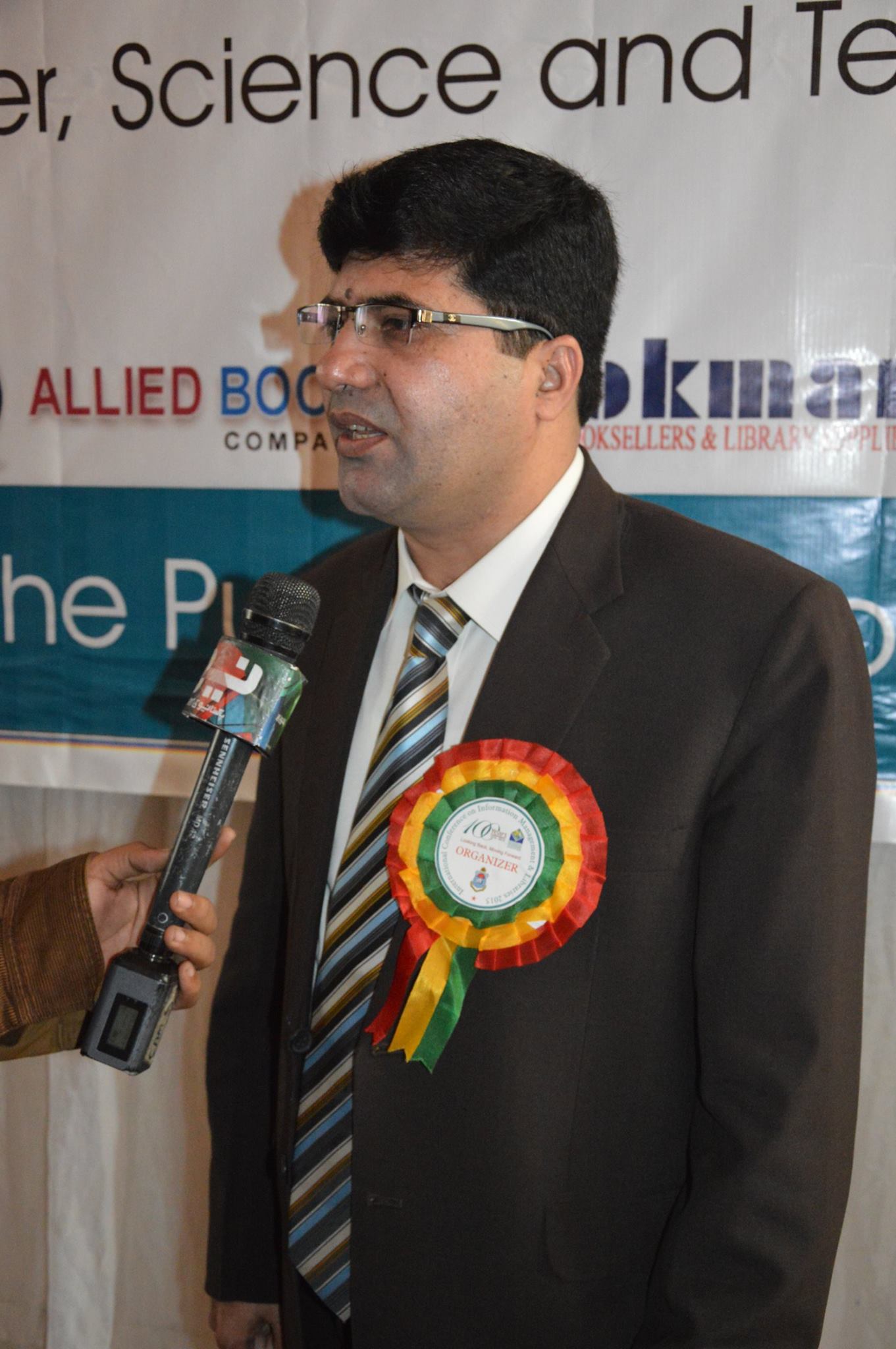
I completed my doctorate in Library and Information Science from the Charles de Gaulle University – Lille III, France, with the highest distinction in 2012. I have more than 24 years of professional, teaching and administrative experience at various universities and academic institutions across different countries such as France, Pakistan, and Saudi Arabia. I am actively engaged in research and have produced 78 research papers. I have also presented 15 research papers at various national and international conferences. I am an HEC (Higher Education Commission of Pakistan) approved Ph.D. supervisor and am actively involved in teaching as well as supervising postgraduate students. I have provided training in various research tools such as NVIVO, SPSS, AMOS, Endnote, Mendeley, Zotero, RefWorks Turnitin, Biblioshiny, VOSViewer, HistCite, CiteSpace, BibExcel, and have conducted more than 650 workshops and training sessions as a resource person in Pakistan and abroad.
RESEARCH INTERESTS
Library service quality, Bibliometrics, Mobile learning, open access. library leadership
82
Scopus Publications
Scopus Publications
Equity at stake? Fostering social justice in Pakistani academic libraries Murtaza Ashiq, Nosheen Fatima Warraich, Shafiq Ur Rehman Ifla Journal, 2026 Social justice refers to the distribution of fundamental rights, duties, and facilities among members of a community. Equity, diversity, inclusion, and accessibility (EDIA) are basic principles of social justice and considered core values of librarianship. Literature on EDIA in the developing world is scarce, and this study addresses the gap and explores EDIA practices in academic libraries in terms of designing library services, resources, spaces, infrastructure, and facilities. A qualitative research design was chosen and data were collected through interviews with 18 chief librarians. The data analysis approach was thematic using NVivo software. The findings revealed eight major themes demonstrating EDIA-based library practices in Pakistani academic libraries. Overall, it revealed that EDIA practices in university libraries lacked inclusive services, resources, infrastructure, accessibility, and spaces, especially for differently abled library users. The study also identified the necessity for special attention groups to promote EDIA in academic library practices.
A scientometrics analysis of equity, diversity, inclusion, and accessibility (EDIA) literature in library and information science profession Murtaza Ashiq, Shafiq Ur Rehman, Nosheen Fatima Warraich Global Knowledge Memory and Communication, 2025 Purpose Equity, diversity, inclusion and accessibility (EDIA) are the core values of librarianship. This study aims to examine the EDIA literature in the library and information science (LIS) profession, focusing on publishing trends, authorship patterns, thematic evolution, co-occurrence network, international collaboration network and three-factor analysis. Design/methodology/approach A scientometrics analysis was performed, and data were retrieved from the Web of Science database following a four-phase data extraction and filtration process. Data analysis was performed using specialized scientometrics tools. Findings Most of the published work comes from the developed world. The thematic evolution identified that the initial period (1971–2010) was dedicated to the diversity of library resources, services and users. The second phase (2011–2015) concentrated on accessibility and information literacy. The recent period (2016–2021) is linked with social inclusion, diversity and accessibility. Furthermore, the co-cluster citation and content analysis identified five major interconnected streams in the EDIA literature in LIS: disability and accessibility; diversity, inclusion and recruitment; social justice and libraries; libraries and immigrants; and libraries and the lesbian, gay, bisexual, transgendered, queer community. Research limitations/implications Theoretical, practical and implications for policy makers and curriculum developers were added to create awareness and better observe EDIA in LIS field. Originality/value The identification of research streams is one of the most important findings of this study, which shows that some areas of EDIA are maturing and others are emerging in the profession.
A systematic literature review on the use of mobile phones to access library services and resources: challenges and benefits Muhammad Safdar, Shafiq Ur Rehman, Ammara Yousaf, Murtaza Ashiq Global Knowledge Memory and Communication, 2025 Purpose This paper is a systematic review that aims to collect and review studies on library users’ smartphone use to access library services and resources. Another objective of the systematic review is to identify the challenges and benefits (reported in the reviewed literature) regarding using smartphones to access library resources and services. Design/methodology/approach The researchers searched the relevant literature from four databases: Scopus, Library and Information Science Technology Abstracts, Web of Science and Google Scholar. A total of 20 studies were selected, out of the 2,416 retrieved titles, for review in light of the PRISMA guidelines. This systematic review also used the quality assessment guidelines of Boynton and Greenhalgh (2004), to analyze the quality of the publications reviewed in the study. Findings The results highlighted that library users used smartphones to access a wide range of library services, including directions help, fresh arrivals, library news notifications, room and course reservations, library account management, circulation and the Online Public Access Catalogue (OPAC). The libraries offered their users multiple mobile-supported services related to searching for resources and account management. The challenges, as well as the benefits associated with the use of smartphones for accessing and using library services, have also been reported. Most reviewed studies scored high (9–13 out of 13) in the quality assessment. Research limitations/implications This research has some limitations. First, only the English-language research studies were included in the review. Therefore, it is possible that a significant study conducted in a language other than English was missed. Second, researchers performed a comprehensive search to collect the maximum number of relevant studies; there is a chance that an important study was missed during the search and retrieval process. Practical implications This research fills the research gap by advancing the literature on mobile device use for accessing library services and resources. The findings might help library professionals understand the current trends in accessing library services through smartphones. This also helps them plan the latest mobile-supported library services to meet the ever-changing demands of library users. Policymakers could also benefit from this research, as it could help them understand current trends in library services and facilitate them in making appropriate policies, funding allocations and implementing mobile services in libraries. Social implications The researchers found that the use of mobile phones to access library services and resources impacts society in a discernible way. It provides a rich environment as users access a wide range of library services, including directions help, fresh arrivals, library news notifications, room and course reservations, library account management, circulation and the OPAC without any hindrances or hurdles. Originality/value This is the first review, to the best of the authors’ knowledge, that has systematically collected and reviewed the literature on the topic under study. This study also shares the theoretical and practical implications of the research and future research directions for researchers.
From policy to practice: The contribution of library leadership in ensuring legal preparedness for managing digital content in pakistani university libraries Asghar Ali, Munazza Jabeen, Shafiq Ur Rehman Information Development, 2025 The study investigates the role of university library leadership and legal preparedness for managing digital content in Pakistan. The present study successfully assessed the level of legal preparedness, knowledge and awareness, compliance with legal standards and frameworks, institutional support, and challenges university libraries face in managing digital content. The study employed a quantitative research approach and collected the data using a structured nationwide questionnaire. The questionnaire comprised six sections covering all aspects of legal preparedness for managing digital content in university libraries. The researchers collected the responses of 123 library leaders by adopting a purposive sampling technique. The findings revealed that there was limited awareness of legal requirements and a lack of training programs on legal frameworks among library professionals for digital content management. The study results indicate a partial adherence to copyright laws, and there are gaps in compliance with data protection standards. There were insufficient risk mitigation strategies and a lack of proactive measures for legal challenges in university libraries. There were no consistent practices for legal documentation and records. The findings revealed that inadequate IT infrastructure, compliance with legal frameworks, and budget limitations were the highest-rated challenges.
Correlation between CiteScore and impact factor: a systematic review and meta-analysis Muhammad Safdar, Nadeem Siddique, Shafiq Ur Rehman, Soban Qadir Khan, Muhammad Ajmal Khan, et al. Global Knowledge Memory and Communication, 2025 Purpose This study intends to identify and analyze evidence regarding the relationship between impact factor and CiteScore. The reviews also evaluate the reviewed studies’ quality. The study aims to identify the countries publishing on the topic. Design/methodology/approach The researchers searched eight sources, including WoS and Scopus, to retrieve the literature in the area. The reviewed studies covered different subjects, including medicine, computer science and library sciences. The authors used preferred reporting items for systematic review and meta-analysis (PRISMA) guidelines to screen and select the titles eligible for this review. The investigators identified 13 studies that met the eligibility criteria. The researchers consulted the Boynton and Greenhalgh (2004) checklist for the reviewed literature’s quality assessment. Findings The correlation coefficient values identified in the reviewed studies confirmed a significant relationship between CiteScore and impact factor. The researchers identified heterogeneity in the data. Hence, the random-effect method of the meta-analysis was applied. The values of the pooled correlation coefficient also indicated a positive correlation between the two indicators. The review identified that most (nine) of the reviewed studies’ quality scores ranged between 10 and 13. The review sheds light on the countries’ research production in the area. Practical implications The review contributed to the literature (theoretical implication). The study’s results will be helpful for databases (WoS and Scopus), publishers and research community in understanding the relationship between JIF and CiteScore (practical implications). Originality/value This is the first review and meta-analysis that systematically collected and reviewed the literature that investigated the relationship between CiteScore and impact factor.
Bibliometric analysis of the current status and trends in dental applications of glass fiber-reinforced composites from 1998 to 2022 Khalid S. Almulhim, Shafiq Ur Rehman, Saqib Ali, Shakil Ahmad, Abdul Samad Khan Dental and Medical Problems, 2024 Over the last few years, considerable attention has been devoted to glass fiber-reinforced composites (GFRCs) in the field of dentistry. Glass fiber-reinforced composites are useful in prosthodontics, endodontics, restorative dentistry, orthodontics, and periodontics. This study considered various aspects related to GFRCs to assess the publications and citations on the subject from 1998 to 2022.A bibliometric method of analysis was adopted to conduct the study. The relevant papers published within the established time frame were identified. A document-type filter was applied to retrieve only those results that were peer-reviewed. The most influential authors, journals, institutions, and countries were identified, as indicated by the number of citations, as well as the most frequently used keywords.The findings of the bibliometric analysis revealed that the first article on GFRCs in the context of dentistry was published in 1998. The greatest number of papers on this subject was published in 2011 (n = 51), while the number of citations reached its peak in 2008 (n = 1,546). The University of Turku in Finland published the greatest number of articles, whereas Brazil was the most prolific country, producing the highest number of publications on dental fiber. Researchers from Brazil, Italy and Germany mainly collaborated with researchers from other countries, including the USA and Finland. The analysis revealed that publications of multiple authors were more likely to be cited.Significant advancements have been made in the field of GFRCs, as demonstrated by an increased collaboration amongst different countries, organizations and investigators, which enhanced the development and progression of research related to GFRCs.
The evolution and mapping trends of mobile health (m-Health): a bibliometric analysis (1997–2023) Turki Alanzi, Shafiq Ur Rehman, Muhammad Ajmal Khan, Robert S. H. Istepanian Mhealth, 2024 Background Mobile health (m-Health) is widely acknowledged as a pivotal domain for improving global healthcare and driving its digital health transformation. Despite the vast amount of literature published in recent years, bibliometric studies on m-Health remain limited in scope and coverage. This study presents a comprehensive review of m-Health literature extracted from Scopus and PubMed databases, spanning the period from 1997 to 2023, including publications during the coronavirus disease 2019 (COVID-19) pandemic. Methods The combined Scopus and PubMed databases were used in this study. The search formula for the literature retrieval used the most appropriate and relevant keywords to m-Health. The bibliometric data importation, extraction and analysis of authors, titles, publication date, publication place, publisher, volume number, issue number, citation count, document type, author keywords, affiliation were all carried out using the ‘Biblioshiny’, ‘EndNote X9®’, ‘Microsoft Excel®’ and ‘Microsoft Access®’ software tools. Duplicate records were manually identified and removed. Visualization maps illustrating the recurrent keywords, collaboration patterns, and prolific publishing countries were generated using ‘VOSviewer®’. Results A total of 37,470 (20,703 from Scopus and 16,767 from PubMed) publications were selected for the literature analysis. The results provided the definitive literature evidence on the origin of the concept of m-Health in 2003. Significant increase in the publications followed the global surge of smart phones usage in 2007, and the emergence of m-Health applications (Apps) and their global markets and ecosystems. The number of the publications peaked between 2013 and 2022 with most citations in 2022. There was noticeable spike in m-Health literature during the COVID-19 pandemic. The results also showed that most of the highly cited publications, leading institutions, and most prolific authors were predominantly from the developed countries. The USA has the highest number of publications followed by the UK, Australia, Germany, Canada and China, with most of the prolific authors originating from these countries. Conclusions In conclusion, while there has been a remarkable increase in global m-Health publications since 2003, most of the impactful literature and publications in this area originated from selected countries in the developed world. The study indicates a significant disparity between the published literature from developed compared to the developing countries. Addressing this disparity, further bibliographical studies are required to address these and other literature gaps.
Exploring the use of mobile technologies for learning: an empirical study of library and information science (LIS) students Murtaza Ashiq, Shafiq Ur Rehman, Ammara Yousaf, Muhammad Safdar Digital Library Perspectives, 2023 Purpose The use of mobile technologies and learning devices has been increasing in every field of life, and library and information sciences are no exception. This study aims to explore the perceptions of library and information science (LIS) students regarding mobile learning (m-learning) along with their primary purposes, social media applications, advantages, disadvantages, barriers, impact and overall satisfaction with using these devices. Design/methodology/approach A survey method was used, and data was collected from the students of 12 library schools in Pakistan for a total sample of 250 students. Findings Their main purposes of usage, their needs, advantages, disadvantages, barriers, impacts and the level of overall satisfaction were also identified. The inferential statistics (t-test and ANOVA) also identified the difference of opinion on the basis of gender, programs, types and number of m-learning devices. Overall, the findings highlight the need for academic libraries to give mobile access (launching mobile applications) to better use library services. To ensure this, libraries must keep an eye on new advances in mobile technology, researchers’ needs and related electronic library services and observe how these services are being used. Practical implications Theoretical and practical implications have been highlighted to understand the perceptions of LIS students about m-learning devices. Originality/value The mobile library service providers and management need to improve their services by offering services that fit the diverse needs of their users and should know how to attract modern library users.