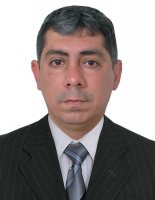
Dr- Musab Tahseen Salahaldeen Al-kaltakchi

@uomustansiriyah.edu.iq

Electrical Engineering Department/Faculty of Engineering
Mustansiriyah University

Dr- Musab Tahseen Salahaldeen Al-kaltakchi
Musab T. S. Al-Kaltakchi is a lecturer at the Electrical Engineering Department, Al-Mustansiriyah University, Baghdad-Iraq. He obtained his BSc in Electrical Engineering (1996) and MSc in Communication and Electronics (2004) from Al-Mustansiriyah University (Baghdad/Iraq). He was awarded PhD degree in Electrical Engineering/ Digital Signal Processing from Newcastle University, UK (2018). He is a member in Institute of Electrical and Electronic Engineering (IEEE) and also in Institute of Engineering and Technology (IET). His research interests include Speaker identification and Verification, Speech and Audio Signal Processing, Machine learning, Pattern recognition, Biometrics.

EDUCATION

Ph.D. degree in Electrical Engineering/ Digital Signal Processing from Newcastle University, UK 2018.
MSc in Communication and Electronics from Mustansiriyah University (Baghdad/Iraq) 2004.
BSc in Electrical Engineering from Mustansiriyah University (Baghdad/Iraq) 1996.

RESEARCH INTERESTS

Biometrics -Speech, Audio and Signal Processing - Machine Learning - Pattern Recognition - Speaker Identification and Verification - Speech compression -
Speech Coding.
27

Scopus Publications

426

Scholar Citations

13

Scholar h-index

16

Scholar i10-index

Scopus Publications

  • Robust text-independent speaker identification and verification using multi-feature fusion and student’s t modelling
    International Journal of Electronics and Telecommunications, 2026
  • Intelligent Face Recognition: Comprehensive Feature Extraction Methods for Holistic Face Analysis and Modalities
    Thoalfeqar G. Jarullah, Ahmad Saeed Mohammad, Musab T. S. Al-Kaltakchi, Jabir Alshehabi Al-Ani
    Signals, 2025
    Face recognition technology utilizes unique facial features to analyze and compare individuals for identification and verification purposes. This technology is crucial for several reasons, such as improving security and authentication, effectively verifying identities, providing personalized user experiences, and automating various operations, including attendance monitoring, access management, and law enforcement activities. In this paper, comprehensive evaluations are conducted using different face detection and modality segmentation methods, feature extraction methods, and classifiers to improve system performance. As for face detection, four methods are proposed: OpenCV’s Haar Cascade classifier, Dlib’s HOG + SVM frontal face detector, Dlib’s CNN face detector, and Mediapipe’s face detector. Additionally, two types of feature extraction techniques are proposed: hand-crafted features (traditional methods: global local features) and deep learning features. Three global features were extracted, Scale-Invariant Feature Transform (SIFT), Speeded Robust Features (SURF), and Global Image Structure (GIST). Likewise, the following local feature methods are utilized: Local Binary Pattern (LBP), Weber local descriptor (WLD), and Histogram of Oriented Gradients (HOG). On the other hand, the deep learning-based features fall into two categories: convolutional neural networks (CNNs), including VGG16, VGG19, and VGG-Face, and Siamese neural networks (SNNs), which generate face embeddings. For classification, three methods are employed: Support Vector Machine (SVM), a one-class SVM variant, and Multilayer Perceptron (MLP). The system is evaluated on three datasets: in-house, Labelled Faces in the Wild (LFW), and the Pins dataset (sourced from Pinterest) providing comprehensive benchmark comparisons for facial recognition research. The best performance accuracy for the proposed ten-feature extraction methods applied to the in-house database in the context of the facial recognition task achieved 99.8% accuracy by using the VGG16 model combined with the SVM classifier.
  • Enhancing Ground Penetrating Radar (GPR) Data Analysis Utilizing Machine Learning
    Mohanad Shehab, Musab T.S. Al-Kaltakchi, Ammar Dukhan, Wai Lok Woo
    Journal of Engineering and Sustainable Development, 2025
    Ground Penetrating Radar is a non-destructive geophysical technique that utilizes radio waves to generate images of the Earth's subsurface to point out the location of buried evidence. In this paper, it is used to identify structures and types of seismic images of a real oil and gas field. This work employs GPR with 500MHz to permit the EMW to penetrate deep and to provide a good resolution for images generated. Gray-Level Co-Occurrence Matrix and Wavelet feature extractor approaches are mixed to extract 48 selected features. Subsequently, preprocessing techniques are utilized to improve GPR data analysis and interpretation, including refining data, imputing the missing values, normalizing all data, and splitting them into 70% for the training and 30% for the testing phases. Finally, various machine learning techniques are employed to classify the collected images using models like Decision Trees,agged trees, Naive Bayes, Artificial Neural Networks, Quadratic Discriminant Analysis, Support Vector Machines, and K-nearest neighbors. The performance metrics of all the machine learning approaches are worthy, and the proposed KNN can achieve an accuracy of 98.169%, 14 seconds of training time, and less than a few seconds of testing time.
  • Identifying three-dimensional palmprints with Modified Four-Patch Local Binary Pattern (MFPLBP)
    Musab T.S. Al-Kaltakchi, Manhal Ahmad Saleh Al-Hussein, Raid Rafi Omar Al-Nima
    International Journal of Electronics and Telecommunications, 2025
    Palmprint biometrics is the best method of identifying an individual with a unique palmprint for every person. The present paper formulates a new methodology towards the identification of 3D palmprints using the Modified Four- Patch Local Binary Pattern (MFPLBP). It improves upon the conventional Four-Patch Local Binary Pattern (FPLBP) by integrating the adaptive weight with the improved texture extraction. Both approaches are created to support the intricate surface information of 3D palmprints. The MFPLBP can exactly capture local variations and is noise and illumination invariant. There are extensive experiments done in this paper and establish that MFPLBP outperforms traditional LBP methods and other stateof- the-art methods in recognition rates. The experiments establish that MFPLBP is a efficient and effective method of making use of 3D palmprints in real-world biometric verification.
  • IoT-MFaceNet: Internet-of-Things-Based Face Recognition Using MobileNetV2 and FaceNet Deep-Learning Implementations on a Raspberry Pi-400
    Ahmad Saeed Mohammad, Thoalfeqar G. Jarullah, Musab T. S. Al-Kaltakchi, Jabir Alshehabi Al-Ani, Somdip Dey
    Journal of Low Power Electronics and Applications, 2024
    IoT applications revolutionize industries by enhancing operations, enabling data-driven decisions, and fostering innovation. This study explores the growing potential of IoT-based facial recognition for mobile devices, a technology rapidly advancing within the interconnected IoT landscape. The investigation proposes a framework called IoT-MFaceNet (Internet-of-Things-based face recognition using MobileNetV2 and FaceNet deep-learning) utilizing pre-existing deep-learning methods, employing the MobileNetV2 and FaceNet algorithms on both ImageNet and FaceNet databases. Additionally, an in-house database is compiled, capturing data from 50 individuals via a web camera and 10 subjects through a smartphone camera. Pre-processing of the in-house database involves face detection using OpenCV’s Haar Cascade, Dlib’s CNN Face Detector, and Mediapipe’s Face. The resulting system demonstrates high accuracy in real-time and operates efficiently on low-powered devices like the Raspberry Pi 400. The evaluation involves the use of the multilayer perceptron (MLP) and support vector machine (SVM) classifiers. The system primarily functions as a closed set identification system within a computer engineering department at the College of Engineering, Mustansiriyah University, Iraq, allowing access exclusively to department staff for the department rapporteur room. The proposed system undergoes successful testing, achieving a maximum accuracy rate of 99.976%.
  • DNA recognition using Novel Deep Learning Model
    Musab T.S. Al-Kaltakchi, Hasan A. Abdulla, Raid Rafi Omar Al-Nima
    International Journal of Electronics and Telecommunications, 2024
    DNA, a significant physiological biometric, is present in all human cells like hair, blood, and skin. This research introduces a new approach called the Deep DNA Learning Network (DDLN) for person identification based on their DNA. This novel Machine Learning model is designed to gather DNA chromosomes from an individual’s parents. The model’s flexibility allows it to expand or contract and has the capability to determine one or both parents of an individual using the provided chromosomes. Notably, the DDLN model offers quick training in comparison to traditional deep learning methods. The study employs two real datasets from Iraq: the Real Iraqi Dataset for Kurds (RIDK) and the Real Iraqi Dataset for Arabs (RIDA). The outcomes demonstrate that the proposed DDLN model achieves an Equal Error Rate (EER) of 0 for both datasets, indicating highly accurate performance.
  • Study on Sensing Urine Concentrations in Water Using a Microwave Sensor Based on Hilbert Structure
    Rusul Khalid Abdulsattar, Musab T. S. Al-Kaltakchi, Iulia Andreea Mocanu, Amer Abbood Al-Behadili, Zaid A. Abdu Hassain
    Sensors, 2024
    In this study, a two-port network-based microwave sensor for liquid characterization is presented. The suggested sensor is built as a miniature microwave resonator using the third iteration of Hilbert’s fractal architecture. The suggested structure is used with the T-resonator to raise the sensor quality factor. The suggested sensor is printed on a FR4 substrate and has a footprint of 40×60×1.6mm3. Analytically, a theoretical investigation is made to clarify how the suggested sensor might function. The suggested sensor is created and put to the test in an experiment. Later, two pans to contain the urine Sample Under Test (SUT) are printed on the sensor. Before loading the SUT, it is discovered that the suggested structure’s frequency resonance is 0.46 GHz. An 18 MHz frequency shift is added to the initial resonance after the pans are printed. They monitor the S-parameters in terms of S12 regarding the change in water content in the urine samples, allowing for the sensing component to be completed. As a result, 10 different samples with varying urine percentages are added to the suggested sensor to evaluate its ability to detect the presence of urine. Finally, it is discovered that the suggested process’ measurements and corresponding simulated outcomes agreed quite well.
  • Identifying deoxyribonucleic acids of individuals based on their chromosomes by proposing a special deep learning model
    Raid Rafi Omar Al-Nima, Musab Tahseen Salahaldeen Al-Kaltakchi, Hasan A. Abdulla
    Bulletin of Electrical Engineering and Informatics, 2024
    One of the most significant physiological biometrics is the deoxyribonucleic acid (DNA). It can be found in every human cell as in hair, blood, and skin. In this paper, a special DNA deep learning (SDDL) is proposed as a novel machine learning (ML) model to identify persons depending on their DNAs. The proposed model is designed to collect DNA chromosomes of parents for an individual. It is flexible (can be enlarged or reduced) and it can identify one or both parents of a person, based on the provided chromosomes. The SDDL is so fast in training compared to other traditional deep learning models. Two real datasets from Iraq are utilized called: Real Iraqi Dataset for Kurd (RIDK) and Real Iraqi Dataset for Arab (RIDA). The results yield that the suggested SDDL model achieves 100% testing accuracy for each of the employed datasets.
  • Estimating risk levels for blood pressure and thyroid hormone using artificial intelligence methods
    Musab T.S. Al-Kaltakchi, Raid Rafi Omar Al-Nima, Azza Alhialy
    International Journal of Electronics and Telecommunications, 2024
    In this work, artificial intelligence methods are designed and adopted for evaluating various risk levels of thyroid hormone and blood pressure in humans. Fuzzy Logic (FL) method is firstly exploited to provide the risk levels. Additionally, a machine learning was proposed using the Adaptive Neuron- Fuzzy Inference System (ANFIS) to learn and assess the risk levels by fusing a multiple-layer Neural Network (NN) with the FL. The data are collected for standard risk levels from real medical centers. The results lead to well ANFIS design based on the FL, which can generate such interesting outcomes for predicting risk levels for thyroid hormone and blood pressure. Both proposed methods of the FL and ANFIS can be exploited for medical applications.
  • Road Tracking Enhancements for Self-Driving Cars Applications
    Raid Rafi Omar Al-Nima, Musab T. S. Al-Kaltakchi, Tingting Han, Wai Lok Woo
    Aip Conference Proceedings, 2023
  • Ensemble System of Deep Neural Networks for Single-Channel Audio Separation
    Musab T. S. Al-Kaltakchi, Ahmad Saeed Mohammad, Wai Lok Woo
    Information Switzerland, 2023
  • Comprehensive Evaluations of Student Performance Estimation via Machine Learning
    Ahmad Saeed Mohammad, Musab T. S. Al-Kaltakchi, Jabir Alshehabi Al-Ani, Jonathon A. Chambers
    Mathematics, 2023
  • Classifications of signatures by radial basis neural network
    Musab Tahseen Salahaldeen Al-Kaltakchi, Saadoon Awad Mohammed Al-Sumaidaee, Raid Rafi Omar Al-Nima
    Bulletin of Electrical Engineering and Informatics, 2022
  • Combined i-Vector and Extreme Learning Machine Approach for Robust Speaker Identification and Evaluation with SITW 2016, NIST 2008, TIMIT Databases
    Musab T. S. Al-Kaltakchi, Mohammed A. M. Abdullah, Wai L. Woo, Satnam S. Dlay
    Circuits Systems and Signal Processing, 2021
  • Closed-set speaker identification system based on MFCC and PNCC features combination with different fusion strategies
    Musab T.S. Al-Kaltakchi, Mohammed A.M. Abdullah, Wai L. Woo, Satnam S. Dlay
    Applied Speech Processing Algorithms and Case Studies, 2021
  • Speaker Verification Using Cosine Distance Scoring with i-vector Approach
    Musab T. S. Al-Kaltakchi, Raid Rafi Omar Al-Nima, Mahmood Alfathe, Mohammed A. M. Abdullah
    Proceedings of the 2020 International Conference on Computer Science and Software Engineering Csase 2020, 2020
  • Comparisons of extreme learning machine and backpropagation-based i-vector approach for speaker identification
    Musab T.S. Al-KALTAKCHI, Raid R. O. AL-NIMA, Mohammed A.M. ABDULLAH
    Turkish Journal of Electrical Engineering and Computer Sciences, 2020
  • Comparison of feature extraction and normalization methods for speaker recognition using grid-audiovisual database
    Musab T. S. Al-Kaltakchi, Haithem Abd Al-Raheem Taha, Mohanad Abd Shehab, Mohamed A.M. Abdullah
    Indonesian Journal of Electrical Engineering and Computer Science, 2020
  • Thorough evaluation of TIMIT database speaker identification performance under noise with and without the G.712 type handset
    Musab T. S. Al-Kaltakchi, Raid Rafi Omar Al-Nima, Mohammed A. M. Abdullah, Hikmat N. Abdullah
    International Journal of Speech Technology, 2019
  • Personal verification based on multi-spectral finger texture lighting images
    Raid R.O. Al‐Nima, Musab T.S. Al‐Kaltakchi, Saadoon A.M. Al‐Sumaidaee, Satnam S. Dlay, Wai Lok Woo, et al.
    Iet Signal Processing, 2018
  • Evaluation of a speaker identification system with and without fusion using three databases in the presence of noise and handset effects
    Musab T. S. Al-Kaltakchi, Wai L. Woo, Satnam Dlay, Jonathon A. Chambers
    Eurasip Journal on Advances in Signal Processing, 2017
  • Finger texture biometric verification exploiting Multi-scale Sobel Angles Local Binary Pattern features and score-based fusion
    R.R.O. Al-Nima, M.A.M. Abdullah, M.T.S. Al-Kaltakchi, S.S. Dlay, W.L. Woo, et al.
    Digital Signal Processing A Review Journal, 2017
  • Comparison of I-vector and GMM-UBM approaches to speaker identification with timit and NIST 2008 databases in challenging environments
    Musab T. S. Al-Kaltakchi, Wai L. Woo, Satnam S. Dlay, Jonathon A. Chambers
    25th European Signal Processing Conference Eusipco 2017, 2017
  • Multi-dimensional I-vector closed set speaker identification based on an extreme learning machine with and without fusion technologies
    Musab T. S. Al-Kaltakchi, Wai L. Woo, Satnam S. Dlay, Jonathon A. Chambers
    2017 Intelligent Systems Conference Intellisys 2017, 2017
  • Speaker identification evaluation based on the speech biometric and i-vector model using the TIMIT and NTIMIT databases
    Musab T. S. Al-Kaltakchi, Wai L. Woo, Satnam S. Dlay, Jonathon A. Chambers
    Proceedings 2017 5th International Workshop on Biometrics and Forensics Iwbf 2017, 2017

RECENT SCHOLAR PUBLICATIONS

  • Robust text-independent speaker identification and verification using multi-feature fusion and student’s t modelling
    Musab T.S. Al-Kaltakchi, Mohanad Abd Shehab, Emad A. Hussien, Amal Ibrahim ...
    INTL JOURNAL OF ELECTRONICS AND TELECOMMUNICATIONS 72 (2), ,PP. 1–7 , 2026
    2026
  • Intelligent Face Recognition: Comprehensive Feature Extraction Methods for Holistic Face Analysis and Modalities
    TGJ Jarullah, AS Mohammad, MTS Al-Kaltakchi, JA Al-Ani
    Signals-MDPI ISSN: 2624-6120 6 (3), 49 , 2025
    2025
    Citations: 4
  • Enhancing ground penetrating radar (GPR) data analysis utilizing machine learning
    M Shehab, MTS Al-Kaltakchi, A Dukhan, WL Woo
    Journal of Engineering and Sustainable Development 29 (3), 321-330 , 2025
    2025
    Citations: 6
  • Identifying three-dimensional palmprints with modified four-patch local binary pattern (MFPLBP)
    MTS Al-Kaltakchi, MAS Al-Hussein, RRO Al-Nima
    International Journal of Electronics and Telecommunications, 555-559-555-559 , 2025
    2025
    Citations: 1
  • IoT-MFaceNet: Internet-of-Things-Based Face Recognition Using MobileNetV2 and FaceNet Deep-Learning Implementations on a Raspberry Pi-400
    AS Mohammad, TG Jarullah, MTS Al-Kaltakchi, JA Al-Ani, S Dey
    Journal of Low Power Electronics and Applications 14 (3), 46 , 2024
    2024
    Citations: 21
  • Estimating Risk Levels for Blood Pressure and Thyroid Hormone Using Artificial Intelligence Methods
    MTS Al-Kaltakchi, RRO Al-Nima, A Alhialy
    International Journal of Electronics and Telecommunications 70 (3), 667-672 , 2024
    2024
  • DNA recognition using Novel Deep Learning Model
    MTS Al-Kaltakchi, HA Abdulla, RRO Al-Nima
    International Journal of Electronics and Telecommunication (IJET) 70 (2 … , 2024
    2024
  • Study on Sensing Urine Concentrations in Water Using a Microwave Sensor Based on Hilbert Structure
    RK Abdulsattar, MTS Al-Kaltakchi, IA Mocanu, AA Al-Behadili, ...
    Sensors-MDPI 24 (11), 3528 , 2024
    2024
    Citations: 5
  • Identifying deoxyribonucleic acids of individuals based on their chromosomes by proposing a special deep learning model
    RRO Al-Nima, MTS Al-Kaltakchi, HA Abdulla
    Bulletin of Electrical Engineering and Informatics 13 (No. 2), pp. 1344~1350 , 2024
    2024
    Citations: 2
  • Alshehabi Al-Ani, J
    AS Mohammad, TG Jarullah, MTS Al-Kaltakchi
    Dey, S. IoT-MFaceNet: Internet-of-Things-Based Face Recognition Using … , 2024
    2024
    Citations: 10
  • Road Tracking Enhancements for Self-Driving Cars Applications
    RRO Al-Nima, MTS Al-Kaltakchi, T Han, WL Woo
    AIP Conference Proceedings and in International Conference on Innovations in … , 2023
    2023
    Citations: 4
  • Comprehensive Evaluations of Student Performance Estimation via Machine Learning
    AS Mohammad, MTS Al-Kaltakchi, JA Al-Ani, JA Chambers
    Journal of Mathematics-MDPI 11 (14), 3153 @Code:EL-23-01-71 , 2023
    2023
    Citations: 21
  • Ensemble System of Deep Neural Networks for Single-Channel Audio Separation
    MTS Al-Kaltakchi, AS Mohammad, WL Woo.
    Journal of Information-MDPI @Code:EL-23-01-70 14 (7), 352 @Code:EL-23-01-70 , 2023
    2023
    Citations: 7
  • Indoor Human Tracking System Based on Simple Electronic Mobile Network
    MA Shehab, MTS Al-Kaltakchi
    the International Conference on Studies in Education and Social Sciences … , 2023
    2023
  • Classifications of signatures by radial basis neural network
    MTS Al-Kaltakchi, SAM Al-Sumaidaee, RRO Al-Nima
    Bulletin of Electrical Engineering and Informatics 11 (6), pp. 3294~3300 … , 2022
    2022
    Citations: 4
  • Combined i-Vector and Extreme Learning Machine Approach for Robust Speaker Identification and Evaluation with SITW 2016, NIST 2008, TIMIT Databases
    MTS Al-Kaltakchi, MAM Abdullah, WL Woo, S and Dlay
    Circuits, Systems, and Signal Processing, Springer, Pages: 4903 - 4923 … , 2021
    2021
    Citations: 19
  • Closed-set speaker identification system based on MFCC and PNCC features combination with different fusion strategies
    MTS Al-Kaltakchi, MAM Abdullah, WL Woo, S and Dlay
    Applied Speech Processing: Algorithms and Case Studies, Elsevier, pp.147-173 , 2021
    2021
    Citations: 5
  • Comparison of feature extraction and normalization methods for speaker recognition using grid-audiovisual database
    MTS Al-Kaltakchi, HAAR Taha, MA Shehab, MAM Abdullah
    Indonesian Journal of Electrical Engineering and Computer Science 18 (No. 2 … , 2020
    2020
    Citations: 10
  • Speaker Verification Using Cosine Distance Scoring with I-vector Approach
    MTS Al-Kaltakchi, ANRR Omar, M Alfathe, MAM Abdullah
    2020 IEEE International Conference on Computer Science and Software … , 2020
    2020
    Citations: 13
  • Comparison of Extreme Learning Machine and BackPropagation Based i-Vector Approach for Speaker Identification
    Musab Tahseen Salahaldeen Al-kaltakchi, Ph.D Raid Rafi Omar Al-Nima, PhD ...
    TURKISH JOURNAL OF ELECTRICAL ENGINEERING & COMPUTER SCIENCES 28 (number 3 … , 2020
    2020
    Citations: 20

MOST CITED SCHOLAR PUBLICATIONS

  • Finger texture biometric verification exploiting multi-scale sobel angles local binary pattern features and score-based fusion
    RRO Al-Nima, MAM Abdullah, MTS Al-Kaltakchi, SS Dlay, WL Woo, ...
    Digital Signal Processing 70, 178-189 , 2017
    2017
    Citations: 50
  • Study of fusion strategies and exploiting the combination of MFCC and PNCC features for robust biometric speaker identification
    MTS Al-Kaltakchi, WL Woo, SS Dlay, JA Chambers
    2016-4th IEEE International Conference on Biometrics and Forensics (IWBF … , 2016
    2016
    Citations: 44
  • Evaluation of a speaker identification system with and without fusion using three databases in the presence of noise and handset effects
    MTS Al-Kaltakchi, WL Woo, S Dlay, JA Chambers
    EURASIP Journal on Advances in Signal Processing, Springer, 80 (number 1), 1-17 , 2017
    2017
    Citations: 26
  • Personal verification based on multi-spectral finger texture lighting images
    RRO Al-Nima, MTS Al-Kaltakchi, SAM Al-Sumaidaee, SS Dlay, WL Woo, ...
    IET Signal Processing 12 (Number 9- DOI: 10.1049/iet-spr.2018.50), Pages … , 2018
    2018
    Citations: 25
  • Finger texture verification systems based on multiple spectrum lighting sensors with four fusion levels. Iraqi Journal of Information & Communications Technology 1 (3), pp. 1 …
    M Al-Kaltakchi, R Omar, H Abdullah, T Han
    Iraqi Journal of Information and Communications Technology(IJICT) 1 (3), 1-16 , 2018
    2018
    Citations: 25
  • Finger Texture Verification Systems Based on Multiple Spectrum Lighting Sensors with Four Fusion Levels
    MTS Al-Kaltakchi, RRO Al-Nima, HN Abdullah, T Han, JA Chambers
    Iraqi Journal of Information and Communications Technology 1 (number 3), 1-16 , 2018
    2018
    Citations: 25
  • Comparison of I-vector and GMM-UBM approaches to speaker identification with TIMIT and NIST 2008 databases in challenging environments
    MTS Al-Kaltakchi, WL Woo, SS Dlay, JA Chambers
    25th IEEE-European Signal Processing Conference (EUSIPCO), 2017-Kos, Greece … , 2017
    2017
    Citations: 24
  • STUDY OF STATISTICAL ROBUST CLOSED SET SPEAKER IDENTIFICATION WITH FEATURE AND SCORE-BASED FUSION
    MTS Al-Kaltakchi, WL Woo, SS Dlay, JA Chambers
    2016 IEEE Workshop on Statistical Signal Processing-Palma de Mallorca, Spain … , 2016
    2016
    Citations: 23
  • Thorough Evaluation of TIMIT Database Speaker Identification Performance under noise with and without the G.712 Type Handset
    Musab T. S. Al-kaltakchi, Raid Rafi Omar Al-Nima, Mohammed A. M. Abdullah ...
    International Journal of Speech Technology, Springer, 22 (ISSN 1381:DOI 10 … , 2019
    2019
    Citations: 22
  • IoT-MFaceNet: Internet-of-Things-Based Face Recognition Using MobileNetV2 and FaceNet Deep-Learning Implementations on a Raspberry Pi-400
    AS Mohammad, TG Jarullah, MTS Al-Kaltakchi, JA Al-Ani, S Dey
    Journal of Low Power Electronics and Applications 14 (3), 46 , 2024
    2024
    Citations: 21
  • Comprehensive Evaluations of Student Performance Estimation via Machine Learning
    AS Mohammad, MTS Al-Kaltakchi, JA Al-Ani, JA Chambers
    Journal of Mathematics-MDPI 11 (14), 3153 @Code:EL-23-01-71 , 2023
    2023
    Citations: 21
  • Comparison of Extreme Learning Machine and BackPropagation Based i-Vector Approach for Speaker Identification
    Musab Tahseen Salahaldeen Al-kaltakchi, Ph.D Raid Rafi Omar Al-Nima, PhD ...
    TURKISH JOURNAL OF ELECTRICAL ENGINEERING & COMPUTER SCIENCES 28 (number 3 … , 2020
    2020
    Citations: 20
  • Combined i-Vector and Extreme Learning Machine Approach for Robust Speaker Identification and Evaluation with SITW 2016, NIST 2008, TIMIT Databases
    MTS Al-Kaltakchi, MAM Abdullah, WL Woo, S and Dlay
    Circuits, Systems, and Signal Processing, Springer, Pages: 4903 - 4923 … , 2021
    2021
    Citations: 19
  • Speaker Verification Using Cosine Distance Scoring with I-vector Approach
    MTS Al-Kaltakchi, ANRR Omar, M Alfathe, MAM Abdullah
    2020 IEEE International Conference on Computer Science and Software … , 2020
    2020
    Citations: 13
  • Speaker identification evaluation based on the speech biometric and i-vector model using the TIMIT and NTIMIT databases
    MTS Al-Kaltakchi, WL Woo, SS Dlay, JA Chambers
    2017 5th IEEE International Workshop on Biometrics and Forensics (IWBF … , 2017
    2017
    Citations: 13
  • Alshehabi Al-Ani, J
    AS Mohammad, TG Jarullah, MTS Al-Kaltakchi
    Dey, S. IoT-MFaceNet: Internet-of-Things-Based Face Recognition Using … , 2024
    2024
    Citations: 10
  • Comparison of feature extraction and normalization methods for speaker recognition using grid-audiovisual database
    MTS Al-Kaltakchi, HAAR Taha, MA Shehab, MAM Abdullah
    Indonesian Journal of Electrical Engineering and Computer Science 18 (No. 2 … , 2020
    2020
    Citations: 10
  • Multi-Dimensional I-Vector Closed Set Speaker Identification based on an Extreme Learning Machine with and without Fusion Technologies
    MTS Al-Kaltakchi, WL ,Woo, SS Dlay, JA Chambers
    IEEE-Intelligent Systems Conference 2017 (IntelliSys2017) London, UK … , 2018
    2018
    Citations: 9
  • Ensemble System of Deep Neural Networks for Single-Channel Audio Separation
    MTS Al-Kaltakchi, AS Mohammad, WL Woo.
    Journal of Information-MDPI @Code:EL-23-01-70 14 (7), 352 @Code:EL-23-01-70 , 2023
    2023
    Citations: 7
  • Enhancing ground penetrating radar (GPR) data analysis utilizing machine learning
    M Shehab, MTS Al-Kaltakchi, A Dukhan, WL Woo
    Journal of Engineering and Sustainable Development 29 (3), 321-330 , 2025
    2025
    Citations: 6