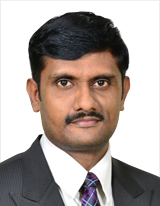
Dr. Prakasha G S is an Assistant Professor at School of Education, Christ University, Bangalore, India. He has 20 years of teaching and research experience in Education. He is the PhD programme coordinator of the department. He is the Consultant for school of education at Christ consulting group. He is also the Coordinator for Human resource development Centre, Deanery of Social Sciences. He is the member of Board of studies, Think-tank, Curriculum cell, and Faculty coordinator for UN academic Impact.
He was the Project Director of Radio-Namaste - a faculty and student exchange project on Indo-Swiss education in collaboration with Switzerland’s Teacher education University (hep, Vaud) and Christ University, from 2017 to 2019.
He completed his Master’s in Education from RIE, Mysore. PhD from Bangalore University. He has cleared National eligibility test (NET) and awarded junior research fellowship (JRF) in 2009. In 2017, he obtained IB Teaching certificate in DP and MYP from DePaul Univ
EDUCATION
MSc, MEd, MPhil, PhD, PGDGC, NET-JRF
RESEARCH INTERESTS
Teacher Education
Educational Research
Teaching and Learning
ICT
89
Scopus Publications
Scopus Publications
K-12 schools’ campus, food service, and transportation directors’ COVID-19 and current challenges G. S. Prakasha, Trent Grundmeyer, Sivaselwam Arulnesan, S. Thirumalesha, C. S. Gururaja Journal of Education and Learning, 2026 This study examines the COVID-19 experiences of K-12 school campus directors, especially in terms of building and grounds, transportation, and food services from the Midwestern United States. The COVID-19 pandemic has changed to online education mode and implemented safety protocols to ensure equitable access to K-12 education. School directors play a crucial role in United States’s school administration. The researchers used a mixed method research design and purposive sampling. The sample included 9 school-grounds directors, 34 food service directors, and 31 transportation directors. A 5-point Likert-type questionnaire was prepared by the researchers to collect the relevant data for the study. The data were analyzed using descriptive statistics and thematic analysis. While revealing their experiences, various school directors mentioned that key challenges are reliable sources of information for them to work, inequities in resource allocation, finance allocation, and lack of professional training. The survey highlighted the need for several resources, including federal and state funding, teacher professional development programs, and community partnerships that support K-12 education. School directors addressed challenges regarding transportation, buildings, grounds, and food services during COVID-19. The study revealed the need for systemic policy changes and communication resources to create resilient and adaptive learning environments for K-12 education. Eventually, the study recommended that policymakers and educational leaders bring changes to K-12 infrastructure to withstand crises like COVID-19.
Role of breakup distress on perceived academic performance and psychosocial functioning among University students Youth Voice Journal, 2026
SDG-4 in Action: Teachers’ Training in Classroom Pedagogical Practices G S Prakasha, Anthony Kenneth Quality Education for all in Asia Pacific Countries Research Insights Reflections and Initiatives on Sdg 4, 2026 Education has the potential to change the culture of society. It is the education that can change the youth and adults’ mindset in support of achieving all United Nations sustainable development goals (UN SDGs). Since students’ understanding and implementation of the SDGs begins from their schools, teachers should be given considerable training and awareness to be equipped to implement the SDGs in their lesson plans on a regular basis. Nevertheless, teachers must strongly uphold the responsibility of supporting the UN SDGs and then must pass on to the younger generation. Thus, the present chapter aims to suggest teacher activities that can enhance teachers’ understanding of SDGs. It further suggests pedagogical practices for teachers in their regular classroom to develop a deeper understanding and the need for achieving UN SDGs among students. Thus, the present chapter comprises two sections. This chapter presents 14 teacher development activities on SDG-4 target indicators and 13 classroom activities to develop awareness on SDG-4 target indicators among students. The chapter suggests teachers to create activities that can generate critical thinking about sustainability as per the nature of their cohort, class size, context, and the facilities available in their school and immediate surroundings.
SDG-4 Research Insights on SDG-4 Among Asia Pacific Countries G S Prakasha, Anthony Kenneth Quality Education for all in Asia Pacific Countries Research Insights Reflections and Initiatives on Sdg 4, 2026 Educating all is a global movement for years; however, providing education with quality, equity and justice is a matter of concern. Despite United Nations’ (UN) determination to achieve all 17 sustainable development goals (SDGs) by 2030, achieving the SDG-4 has its own challenges. Thus, the present chapter of the volume aims to capture insights from research that has occurred pertaining to SDG-4 since 2015. The study explored research journal databases mostly indexed in Scopus or Web of Science. It did not include findings from any predatory journals. The study revealed significant research works that are conducted to support quality education among Asia Pacific (APAC) countries, viz., India, Japan, Australia, Malaysia, Sri Lanka, the Philippines, South Korea and a few other. Some of the milestones mentioned are nutritious food, health and hygiene, environmental education, inclusivity, climate education, STEM education and robotics. The current chapter suggests that future researchers conduct systematic studies and qualitative research to capture the nuances of SDG-4 implementation across the world.
SDG-4 Education and Sustainable Development: Mapping Initiatives in India G S Prakasha, Malavika Menon Quality Education for all in Asia Pacific Countries Research Insights Reflections and Initiatives on Sdg 4, 2026 This chapter, in keeping with the larger theme of the volume, will present a critical overview of the steps taken by the Indian Government toward the United Nations Sustainable Development Goals (UN SDGs), in particular Goal 4: “Inclusive and equitable quality education and to promote lifelong opportunities for all.” The initiatives are mapped across primary, secondary, higher, and technical education from 2015 to 2024. The chapter looks at policy initiatives, budgetary allocation to education in the Five-Year Plan (2015–2020), infrastructure development, and inclusivity. The Indian state has always been conscious of its responsibility toward education. Through this chapter, the authors can help situate the position of the Indian education system vis-à-vis global indicators like SDGs. Moreover, the chapter will attempt to demonstrate the marked changes in the education system in India in the 21st century. The chapter argues that Indian educational initiatives since independence have prioritized quality, inclusive, and lifelong learning, aligning with the UN Sustainable Development Goals (SDGs) established in 2015. Hence, India had always addressed these concerns systematically, and now, identifying with UN SDGs has a global benchmarking. The chapter begins with a brief introduction of the developmental goals set by the United Nations and discusses its transition from millennium development goals (MDGs) to SDGs. This is followed by an overview of educational landmarks in the short history of India's independence. The last section looks at policy initiatives and legislation across primary, secondary, and higher education, focusing largely on the two decades of the 21st century.
SDG-4 Across the Asia Pacific Countries: The Way Forward G S Prakasha, Hideki Maruyama Quality Education for all in Asia Pacific Countries Research Insights Reflections and Initiatives on Sdg 4, 2026 This chapter will describe the future directions toward achieving SDG-4 targets put forth by the United Nations 2030 Agenda in 2015. This chapter would provide a summary of each of the selected Asia Pacific (APAC) countries present status on quality education and an individual plan that needs attention and immediate action. Furthermore, throws light on utilizing artificial intelligence (AI) in enhancing the quality of education. Future education will certainly have AI-enabled systems in place to educate the 21st-century learners. The chapter will provide a forecast of future requirements and the timeline to achieve the SDG-4 target indicators as envisioned by the UN at the beginning. This chapter takes the analytical and critical approach to inform the respective stakeholders of the APAC countries to march forward in achieving the set target by 2030.
Preface Quality Education for all in Asia Pacific Countries Research Insights Reflections and Initiatives on Sdg 4, 2026
Training Secondary School Teachers In 21st-Century Skills: A Systematic Review Nirmala Sebastin Horta, Anjali Majumdar, Anuradha Sathiyaseelan, Prakasha GS TEM Journal, 2026 The present study on systematic literature review aimed to identify the studies on secondary school teachers training in developing 21stcentury skills. Teaching skills in the recent decades underwent multidimensional changes and teacher training pertaining these changes are less visible in academia. Thus, present study aimed to review the studies on teacher training for 21st-century skills between 2007 and 2024. The study reviewed articles from Scopus, Eric, and EBSCO databases utilising PRISMA framework and analysed the same using JBI appraisal tool. The findings revealed from the finally obtained 31 articles that, teachers were trained on problem-solving, critical thinking, creativity, collaboration, information and technology integration skills using various strategies. The reviews highlighted the importance of developing a training to support skills of 21st-century based on constructivist and experiential theories. Further studies may focus on enhancing such training to a larger scale and to hold quality training hours.
Quality Education for All in Asia-Pacific Countries: Research Insights, Reflections and Initiatives on SDG-4 Quality Education for all in Asia Pacific Countries Research Insights Reflections and Initiatives on Sdg 4, 2026
Mental Health Diya Mariam Chacko, Rituparna Chakraborty, G.S. Prakasha Health and Healthcare Systems A Global View, 2025
M. Anand, G. Devi, S. Gokul Raghavendra, G. S. Prakasha, and T. Lakshmanan , "A critical study on acetylene as an alternative fuel for transportation", AIP Conference Proceedings 2396, 020005 (2021)
G S Prakasha, Rituparna Chakraborty, and Anthony Kenneth , "Energy saving, waste management, and pollution free steps for university campuses", AIP Conference Proceedings 2396, 020021 (2021)