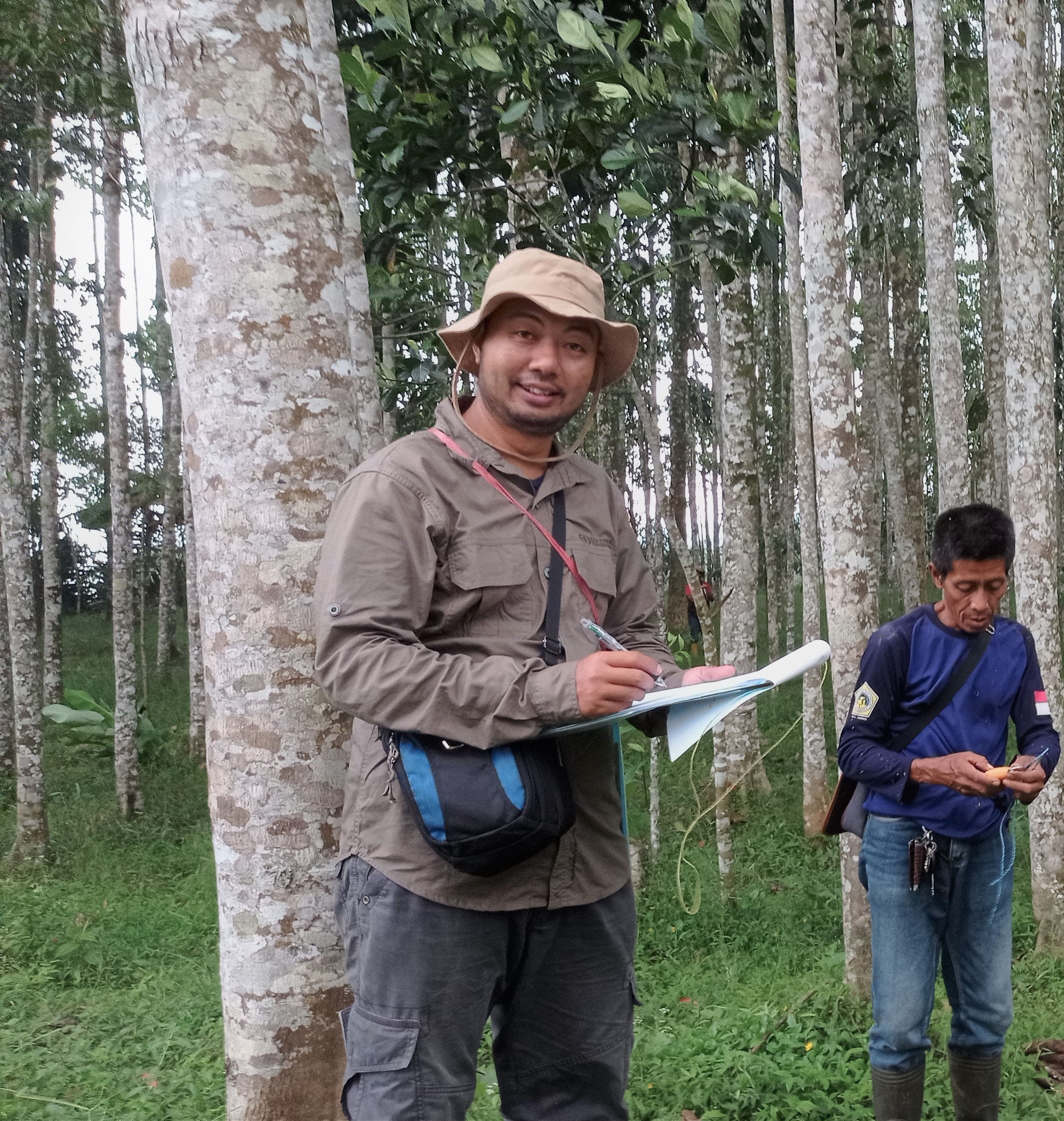
Mohamad Siarudin

Verified @yahoo.com

Research Center for Ecology and Ethnobiology
National Research and Innovation Agency (BRIN), Indonesia

Mohamad Siarudin
Mohamad Siarudin is a researcher at the Ministry of Environment and Forestry, Republic of Indonesia. His research focuses on agroforestry, climate change, tree structure and growth.

EDUCATION

Doctor of Forest Science, Gadjah Mada University, Yogyakarta, Indonesia
Master of Media and Governance, at Keio University, Fujisawa Campus, Japan
Master of Science, Magister of Regional and City Planning, Institut Teknologi Bandung, Indonesia
Bachelor of Science in Forestry, Faculty of Forestry, Gadjah Mada University, Yogyakarta, Indonesia

RESEARCH INTERESTS

Agroforestry, climate change, carbon accounting, forest structure and growth, biomass energy
19

Scopus Publications

916

Scholar Citations

16

Scholar h-index

22

Scholar i10-index

Scopus Publications

  • Wooden Materials as Alternative for Reduced Embodied Energy and CO2 in Residential Buildings in Indonesia
    Diego Alvarez, Tetsu Kubota, Hanief Sani, Usep Surahman, Mohamad Siarudin
    Iop Conference Series Earth and Environmental Science, 2026
    The building sector is responsible for 39% of GHG emissions resulting from the world energy consumption and for 25% of the residues worldwide, thus, any effort in tackling its environmental impact is important for climate change adaptation. Wood offers more sustainable building materials, and unlike reinforced concrete (RC) or steel, wood production and use require less energy and release less CO 2 . This research analyzes the environmental benefits of Glulam (Glue-laminated timber) and wooden materials for residential construction in Indonesia, studying three building scenarios: a conventional study case (RC), a “hybrid” scenario, and a “wooden” scenario. Building Information Modeling (BIM) was used to calculate the bill of quantities (BoQ), then, embodied energy (EE) and embodied CO 2 (ECO 2 ) emissions among the three scenarios were compared, using a hybrid-based input-output (I-O) analysis utilizing the latest available national level Indonesian I-O 2024, and data from an Indonesian Glulam manufacturer. This study found an EE & ECO 2 decrease of around 16% in the hybrid scenario, and 31% in the wooden scenario, when compared with conventional construction. Using Glulam and wooden materials contributed to foundation material optimization and the best alternative for biogenic carbon storage was domestic species, which stored more carbon than imported alternatives.
  • Assessing the sustainability of Sengon (Falcataria moluccana) community forests in West Java, Indonesia: insights from litter dynamics and nutrient contributions
    Edy Junaidi, Aditya Hani, Aris Sudomo, Ary Widiyanto, Mohamad Siarudin, Endah Suhaendah, Wuri Handayani, Ahmad Junaedi, Dona Octavia, Adisti Permatasari Putri Hartoyo
    Forest Science and Technology, 2026
    Sengon (Falcataria moluccana)-based community forests are widely promoted in Indonesia for their rapid growth and economic value. However, understanding of their litter dynamics and nutrient contributions to soil fertility remains limited. This study aimed to evaluate litter production, decomposition rates, and nutrient (C, N, P, K) returns across an altitudinal gradient and varying planting distances in West Java, Indonesia. Research was conducted over 12 months, encompassing both dry and wet seasons, using litter traps and litterbags combined with laboratory analyses. Results showed that lower elevations (200–500 m a.s.l.) and wider planting distances (2 m × 4 m) produced the highest litterfall (up to 7.5 t/ha/year) and fastest decomposition rates (k = 3.17 year⁻¹), driven by favorable microclimatic conditions. Annual nutrient returns reached 2.8 t C/ha, 98 kg N/ha, 6 kg P/ha, and 78 kg K/ha, translating into potential fertilizer savings of up to 13,990 kg manure, 212 kg urea, 40 kg SP-36, and 156 kg KCl per hectare per year. These findings underscore the importance of optimizing Sengon site selection and planting configurations to enhance nutrient cycling and reduce dependence on external fertilizers. This approach supports the long-term sustainability of community forest and provides a model for similar tropical agroforestry landscapes.
  • The Potencies of Melaleuca acacioides: A Cajuput Tree Species from Papua, Indonesia
    Ary Widiyanto, Mohamad Siarudin, Aji Winara, Edy Junaidi, Yonky Indrajaya, Ratih Damayanti
    Aip Conference Proceedings, 2025
  • Nonlinear Height-Diameter Models for Anthocephalus macrophyllus in Indonesia
    Yonky Indrajaya, Mohamad Siarudin, Muhammad Abdul Qirom, Arif Nirsatmanto, Sri Sunarti, Noor Khomsah Kartikawati, Anto Rimbawanto, Liliek Haryjanto, Toni Herawan, Asri Insiana Putri, Fajar Lestari, Wawan Halwany, Pamungkas Buana Putra, Dian Pratiwi
    International Journal of Design and Nature and Ecodynamics, 2024
  • Out of the woods: social capital and smallholder dairy farmers' access to state-owned agroforestry lands in West Java, Indonesia
    Rudi Kresna, Aji Winara, Ary Widiyanto, Budiman Achmad, Sanudin, Mohamad Siarudin, Tri Sulistyati Widyaningsih, Dewi Gartika, Dian Diniyati, Agus Ruswandi, Eva Fauziyah, Marcellinus Mandira Budi Utomo, Levina Augusta Geraldine Pieter, Yudha Hadian Nur, Muthya Diana, Hana Riana Permatasari
    Agroforestry Systems, 2024
  • Renewable energy from secondary wood products contributes to local green development: the case of small-scale privately owned forests in Ciamis Regency, Indonesia
    Mohamad Siarudin, San Afri Awang, Ronggo Sadono, Priyono Suryanto
    Energy Sustainability and Society, 2023
    Background Wood biomass from forests is a renewable energy source that has the potential to support global green development. However, the process of traditional firewood extraction and its contribution to the energy supply varies and is usually underrecognized, especially in the local context. Therefore, this study aimed to describe the traditional use and estimate the supply and demand for wood bioenergy from small-scale privately owned forests (SSPF) in Ciamis Regency, West Java Province, Indonesia. Methods The sample location was determined in 3 subdistricts, namely, Sukamantri, Ciamis, and Banjaranyar, which represent the northern, central, and southern regions, respectively. The data were collected through observations on stands, interviews with respondents, key informants from users and business actors of wood in the SSPF, and observations on the processes taking place in the flow and use of biomaterials and firewoods. Results and conclusion Firewood is a secondary product that cannot be separated from the main products along SSPF’s chain of production based on the integration of raw material sources, linkages between actors, and volume sharing. The local knowledge and wisdom entanglements included the identification of the type and quality of firewood, distribution of resource allocation for household and industrial needs, and sharing of firewood for household needs. Although wood biomass contributes to the fulfillment of households and industrial needs of 8.51 million m3, there are indications of an imbalance between the potential supply and the demand for firewood due to its high intensity of use in industries. Therefore, multistakeholder and cross-regional support are needed to achieve sustainable SSPF management and fulfill the self-sufficiency of wood energy.
  • A Chronicle of Indonesia’s Forest Management: A Long Step towards Environmental Sustainability and Community Welfare
    Hunggul Yudono Setio Hadi Nugroho, Yonky Indrajaya, Satria Astana, Murniati, Sri Suharti, Tyas Mutiara Basuki, Tri Wira Yuwati, Pamungkas Buana Putra, Budi Hadi Narendra, Luthfy Abdulah, Titiek Setyawati, Subarudi, Haruni Krisnawati, Purwanto, M. Hadi Saputra, Yunita Lisnawati, Raden Garsetiasih, Reny Sawitri, Indra Ardie Surya Liannawatty Purnamawan Putri, Ogi Setiawan, Dona Octavia, Hesti Lestari Tata, Endang Savitri, Abdurachman, Acep Akbar, Achmad Rizal Hak Bisjoe, Adi Susilo, Aditya Hani, Agung Budi Supangat, Agung Wahyu Nugroho, Agus Kurniawan, Ahmad Junaedi, Andhika Silva Yunianto, Anita Rianti, Ardiyanto Wahyu Nugroho, Asep Sukmana, Bambang Tejo Premono, Bastoni, Bina Swasta Sitepu, Bondan Winarno, Catur Budi Wiati, Chairil Anwar Siregar, Darwo, Diah Auliyani, Diah Irawati Dwi Arini, Dian Pratiwi, Dila Swestiani, Donny Wicaksono, Dony Rachmanadi, Eko Pujiono, Endang Karlina, Enny Widyati, Etik Erna Wati Hadi, Firda Mafthukhakh Hilmya Nada, Fajri Ansari, Fatahul Azwar, Gerson Ndawa Njurumana, Hariany Siappa, Hendra Gunawan, Hengki Siahaan, Henti Hendalastuti Rachmat, Heru Dwi Riyanto, Hery Kurniawan, Ika Heriansyah, Irma Yeny, Julianus Kinho, Karmilasanti, Kayat, Luthfan Meilana Nugraha, Luthfi Hanindityasari, Mariana Takandjandji, Markus Kudeng Sallata, Mawazin, Merryana Kiding Allo, Mira Yulianti, Mohamad Siarudin, Muhamad Yusup Hidayat, Muhammad Abdul Qirom, Mukhlisi, Nardy Noerman Najib, Nida Humaida, Niken Sakuntaladewi, Nina Mindawati, Nining Wahyuningrum, Nunung Puji Nugroho, Nur Muhamad Heriyanto, Nuralamin, Nurhaedah Muin, Nurul Silva Lestari, Oki Hidayat, Parlin Hotmartua Putra Pasaribu, Pratiwi, Purwanto, Purwanto Budi Santosa, Rahardyan Nugroho Adi, Ramawati, Ratri Ma’rifatun Nisaa, Reni Setyo Wahyuningtyas, Resti Ura, Ridwan Fauzi, Rosita Dewi, Rozza Tri Kwatrina, Ryke Nandini, Said Fahmi, Sigit Andy Cahyono, Sri Lestari, Suhartono, Sulistya Ekawati, Susana Yuni Indriyanti, Tien Wahyuni, Titi Kalima, Tri Atmoko, Tri Rizkiana Yusnikusumah, Virni Budi Arifanti, Vivi Yuskianti, Vivin Silvaliandra Sihombing, Wahyu Catur Adinugroho, Wahyudi Isnan, Wanda Kuswanda, Wawan Halwany, Wieke Herningtyas, Wuri Handayani, Yayan Hadiyan, Yulizar Ihrami Rahmila
    Land, 2023
    Indonesia is the largest archipelagic country in the world, with 17,000 islands of varying sizes and elevations, from lowlands to very high mountains, stretching more than 5000 km eastward from Sabang in Aceh to Merauke in Papua. Although occupying only 1.3% of the world’s land area, Indonesia possesses the third-largest rainforest and the second-highest level of biodiversity, with very high species diversity and endemism. However, during the last two decades, Indonesia has been known as a country with a high level of deforestation, a producer of smoke from burning forests and land, and a producer of carbon emissions. The aim of this paper is to review the environmental history and the long process of Indonesian forest management towards achieving environmental sustainability and community welfare. To do this, we analyze the milestones of Indonesian forest management history, present and future challenges, and provide strategic recommendations toward a viable Sustainable Forest Management (SFM) system. Our review showed that the history of forestry management in Indonesia has evolved through a long process, especially related to contestation over the control of natural resources and supporting policies and regulations. During the process, many efforts have been applied to reduce the deforestation rate, such as a moratorium on permitting primary natural forest and peat land, land rehabilitation and soil conservation, environmental protection, and other significant regulations. Therefore, these efforts should be maintained and improved continuously in the future due to their significant positive impacts on a variety of forest areas toward the achievement of viable SFM. Finally, we conclude that the Indonesian government has struggled to formulate sustainable forest management policies that balance economic, ecological, and social needs, among others, through developing and implementing social forestry instruments, developing and implementing human resource capacity, increasing community literacy, strengthening forest governance by eliminating ambiguity and overlapping regulations, simplification of bureaucracy, revitalization of traditional wisdom, and fair law enforcement.
  • Mainstreaming Ecosystem Services from Indonesia’s Remaining Forests
    Hunggul Yudono Setio Hadi Nugroho, Fitri Nurfatriani, Yonky Indrajaya, Tri Wira Yuwati, Sulistya Ekawati, Mimi Salminah, Hendra Gunawan, Subarudi Subarudi, Markus Kudeng Sallata, Merryana Kiding Allo, Nurhaedah Muin, Wahyudi Isnan, Indra Ardie Surya Liannawatty Purnamawan Putri, Retno Prayudyaningsih, Fajri Ansari, Mohamad Siarudin, Ogi Setiawan, Himlal Baral
    Sustainability Switzerland, 2022
    With 120 million hectares of forest area, Indonesia has the third largest area of biodiversity-rich tropical forests in the world, and it is well-known as a mega-biodiversity country. However, in 2020, only 70 percent of this area remained forested. The government has consistently undertaken corrective actions to achieve Sustainable Development Goal targets, with a special focus on Goals #1 (no poverty), #2 (zero hunger), #3 (good health and well-being), #7 (affordable and clean energy), #8 (decent work and economic growth), #13 (climate action), and #15 (life on land). Good environmental governance is a core concept in Indonesia’s forest management and includes mainstreaming ecosystem services as a framework for sustainable forest management. This paper analyzes efforts to mainstream Indonesia’s remaining forest ecosystem services. We review the state of Indonesia’s forests in relation to deforestation dynamics, climate change, and ecosystem service potential and options and provide recommendations for mainstreaming strategies regarding aspects of policy, planning, and implementation, as well as the process of the articulation of ecosystem services and their alternative funding.
  • Assessing the Productivity and Socioeconomic Feasibility of Cocoyam and Teak Agroforestry for Food Security
    Aji Winara, Eva Fauziyah, Suhartono, Ary Widiyanto, Sanudin, Aris Sudomo, Mohamad Siarudin, Aditya Hani, Yonky Indrajaya, Budiman Achmad, Dian Diniyati, Wuri Handayani, Endah Suhaendah, Dewi Maharani, Dila Swestiani, Murniati, Tri Sulistyati Widyaningsih, Harry Budi Santoso Sulistiadi, Chotimatul Azmi, Rini Rosliani, Meksy Dianawati, Cheppy Syukur, Dewi Gartika, Agus Ruswandi, Yudha Hadian Nur, Muthya Diana
    Sustainability Switzerland, 2022
    Limited agricultural land areas combined with increasing demands for food require breakthroughs in land use development using agroforestry systems. Intercropping root crops with trees could be an alternative for food production in forest areas. This study aimed to assess the feasibility of cocoyam (Xanthosoma sagittifolium (L.) Schott) farming on dry land within 12- and 42-year-old teak (Tectona grandis L.f.) forests to support local food security. The feasibility assessment took into account both productivity and socio-economic aspects. The agroforestry land productivity was measured using the land equivalent ratio (LER), and our analysis of the cocoyam farming within the teak stands was carried out using the revenue/cost ratio (R/C) at the demonstration plot scale. Furthermore, we also surveyed farmers’ perceptions of the production of cocoyam for food security. The results showed that the R/C values of cocoyam tuber production in agroforestry systems were lower than 1. However, the production rates of cocoyam tubers in the 12-year-old teak stand (48.3% light intensity) and the 42-year-old teak stand (62.5% light intensity) were 2.64 and 2.76 tons/ha, respectively. The overall yields from the teak and cocoyam agroforestry systems were more profitable than those of the monoculture system, as indicated by the LER values of 1.61 and 1.85. Cocoyam production was socially acceptable (77% of respondents) as a smallholder subsistence agroforestry practice to meet food demand. Increasing cocoyam productivity in teak forests requires the adoption of agroforestry silvicultural technology to achieve food security for rural communities. To increase their farming production and income, farmers could apply intensive silvicultural practices. Governmental support that could be provided includes encouraging product diversification and providing assistance for the processing and marketing of cocoyam products.
  • The Dynamic of Functional Microbes Community Under Auri (Acacia auriculiformis Cunn. Ex Benth) Agroforestry System
    E Widyati, , M Siarudin, Y Yonky Indrajaya
    Jurnal Manajemen Hutan Tropika, 2022
    Microbes are important rhizosphere constituents for providing nutrients in the soil. This study analyzes the dynamic of soil functional microbes' populations on land managed as an agroforestry (AF) system. The AF system consists of a 2-years old auri tree combined with several crops, i.e., wild grasses, peanuts (Arachis hypogaea), pigeon pea (Cajanus cajan), and maize (Zea mays). Soil samples were collected from each rhizosphere and then analyzed for their chemical properties such as N, P, K, pH, and C organic contents. The population of functional microbes was observed by isolation of the non-symbiotic N-fixer microbes (BNF), the cellulose-degrading microbes (CDM), and the phosphate solubilizing microbes (PSM) in their selective media. The total soil sugars were also tested for root exudates. The results showed that in an auri agroforestry system, the kind of crops determines the content of the soil organic material that is turned-offer into the soil. This affects the population structure and functional microbial abundance in the rhizosphere. Furthermore, microbial colonization in the rhizosphere affects plants in producing root exudates. Then, root exudates shape the structures of the microbial community, as well as an influence among inhabitants in defining mineralization of soil organic matter, nutrient availability, and trees performance.
  • Traditional Subsistence Farming of Smallholder Agroforestry Systems in Indonesia: A Review
    Budiman Achmad, Sanudin, Mohamad Siarudin, Ary Widiyanto, Dian Diniyati, Aris Sudomo, Aditya Hani, Eva Fauziyah, Endah Suhaendah, Tri Sulistyati Widyaningsih, Wuri Handayani, Dewi Maharani, Suhartono, Maria Palmolina, Dila Swestiani, Harry Budi Santoso Sulistiadi, Aji Winara, Yudha Hadian Nur, Muthya Diana, Dewi Gartika, Agus Ruswandi
    Sustainability Switzerland, 2022
  • The Pattern Recognition of Small-Scale Privately-Owned Forest in Ciamis Regency, West Java, Indonesia
    Siarudin Mohamad, San Afri Awang, Ronggo Sadono, Priyono Suryanto
    Forest and Society, 2022
  • Tropical Forest Landscape Restoration in Indonesia: A Review
    Yonky Indrajaya, Tri Wira Yuwati, Sri Lestari, Bondan Winarno, Budi Hadi Narendra, Hunggul Yudono Setio Hadi Nugroho, Dony Rachmanadi, Pratiwi, Maman Turjaman, Rahardyan Nugroho Adi, Endang Savitri, Pamungkas Buana Putra, Purwanto Budi Santosa, Nunung Puji Nugroho, Sigit Andy Cahyono, Reni Setyo Wahyuningtyas, Retno Prayudyaningsih, Wawan Halwany, Mohamad Siarudin, Ary Widiyanto, Marcellinus Mandira Budi Utomo, Sumardi, Aji Winara, Tien Wahyuni, Daniel Mendham
    Land, 2022
  • The tradition of farming in the State Forest Area: Lesson learned from Batulanteh's Production Forest Management Unit, West Nusa Tenggara Province
    B Achmad, D Diniyati, M Siarudin
    Iop Conference Series Earth and Environmental Science, 2021
  • Carbon sequestration potential of agroforestry systems in degraded landscapes in west Java, Indonesia
    Mohamad Siarudin, Syed Ajijur Rahman, Yustina Artati, Yonky Indrajaya, Sari Narulita, Muhammad Juan Ardha, Markku Larjavaara
    Forests, 2021
  • Preliminary assessment on above ground carbon stock of agroforestry and monoculture crop systems in peatlands
    M Siarudin, Y Indrajaya, A Hani
    Iop Conference Series Earth and Environmental Science, 2020
  • Adaptation and productivity of kaliandra for biomass energy source
    M Siarudin, Y Indrajaya
    Iop Conference Series Earth and Environmental Science, 2020
  • Biomass estimation model for small diameter Auri tree (Acacia auriculiformis A. Cunn. ex Benth.)
    M Siarudin, Y Indrajaya
    Iop Conference Series Earth and Environmental Science, 2019
  • Traditional cropping pattern and management of home garden: Lesson learnt from Ciamis Regency, West Java Province, Indonesia
    M Siarudin
    Iop Conference Series Earth and Environmental Science, 2019

RECENT SCHOLAR PUBLICATIONS

  • Wooden Materials as Alternative for Reduced Embodied Energy and CO 2 in Residential Buildings in Indonesia
    D Alvarez, T Kubota, H Sani, U Surahman, M Siarudin
    IOP Conference Series: Earth and Environmental Science 1582 (1), 012089 , 2026
    2026
  • Assessing the sustainability of Sengon ( Falcataria moluccana ) community forests in West Java, Indonesia: insights from litter dynamics and nutrient contributions
    E Junaidi, A Hani, A Sudomo, A Widiyanto, M Siarudin, E Suhaendah, ...
    Forest Science and Technology 22 (1), 50-68 , 2026
    2026
  • The potencies of Melaleuca acacioides : A Cajuput tree species from Papua, Indonesia
    A Widiyanto, M Siarudin, A Winara, E Junaidi, Y Indrajaya, R Damayanti
    AIP Conference Proceedings 3172 (1), 020035 , 2025
    2025
  • Nonlinear Height-Diameter Models for Anthocephalus macrophyllus in Indonesia
    Y Indrajaya, M Siarudin, MA Qirom, A Nirsatmanto, S Sunarti, ...
    International Journal of Design and Nature and Ecodynamics 19 (4), 1099-1108 , 2024
    2024
    Citations: 2
  • Out of the woods: social capital and smallholder dairy farmers' access to state-owned agroforestry lands in West Java, Indonesia
    R Kresna, A Winara, A Widiyanto, B Achmad, Sanudin, M Siarudin, ...
    Agroforestry Systems 98 (3), 637-652 , 2024
    2024
  • A chronicle of Indonesia’s forest management: a long step towards environmental sustainability and community welfare
    HYSH Nugroho, Y Indrajaya, S Astana, Murniati, S Suharti, TM Basuki, ...
    Land 12 (6), 1238 , 2023
    2023
    Citations: 30
  • Renewable energy from secondary wood products contributes to local green development: the case of small-scale privately owned forests in Ciamis Regency, Indonesia
    M Siarudin, SA Awang, R Sadono, P Suryanto
    Energy, Sustainability and Society 13 (1), 4 , 2023
    2023
    Citations: 21
  • Pengembangan hutan rakyat sebagai sumber pangan dan energi biomassa di Kabupaten Ciamis, Jawa Barat
    M SIARUDIN
    Universitas Gadjah Mada , 2023
    2023
  • Mainstreaming ecosystem services from Indonesia’s remaining forests
    HYSH Nugroho, F Nurfatriani, Y Indrajaya, TW Yuwati, S Ekawati, ...
    Sustainability 14 (19), 12124 , 2022
    2022
    Citations: 76
  • Assessing the Productivity and Socioeconomic Feasibility of Cocoyam and Teak Agroforestry for Food Security
    A Winara, E Fauziyah, Suhartono, A Widiyanto, A Sudomo, Sanudin, ...
    Sustainability 14 (19), 11981 , 2022
    2022
    Citations: 16
  • The Dynamic of Functional Microbes Community under Auri (Acacia auriculiformis Cunn. Ex Benth) Agroforestry System
    E Widyati, M Siarudin, Y Indrajaya
    Jurnal Manajemen Hutan Tropika 28 (2), 120-128 , 2022
    2022
    Citations: 7
  • Tropical forest landscape restoration in Indonesia: A review
    Y Indrajaya, TW Yuwati, S Lestari, B Winarno, BH Narendra, ...
    Land 11 (3), 328 , 2022
    2022
    Citations: 95
  • The Pattern Recognition of Small-Scale Privately-Owned Forest in Ciamis Regency, West Java, Indonesia
    M Siarudin, SA Awang, R Sadono, P Suryanto
    Forest and Society 6 (1), 104-120 , 2022
    2022
    Citations: 11
  • Tropical forest landscape restoration in Indonesia: A review. Land, 11 (3), 328
    Y Indrajaya, TW Yuwati, S Lestari, B Winarno, BH Narendra, H Nugroho, ...
    2022
    Citations: 9
  • Mainstreaming ecosystem services from Indonesia’s remaining forests. Sustainability, 14 (19), 12124
    H Nugroho, F Nurfatriani, Y Indrajaya, TW Yuwati, S Ekawati, M Salminah, ...
    2022
    Citations: 22
  • LAPORAN PENELITIAN
    AD Sutadian, ST Yuli Budiasih
    2022
  • Traditional Subsistence Farming of Smallholder Agroforestry Systems in Indonesia: A Review
    B Achmad, Sanudin, M Siarudin, A Widiyanto, D Diniyati, A Sudomo, ...
    Sustainability 14 (14), 8631 , 2022
    2022
    Citations: 101
  • The tradition of farming in the State Forest Area: lesson learned from Batulanteh’s Production Forest Management Unit, West Nusa Tenggara Province
    B Achmad, D Diniyati, M Siarudin
    IOP Conference Series: Earth and Environmental Science 917 (1), 012005 , 2021
    2021
    Citations: 1
  • The business analysis of Acacia auriculiformis agroforestry in Batulanteh Forest Management Unit, Sumbawa, West Nusa Tenggara
    YI Yonky, MS Siarudin
    Jurnal Wasian 8 (1), 25-35 , 2021
    2021
    Citations: 3
  • Carbon sequestration potential of agroforestry systems in degraded landscapes in West Java, Indonesia
    M Siarudin, SA Rahman, Y Artati, Y Indrajaya, S Narulita, MJ Ardha, ...
    Forests 12 (6), 714 , 2021
    2021
    Citations: 103

MOST CITED SCHOLAR PUBLICATIONS

  • Carbon sequestration potential of agroforestry systems in degraded landscapes in West Java, Indonesia
    M Siarudin, SA Rahman, Y Artati, Y Indrajaya, S Narulita, MJ Ardha, ...
    Forests 12 (6), 714 , 2021
    2021
    Citations: 103
  • Traditional Subsistence Farming of Smallholder Agroforestry Systems in Indonesia: A Review
    B Achmad, Sanudin, M Siarudin, A Widiyanto, D Diniyati, A Sudomo, ...
    Sustainability 14 (14), 8631 , 2022
    2022
    Citations: 101
  • Tropical forest landscape restoration in Indonesia: A review
    Y Indrajaya, TW Yuwati, S Lestari, B Winarno, BH Narendra, ...
    Land 11 (3), 328 , 2022
    2022
    Citations: 95
  • Mainstreaming ecosystem services from Indonesia’s remaining forests
    HYSH Nugroho, F Nurfatriani, Y Indrajaya, TW Yuwati, S Ekawati, ...
    Sustainability 14 (19), 12124 , 2022
    2022
    Citations: 76
  • A chronicle of Indonesia’s forest management: a long step towards environmental sustainability and community welfare
    HYSH Nugroho, Y Indrajaya, S Astana, Murniati, S Suharti, TM Basuki, ...
    Land 12 (6), 1238 , 2023
    2023
    Citations: 30
  • Karakteristik daun dan rendemen minyak atsiri lima jenis tumbuhan kayu putih
    A Widiyanto, M Siarudin
    Jurnal Penelitian Hasil Hutan 31 (4), 235-241 , 2013
    2013
    Citations: 30
  • Daur finansial hutan rakyat jabon di Kecamatan Pakenjeng, Kabupaten Garut, Jawa Barat
    Y Indrajaya, M Siarudin
    Jurnal Penelitian Hutan Tanaman 10 (4), 28953 , 2013
    2013
    Citations: 26
  • Mainstreaming ecosystem services from Indonesia’s remaining forests. Sustainability, 14 (19), 12124
    H Nugroho, F Nurfatriani, Y Indrajaya, TW Yuwati, S Ekawati, M Salminah, ...
    2022
    Citations: 22
  • Karakteristik dan variasi sifat fisik kayu mangium (Acacia mangium Willd.) pada beberapa jarak tanam dan kedudukan aksial-radial
    M Siarudin, SN Marsoem
    Jurnal Pemuliaan Tanaman Hutan 1 (1), 1-11 , 2007
    2007
    Citations: 22
  • Renewable energy from secondary wood products contributes to local green development: the case of small-scale privately owned forests in Ciamis Regency, Indonesia
    M Siarudin, SA Awang, R Sadono, P Suryanto
    Energy, Sustainability and Society 13 (1), 4 , 2023
    2023
    Citations: 21
  • Daur tebang optimal hutan rakyat gmelina (Gmelina arborea Roxb.) di Tasikmalaya dan Banjar, Jawa Barat, Indonesia
    Y Indrajaya, M Siarudin
    Jurnal Penelitian Sosial dan Ekonomi Kehutanan 12 (2), 111-119 , 2015
    2015
    Citations: 21
  • karakteristik sifat fisik kayu jabon (Anthocephalus cadamba Miq) pada arah longitudinal dan radial
    A Widiyanto, M Siarudin
    Jurnal Hutan Tropis 4 (2), 102-108 , 2016
    2016
    Citations: 20
  • Sifat fisikokimia minyak kayu putih jenis Asteromyrtus brasii
    A Widiyanto, M Siarudin
    Jurnal Penelitian Hasil Hutan 32 (4), 243-252 , 2014
    2014
    Citations: 20
  • Analisis kelayakan finansial pengusahaan minyak kayu putih tradisional di Taman Nasional Wasur, Papua
    Y Indrajaya, A Winara, M Siarudin, E Junaidi, A Widiyanto
    Jurnal Penelitian Sosial dan Ekonomi Kehutanan 10 (1), 29033 , 2013
    2013
    Citations: 19
  • Biomassa lantai hutan dan jatuhan serasah di kawasan mangrove Blanakan, Subang, Jawa Barat
    M Siarudin, E Rachman
    Jurnal Penelitian Hutan dan Konservasi Alam 5 (4), 329-335 , 2008
    2008
    Citations: 19
  • Assessing the Productivity and Socioeconomic Feasibility of Cocoyam and Teak Agroforestry for Food Security
    A Winara, E Fauziyah, Suhartono, A Widiyanto, A Sudomo, Sanudin, ...
    Sustainability 14 (19), 11981 , 2022
    2022
    Citations: 16
  • Karakteristik Penguapan Air Dan Kualitas Minyak Pada Daun Kayu Putih Jenis Asteromyrtus symphyocarpa
    M Siarudin, A Widiyanto
    Jurnal Penelitian Hasil Hutan 32 (2), 139-150 , 2014
    2014
    Citations: 14
  • Pengawetan kayu tisuk (Hibiscus macrophyllus Roxb.) melalui rendaman dingin dengan bahan pengawet boric acid equivalent
    E Suhaendah, M Siarudin
    Jurnal Penelitian Hasil Hutan 32 (2), 103-110 , 2014
    2014
    Citations: 13
  • Pengaturan Hasil Agroforestry Jabon (Neolamarckia Cadamba Miq.) dan Kapulaga (Amomum Compactum) di Kecamatan Pakenjeng, Garut, Jawa Barat
    Y Indrajaya, M Siarudin
    Jurnal Penelitian Sosial dan Ekonomi Kehutanan 12 (2), 29149 , 2015
    2015
    Citations: 12
  • The Pattern Recognition of Small-Scale Privately-Owned Forest in Ciamis Regency, West Java, Indonesia
    M Siarudin, SA Awang, R Sadono, P Suryanto
    Forest and Society 6 (1), 104-120 , 2022
    2022
    Citations: 11