@siu.edu.in
Assistant Professor Academic Level 12 7th Pay CPC
Symbiosis International Deemed University
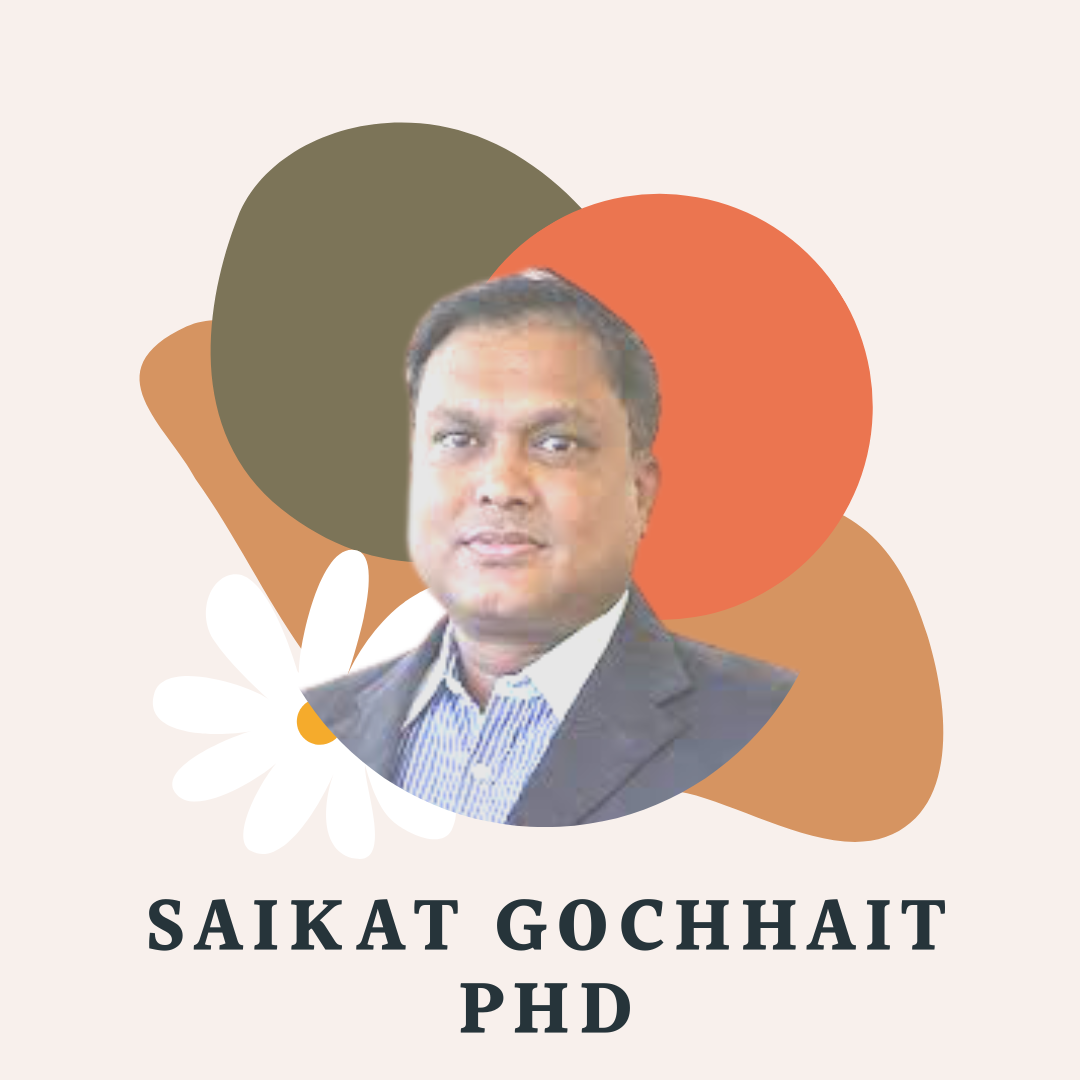
Dr. Saikat Gochhait teaches at Symbiosis Institute of Digital & Telecom Management, Symbiosis International Deemed University Pune, India and Neurosciences Research Institute-Samara State Medical University, Russia. He is Ph.D and Post-Doctoral Fellow from the UEx, Spain and National Dong Hwa University, Taiwan. He was Awarded DITA and MOFA Fellowship in 2017 and 2018. His research publication with foreign authors is indexed in Scopus, ABDC, and Web of Science. He is a Senior IEEE member.
Post Doctoral Fellow - Uex, Spain
Post Doctoral Fellow - National Dong Hwa University, Taiwan
PhD - Sambalpur University
Technology Management
Marketing
Healthcare
Entrepreneurship
NeuroMarketing
Women Entrepreneurs
Scopus Publications
Scholar Citations
Scholar h-index
Scholar i10-index
Saikat Gochhait, Irina Leonova, Prabha Kiran, Ayodeji Olalekan Salau, Aitizaz Ali, and Tin Tin Ting
BON VIEW PUBLISHING PTE
Brainwave neurofeedback mediated by electroencephalography (EEG) has a high potential in influencing brainwave activity, which is linked to cognitive functions such as attention, stress regulation, and motor learning. Nevertheless, the exact changes in brainwave frequencies, such as those in the sensorimotor regions (C3, C4) during neurofeedback tasks, have not been well addressed. The present research compares EEG brainwave patterns between the resting baseline and the neurofeedback task to clarify the neural dynamics underlying cognitive engagement. Such findings can contribute to developing more efficient neurofeedback protocols for cognitive enhancement and mental health treatments. Twenty healthy individuals (age 18–40 years) with no neurological conditions or prior exposure to neurofeedback were enrolled. EEG was recorded in a 5-minute resting baseline and a 10-minute neurofeedback session aimed at attention, mental workload, and stress regulation. Specifically, the brainwave was decomposed into five frequency bands including Delta (1–4 Hz), Theta (4–8 Hz), Alpha (8–12 Hz), Beta (13–30 Hz), and Gamma (30–50 Hz) and analyzed by the joint application of advanced deep learning algorithms, such as the 1D Convolutional Neural Networks (1D-CNN) and Bidirectional Long Short-Term Memory network (BI-LSTM). These results also underscore the differential role that Alpha, Beta, and Gamma waves play in neurofeedback, supporting improved attention, and cognitive workload regulation, whereas Theta and Delta remained essentially unchanged. Received: 24 February 2025 | Revised: 27 May 2025 | Accepted: 19 June 2025 Conflicts of Interest The authors declare that they have no conflicts of interest to this work. Data Availability Statement Data are available from the corresponding author upon reasonable request. Author Contribution Statement Saikat Gochhait: Conceptualization, Methodology, Software, Validation, Formal analysis, Data curation, Project administration. Irina Leonova: Investigation. Prabha Kiran: Resources. Ayodeji Olalekan Salau: Writing - original draft. Aitizaz Ali: Writing - review & editing, Visualization, Supervision. Tin Tin Ting: Writing - review & editing, Visualization, Supervision, Funding acquisition.
Shalini Tripathi, Saikat Gochhait, and Prabakaran Raghavendran
IGI Global Scientific Publishing
Neuromarketing, an interdisciplinary field merging neuroscience and marketing, aims to understand consumer behavior by examining the neural processes behind decision-making and preferences. This paper explores the potential and challenges of neuromarketing, which, by using tools like fMRI and EEG, uncovers subconscious responses to marketing stimuli that traditional research methods often miss. Neuromarketing offers businesses the chance to make data-driven decisions in product design, advertising, and brand management, enabling more tailored and effective marketing strategies. However, the field faces ethical issues related to consumer privacy, the manipulation of subconscious preferences, and substantial financial and technical barriers, which hinder widespread adoption. Despite these concerns, neuromarketing holds the promise of enhancing consumer insight and fostering ethically responsible advertising when used thoughtfully. Recognizing both the opportunities and limitations of this field is crucial for businesses in today's market.
Shaji Joseph, Anil Jadhav, Saikat Gochhait, and Ayodeji Olalekan Salau
Springer Science and Business Media LLC
Hashmat Fida, Harsh Sadawarti, Binod Kumar Mishra, Ashaq Hussain Bhat, Saikat Gochhait, and Sami Alshmrany
Springer Science and Business Media LLC
Prabakaran Raghavendran, Saikat Gochhait, and Tharmalingam Gunasekar
MyJove Corporation
Saikat Gochhait, Renuka Lenka, and Aidin Salamzadeh
Uniwersytet Ekonomiczny w Krakowie - Krakow University of Economics
Amitesh Prakash, Saikat Gochhait, Prabakaran Raghavendran, and Tharmalingam Gunasekar
IGI Global
Modern simulation models of virtual reality (VR) and augmented reality (AR) are, at present, enhancing medical education. Users can engage structures in real-time 3D interaction using virtual reality. Advanced technologies in haptics, display systems, and motion detection help the user to achieve an experience of realism with interactive features; hence VR is best suited for practical procedures training. As such, applications of VR are found more in surgeries and other interventional procedures. The application of AR allows for the modification or augmentation of the physical environment by combining virtual data and structures with physical objects. It seems useful to have AR applications as an integral part of our knowledge concerning physiological and anatomical processes. Numerous VR and AR applications using various hardware platforms and in diverse settings have been the subject of experiments aiming to prove their realism and didactic value. Some history of VR AR in medicine can be found in this chapter, and some guide ideals and norms rule them.
Prakash Chand Thakur, Dinesh Thakur, Tharmalingam Gunasekar, Prabakaran Raghavendran, and Saikat Gochhait
IGI Global
This paper presents a cryptographic framework that incorporates the Anuj Transform and the congruence modulo operator to improve data security and allow for efficient information retrieval. The methodology, based on the mathematical properties of the Anuj Transform and its inverse, is used in designing strong encryption and decryption techniques. The additional security of encrypted messages is assured by the incorporation of the congruence modulo operator. Comprehensive analyses are carried out through graphs and evaluations over the principal parameters: encryption precision, computing speed, resistance, scalability. The outcome shows how well the Anuj Transform coupled with the congruence modulo operator can really help to face modern problems within cryptography.
Saikat Gochhait
IGI Global
Although online social platforms are vulnerable to private information leakage, third parties can still do want with your data easily and consent. With Indeed the rapid spread of information today and changed role for social media, people more commonly worry over privacy. India's Digital Personal Data Protection Act 2023 seeks to cope with this risk by strengthening data protection. The legal framework must evolve constantly to guarantee the privacy and dignity of its recipients, permitting properly informed control over personal information in a world increasingly digital all the time.
Saikat Gochhait and Grace Korter
Institute of Economic Sciences
The Entrepreneurial Quotient (EQ) is a crucial framework for understanding the competencies that drive entrepreneurial success, particularly among women entrepreneurs. This study examines the dimensions of EQ – creativity, risk-taking, resilience, and sustainability, and their impact on technology adoption in contemporary enterprises. Using the Digital Transformation and Technology Adoption Model (DTTAM), the research examines how women entrepreneurs integrate technological innovations into their businesses. A structured survey was conducted from January to June 2020 among 100 women entrepreneurs in India to assess their EQ and its impact on business adaptability. The findings highlight that creativity fosters innovation, risk-taking enhances strategic decision-making, resilience strengthens adaptability, and sustainability ensures long-term business viability. These insights underscore the importance of integrating EQ development into entrepreneurial education through mentorship programs, experiential learning, and sustainability-focused curricula. The study provides actionable recommendations for educators, policymakers, and business leaders seeking to cultivate resilient, innovative, and future-ready enterprises.
Abhijit Vhatkar and Saikat Gochhait
IEEE
Prabakaran Raghavendran, Tharmalingam Gunasekar, and Saikat Gochhait
IEEE
This study examines the emergent interest in accurate Solana price predictions among depositors, buyers, and governmental bodies. Solana, a groundbreaking cryptocurrency known for its reorganized nature, has appealed substantial responsiveness. Applying progressive artificial neural networks (ANN), we aim to projection Solana prices by leveraging their capacity to understand the intricate and impulsive outlines typical of cryptocurrency markets. Our pioneering line of attack encompasses exploring diverse lag conformations over specific time intervals to optimize forecast accuracy and timeliness. Through rigorous validation, focusing on root mean square error as a key performance metric, our ANN model dependably outclasses traditional prediction methods. These findings offer valuable insights for individuals, industries, and governmental bodies directing the intricacies of the cryptocurrency landscape. Furthermore, we introduce an algorithm and provide Python code to determine the execution of our approach for forecasting Solana prices.
Manisha Paliwal, Omkar Jagdish Bapat, and Saikat Gochhait
Philippine Normal University
The field of higher education in India is plagued by various fraudulent institutions and actors who profit at the expense of students and parents, for example, by issuing fake course completion certificates, which adversely affect the quality of teacher education. This paper presents a possible solution in the form of a model in which a digital record of the student's academic progress is created on the blockchain, which is then used to create a non-falsifiable tokenized version of the student's certificate of completion with a QR code-based mechanism that helps to improve the quality of teacher education in the course completion certificate process. Through this model, cases of certificate fraud can be reduced, and confidence in the quality of education that students receive in the institutions can be ensured. Publication History Version of Record online: December 28, 2023 Manuscript accepted: December 19, 2023 Manuscript revised: December 14, 2023 Manuscript received: August 7, 2023
Prabakaran Raghavendran, Tharmalingam Gunasekar, and Saikat Gochhait
European Alliance for Innovation n.o.
This paper examines various types of fractional differential equations using fractional calculus methods. It extends the classical Frobenius method and introduces key theorems that apply the Ramadan Group transform and other techniques. Additionally, the research incorporates machine learning, specifically neural networks, to solve these equations. The paper demonstrates that machine learning can enhance the solution process through data generation, model design, and optimization. Examples provided illustrate how combining traditional methods with machine learning can effectively solve fractional differential equations.
M. Vijai, T. Ananth Kumar, P. Kanimozhi, and Saikat Gochhait
IEEE
Lane detection and tracking are crucial for modern vehicle navigation systems, especially for ADAS and autonomous vehicles. Traditional methods often fail under adverse conditions such as poor lighting, bad weather, and inconsistent road markings. This paper presents a novel approach using YOLOv5, an advanced object detection model known for its real-time performance and accuracy, to detect lane boundaries directly from images. We improved its robustness in challenging scenarios by adapting YOLOv5 for lane detection and introducing innovative post-processing techniques. These techniques include refining lane predictions, handling occlusions, and reducing noise. Extensive experiments on datasets from various conditions (daytime, nighttime, and adverse weather) show that our method outperforms existing approaches. The proposed YOLOv5-based system offers a promising solution for real-world driving challenges, enhancing the precision and dependability of lane recognition and tracking and positively impacting road safety and autonomous vehicle technologies.
Rushali Garg, Anuradha S. Kanade, Prabha Kiran, and Saikat Gochhait
Springer Nature Singapore
Sanjana Umrao, Shamneesh Sharma, Ajay Sharma, Saikat Gochhait, and Mohammed Alandoli
IEEE
Revuri Jaswanth, S Rakesh Kumar, N Gayathri, Saikat Gochhait, and Mohammed Alandoli
IEEE
Shrishti Bajpai, Saikat Gochhait, Prabakaran Raghavendran, Tharmalingam Gunasekar, and Mohammed Alandoli
IEEE
Palla Manoj Babu, Ashish Kumar, P. Venkata Subbaiah, V. Mouneswari, Prabha Kiran, and Saikat Gochhait
Springer Nature Singapore
Samiksha Pedewad, Anjali Thakur, Pradeep Chintale, Gaurav Gupta, Arun Pandiyan Perumal, and Saikat Gochhait
Springer Nature Singapore
Apurva Kale, Gaurav Gupta, Priyanshi Sharma, Piyush Ranjan, Dhruv Seth, and Saikat Gochhait
Springer Nature Singapore
Department of Science and Industrial Research , Govt of India with Grant of Rs 13,000,00
Ministry of Foreign Affairs, Taiwan with Grant of Rs 12,000,00
University of Deusto, Spain with Research Grant of Rs 2,000,00
University of Extremadura, Spain with Research Grant of Rs 2,000,00
Samara State Medical University, Russia with Research Visit grant of Rs 2,500,00
Symbiosis International Deemed University with Travel and Research Grant of 4,000,000
IFGL Refractories Ltd