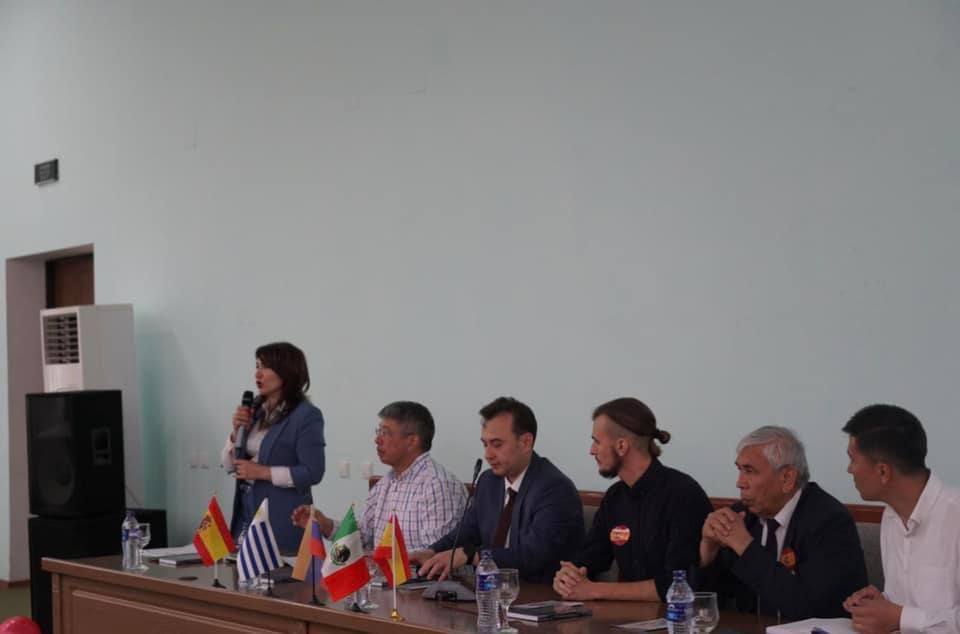
Dilrabo Bakhronova earned her PhD (2017) and Doctor of Science (DSc) (2022) in Spanish and Uzbek languages from the University of Oriental Studies in Tashkent, Uzbekistan. A very Motivating and Talented Spanish, Russian and Uzbek languages Professor driven to inspire students to pursue academic and personal excellence. She is Consistently driven toward extensive research and has an exceptional track record of contributing to various publications. She is Energetic, highly career-oriented, and focused on attaining goals. Her area of interest includes Linguocognitive and Culture studies, Sociolinguistics. She has over 23 years of teaching and research experience. Organized a National Workshop on Publishing Manuscript in 2021 with the Universidad Autónoma del Estado de México (UAEMex) and International Conference on "PERSPECTIVE WAYS OF IMPLEMENTATION IN THE EDUCATIONAL PROCESS OF THE ADVANCED EXTERIOR EXPERIENCE IN TEACHING FOREIGN LANGUAGES" in April 2020.
RESEARCH, TEACHING, or OTHER INTERESTS
Arts and Humanities, Language and Linguistics
9
Scopus Publications
Scopus Publications
Security and Privacy Frameworks for Mobile Internet Services in Ubiquitous Computing Environments for Smart Classrooms in Educational Institutions Dilrabo Bakhronova Journal of Wireless Mobile Networks Ubiquitous Computing and Dependable Applications, 2025 In the contemporary learning setting, ubiquitous computing technologies and mobile internet services have radically changed the manner in which smart classrooms are being conducted. Nevertheless, the security and privacy issues of the widespread application of mobile devices and IoT in these settings have become a critical concern. The study will deal with these issues by suggesting all-inclusive security and privacy frameworks in relation to mobile internet services within the educational institutes. The research methodology will involve a critical review of the current security measures and then developing a new security system that will integrate real-time security systems, data encryption procedures, and access control systems. A qualitative and quantitative analysis was used, and the priority was put on such indicators as the integrity of data, system resilience, and user privacy. Experimental testing of the proposed framework was carried out in the simulated smart classroom setting where real-time datasets on the behavior of the devices, communication patterns, and user interactions were performed. The findings suggest that the suggested framework has a beneficial effect on the security and privacy of the mobile internet services, and the cases of the data breach decrease by 40, and the system performance becomes high with minimal latency. The study also ends up with the implications of the findings and creating possible future research directions, including the investigation of state-of-the-art AI-driven security feature in smart classrooms.
Intelligent Information Security System for Language and History Education Using Machine Learning-based Intrusion Detection Algorithm Dilrabo Bakhronova Journal of Internet Services and Information Security, 2025 The recent spread of the internet has led to a significant increase in the use of personal online banking and e-commerce. Operations and marketing inside organizations, government, and banking sectors are experiencing tremendous growth, primarily through online shopping malls and web pages. There is a growing prevalence of cyber-attacks, including sophisticated strikes, unauthorized cyber intrusions, and the compromise of electronic data. Defensive measures, operational exercises, and Information Security (IS) incidents are not implemented effectively. This study uses Machine Learning to establish an Intrusion Detection System (IDS) for language and history education. IS training is being implemented for affiliated staff and educational subjects utilizing the Information Technology (IT) infrastructure to address IS incidents resulting from fraudulent emails and file attachments that commonly arise in government organizations and private enterprises. This approach could preempt IS incidents resulting from phishing emails and mitigate economic losses by averting data loss or system stoppage.
INTERPRETATIONAL POTENTIAL OF CONCEPTUAL METAPHOR IN DIFFERENT SYSTEM LANGUAGES Voprosy Kognitivnoy Lingvistiki, 2025
General Structure of Uzbek Treebank Mukhabbat Kurbanova, Dilrabo Bakhronova International Conference on Computer Science and Engineering Ubmk, 2025
Digital and Innovative Education during the Covid-19 Pandemic: Uzbekistan Dilrabo Bakhronova, Qudratulla Omonov Ecs Transactions, 2022 The pandemic has become a unique test of the power of international cooperation, manifested not only in the exchange of experience on epidemiological and organizational issues, but also in mutual financial, economic, and food assistance among the population. In this regard, it has become clear in Uzbekistan that it is difficult to fully ensure national security, especially human security, by eradicating the coronavirus only within the country. During the pandemic, international organizations provided the necessary assistance to Uzbekistan, and in 2020, $2.7 billion directed by international and foreign financial institutions, such as the Asian Development Bank, the World Bank, and the Japan International Cooperation Agency. The financial institutions will provide health care to fight the pandemic and have allocated $277 million to the storage health sector, sources said. The COVID-19 pandemic in the social context has significantly affected the population due to the great impact that has been generated in all the contexts where the individual develops. Among the problems that can be highlighted due to their level of increase is social inequality, discrimination, exclusion, and violence, among others, being those a reason for people to have effects on their well-being and quality of life. In relation to the aforementioned, this research aimed to analyze COVID-19 in the educational context in Uzbekistan universities and in the methodological context in virtual classes during this pandemic.
The Influence of the National-Cultural Image of the World on the Construction of Metaphors in the Poetic Discourse Dilrabo Bakhronova, Sobir Abduraimov Ecs Transactions, 2022 The poetic language of Federico García Lorca amazes the reader’s imagination with the richness of images with the outward simplicity and clarity of style. Lorca’s poems simultaneously reveal to us both the national and cultural specifics of the Spanish linguistic picture of the world, and the ways of cognition and reflection of reality by the author, his assessment of the phenomena of this reality from the standpoint of the aesthetic ideal. One of the ‘keys’ of the secret of the phenomenal success of Lorca’s poetry is its metaphor city, the semantic aesthetics of which is revealed only in the context of not only the poems themselves, but also in the context of Spanish culture as a whole. The metaphor, we emphasize once again, is one of the most mysterious phenomena of language, the intuitive comprehension of which is inherent only in true poets. In a metaphor, reality escapes, as if hiding from thought, and then a deep and urgent question begins to arise before the researcher about the role of metaphor in cognition. In the work of Federico Garcia Lorca, the ability of metaphor to clearly reveal the features of national culture characterizes the Spanish linguistic consciousness and the Spanish linguistic personality. The humanities are armed with modern scientific research tools at the present stage of development and lay the foundation for studying the role of metaphor in understanding the essence of Federico Garcia Lorca's work, as well as its relationship and interaction with reality, thinking and consciousness.
Axiological evaluation as the base of knowledge and cultural research of Spanish and Uzbek languages International Journal of Recent Technology and Engineering, 2019 Language and speech are the main factors in human life. Language is a spiritual wealth which connects all generations, preserves and saves cultural and scientific property created by humanity, furnishing them for the next generation. Developing mutual relations in various spheres among the nations of the world needs new scientific researches in modern spheres and the field of linguistics, such as culture-oriented linguistics, ethno linguistics. All nations in the world have their own national-cultural traditions and customs which is worth studying in order to have successful communication between nations and understanding them.