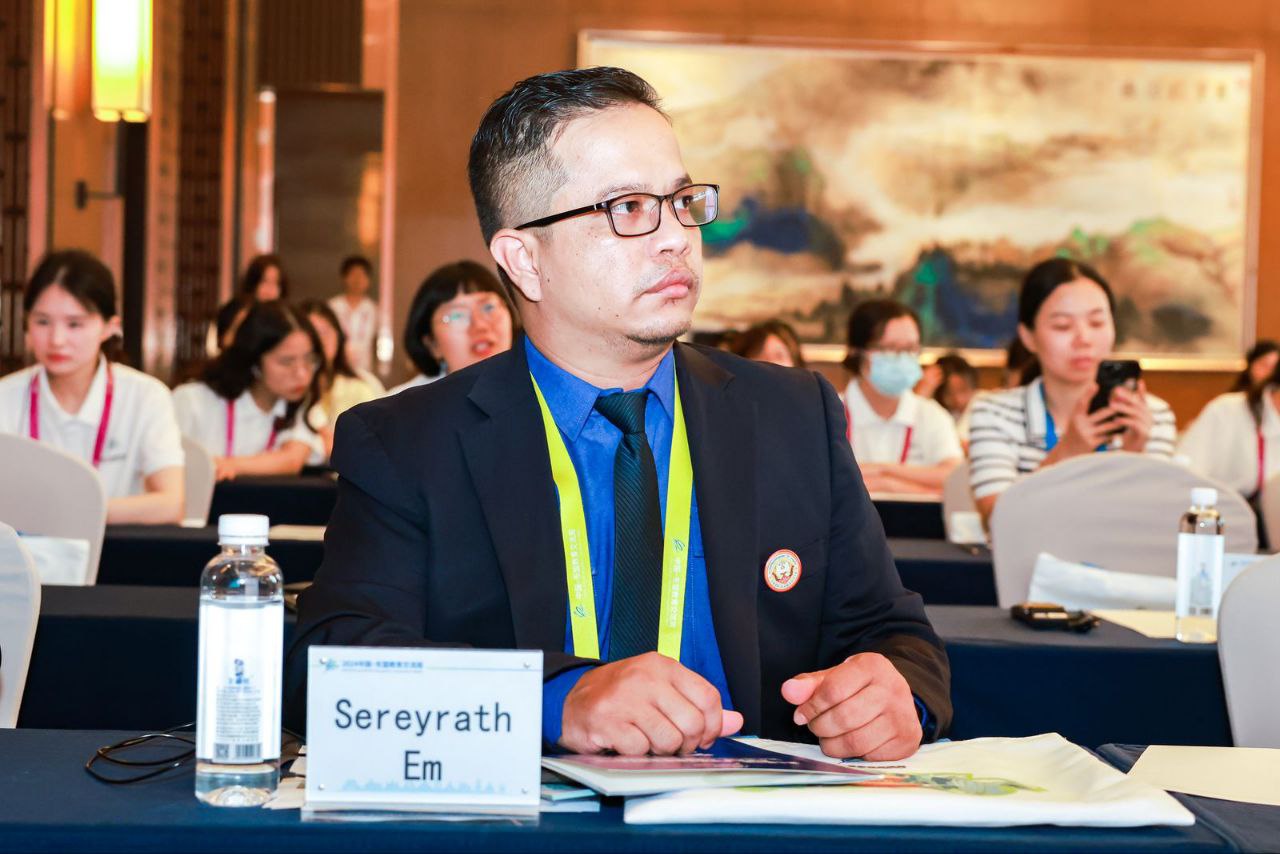
Dr. Sereyrath Em is a Cambodian government teacher of English with a higher education degree, a visiting lecturer at the National University of Cheasim Kamchaymear (NUCK) and some other universities, and an Editor at the Cambodian Journal of Educational Research (CJER). He is also the founder and the Editor-in-Chief of the Cambodian Journal of Educational and Social Sciences (CJESS).
EDUCATION
PhD in Educational Administration
PhD in Educational Science
PhD in Cooperative Education
Impacts of self-esteem and social exposure on English willingness to communicate during internship Narupollawat Hastindra Na Ayudhaya, Paing Soe Oo, Jetnipit Kunchai, Sereyrath Em, Naputsanun Chatchaikulsiri, et al. Discover Psychology, 2026 English proficiency and communication confidence are vital for graduates entering internationalized workplaces. This study investigates how self-esteem and social exposure factors predict Thai university students’ willingness to communicate (WTC) in English during internships. The participants were 312 final-year undergraduate students undertaking internship programs in the workplace. To address the research objectives, structural equation modeling (SEM) was used to examine the effects of self-esteem, father’s education level, number of foreign friends, and time spent using English on social media on students’ WTC in three communication contexts: with strangers, acquaintances, and friends. The findings indicate that self-esteem consistently and significantly predicts WTC across all contexts. On the other hand, social exposure factors, particularly having foreign friends and frequent use of English online, play a more important role in unfamiliar environments, such as communication with strangers. The results support integrated frameworks of second language communication, emphasizing the dynamic interaction between personal and environmental variables. This study contributes to language learning theory and offers practical implications for teachers, educators, and those involved in enhancing students’ self-esteem and promoting authentic language exposure both online and in-person, which can increase their WTC in English.
Harnessing AI to Transform Cambodian Higher Education: Strategies for Building a Future-Ready Curriculum Dina Pen, Sereyrath Em, Rany Sam, Ganda Febri Kurniawan, Mardy Serey AI Education Strategies for Future Proofing Curriculum Design, 2026 This chapter examines the potential of Artificial Intelligence (AI) to revolutionize Cambodian higher education by tackling existing issues and capitalizing on possibilities to develop a future-oriented curriculum. It analyzes the principles of AI technology, international trends in AI education, and the higher education framework in Cambodia, encompassing systemic constraints in funding, quality, and infrastructure. The chapter advocates for strategic initiatives like curriculum reform, faculty development, student participation via AI tools, and collaborations with international institutions and technology firms. This chapter underscores the significance of supportive policies and governance, advocating for the incorporation of AI to improve educational outcomes, foster innovation, and equip Cambodian students for a rapidly evolving, AI-centric future.
Strategic Leadership for Organizational Transformation in Cambodian Higher Education to Support Global Sustainability Goals Morin Tieng, Sokwin Phon, Socheat Suon, Sarith Chiv, Thy Chhit, et al. Strategic Leadership for International Collaboration in Higher Education, 2026 Strategic leadership can help Cambodian universities meet global sustainability goals, especially the UN SDGs. Thus, higher education leaders are becoming more important as Cambodia modernizes its education system to meet national development goals and international norms. Strategic leadership is essential for driving institutional change, innovation, research, academic excellence, effective governance, resource management, and curricular sustainability. This chapter examines how Cambodian university leaders interpret and implement strategic transformation, focusing on financial restrictions, policy enforcement challenges, and leadership competencies. Moreover, the chapter draws on global literature and local trends. Strategic leadership can increase organizational resilience, inclusive education, and national development through sustainability-focused academic projects. Cambodian higher education case studies and legislative changes demonstrate the pros and cons. Finally, leadership development, policy alignment, and sustainable change proposals conclude the chapter.
Cultural Perceptions and Acceptance of Non-Alcoholic Wine in Cambodia Phany Bun, Virak Voan Ratha, Wattanak Non, Sophat Phon, Simeng Lang, et al. Sustainability and Innovation in the Non Alcoholic Wine Industry, 2026 The global beverage industry has new opportunities and challenges from non-alcoholic wine, particularly in areas with minimal wine consumption or culturally specific wine practices. In this regard, Cambodia serves as a compelling case study for the acceptability of non-alcoholic wine among consumers. Specifically, the wine culture is underdeveloped, presenting opportunities for market introduction and cultural barriers. By contrast, beer and spirits prevail in social and cultural behaviors. Therefore, this chapter analyzes Cambodians' acceptance of non-alcoholic wine from cultural, religious, and generational perspectives. Moreover, social interactions, hospitality, and cosmopolitan lives influence Cambodian drinking behaviors, indicating that urban young and middle-class consumers may exhibit interest. In addition, the chapter analyzes the impact of sustainability and innovation on non-alcoholic wine, emphasizing opportunities to advocate for it as a healthier and socially responsible option.
The impact of instructional behaviors on learning motivation via subjective task value in high school students in Cambodia Daro Ruos, Sereyrath Em, Phanommas Bamrungsin, Buratin Khampirat Scientific Reports, 2025 Instructional behavior plays a key role in learning motivation. In many developing countries, students’ learning motivation needs to be restored, primarily through effective teaching. This research investigated the impact of instructional behaviors on learning motivation among high school students in Cambodia, emphasizing the mediating role of subjective task value. This study was conducted in three provinces of Cambodia, and a sample was obtained by convenience sampling. A total of 515 participants (42.72% male and 56.70% female) were lower secondary and high school students. Structural equation modeling (SEM) was applied to test the proposed relationship between the two first-order constructs of instructional behaviors and learning motivation. The results revealed direct positive associations between all of the constructs in the model. Autonomy support was a significant predictor of both subjective task value and intrinsic motivation. Cooperative learning support was significantly associated with only subjective task value and had no direct effect on intrinsic motivation. Conversely, video lecture support positively predicted extrinsic motivation. Additionally, subjective task value played an important role as a mediator of the relationship between autonomy support and cooperative learning support. These results emphasize the importance of developing instructional behaviors to support students’ learning motivation.
Cambodia's Endeavors Toward Research Advancement: Strategies, Challenges, and Policy Responses in Higher Education Sereyrath Em, Mardy Serey Implementing Research Management Policies in Asean Higher Education Institutions, 2025 This chapter examines programs designed to promote research-oriented development in Cambodian higher education and proposes solutions to ensure sustained progress in research. Cambodian universities face substantial obstacles due to their limited capabilities and resources. They have sought to enhance research initiatives through diverse support mechanisms and significantly contribute to national development. Moreover, it is essential to develop academic networks and collaborate with other partners to enhance research. It is essential to cultivate a research-oriented culture among rookie researchers and educators through workshops and training, equipping them to identify and effectively tackle challenges. MoEYS is the principal entity in assisting higher education institutions to augment research capacities. There are significant opportunities for the advancement and enhancement of research in Cambodia. This country faces certain research hurdles; nonetheless, it is capable of overcoming them and significantly influencing research and social progress.
Positioning Cambodian Higher Education: Leveraging Research to Advance in Global University Rankings Mardy Serey, Ganda Febri Kurniawan, Sereyrath Em Implementing Research Management Policies in Asean Higher Education Institutions, 2025 This chapter examines strategic initiatives to elevate the global standing of Cambodian universities in university rankings. Despite the recognition of numerous ASEAN institutions, Cambodian universities are underrepresented owing to insufficient research output, inadequate institutional governance, limited internationalization, and poorly developed graduate programs. The chapter emphasizes the necessity of enhancing research capacity, faculty qualifications, internal quality assurance, and alignment with global ranking metrics, including those established by THE and QS. It underscores the need to cultivate a research culture, promoting international collaboration and aligning institutional plans with global benchmarks. Notwithstanding obstacles, Cambodia possesses the capacity for advancement via strategic reforms, augmented investment, and a long-term commitment to quality in higher education.
Leadership- Driven Faculty Collaboration and Research Capacity Building in ASEAN: Insights From Cambodia Rany Sam, Navin Voeun, Pheaktra Vando, Kanhchakna Vet, Sinath No, et al. Implementing Research Management Policies in Asean Higher Education Institutions, 2025 This chapter responds to Cambodia's primary leadership role in fostering teaching collaboration and professional growth within a system that has barely started acknowledging the significance of collaboration and continuous research capacity development. Faced with the stresses of challenges as disparate as limited resources to teacher experience variation, leaders have managed through interventions intended to foster cooperation through participatory decision-making, communication, and tailored professional learning opportunities. Case interviews and studies indicate that Cambodian university administrators place importance on establishing trust, involving faculty members, researchers, and networking in the sharing of best practices. This collaboration has improved the motivation of faculty members, teaching quality, and student achievement. Limitations of professional development and research capacity building, such as financial, geographic, and cultural differences, are also addressed in this chapter.
Exploring the Motivation for English Reading among Cambodian Undergraduates: A Cross-Sectional Study New English Teacher, 2025
AI in Education R Sam, S Kheuy, H Heak, S Hoeurn, P Phorn, S Kheav, S Em, S No, ... Encyclopedia of Modern Artificial Intelligence, 1-28 , 2027 2027
Developing and validating the WIL-EngDev scale: a measurement tool for assessing English language development in work-integrated learning contexts N Hastindra Na Ayudhaya, PS Oo, S Em, SM Iipinge, P Bamrungsin, ... Language Testing in Asia 16 (1), 18 , 2026 2026
Digital Leadership and Innovation in ASEAN Education S Em IGI Global , 2026 2026
Cultural and Political Impacts on Educational Leadership in ASEAN S Em IGI Global , 2026 2026
Republication of My Work Published Before 2025 S Em CJESS Online Library, 1-12 , 2026 2026
Impacts of self-esteem and social exposure on English willingness to communicate during internship NHN Ayudhaya, PS Oo, J Kunchai, S Em, N Chatchaikulsiri, SM Iipinge, ... Discover Psychology , 2026 2026
The influence of academic leadership styles on school culture within secondary resource schools in Cambodia S Chamraeun, S Mok, M Hor, R Chhun, S Em Journal of General Education and Humanities 5 (2), 2139–2154-2139–2154 , 2026 2026 Citations: 1
Teachers’ self-regulated learning instructional practices: Differences in perception among TVET students in Cambodia C Sok, S Mok, S Som, M Hor, S Em Journal of General Education and Humanities 5 (2), 2121–2138-2121–2138 , 2026 2026
Research Highlight: The Causes of Students’ Dropouts in Cambodia: A Case Study of Darakum Lower-Secondary School S Em CJESS Online Library , 2026 2026
Cultural Perceptions and Acceptance of Non-Alcoholic Wine in Cambodia P Bun, VV Ratha, W Non, S Phon, S Lang, C Ny, S Khen, D Chin, M Serey, ... Sustainability and Innovation in the Non-Alcoholic Wine Industry, 225-276 , 2026 2026
Transformational Leadership Behaviors as Predictors of Teachers' Self-Efficacy and Job Performance S Em, S Suon, VV Ratha, SE Lay, C Ny, M Serey Cultural and Political Impacts on Educational Leadership in ASEAN, 353-380 , 2026 2026
Validation of Research Instruments for Transformational Leadership, Teachers' Self-Efficacy, and Job Performance in Cambodian High Schools S Em, S Mok, R Sam, S Hill, C Pich, S No, M Serey Digital Leadership and Innovation in ASEAN Education, 301-358 , 2026 2026
Strategic Leadership for Organizational Transformation in Cambodian Higher Education to Support Global Sustainability Goals M Tieng, S Phon, S Suon, S Chiv, T Chhit, M Serey, S Em Strategic Leadership for International Collaboration in Higher Education, 75-110 , 2026 2026 Citations: 1
Harnessing AI to Transform Cambodian Higher Education: Strategies for Building a Future-Ready Curriculum D Pen, S Em, R Sam, GF Kurniawan, M Serey AI Education Strategies for Future-Proofing Curriculum Design, 141-170 , 2026 2026
Bridging Equity Gaps: Challenges and Strategies for Inclusive Higher Education in Cambodia S Hill, S Phon, VV Ratha, SE Lay, M Serey, S Em, R Sam Breaking Structural Inequality and Enhancing Social Justice in Higher … , 2026 2026
Cambodia's Endeavors Toward Research Advancement: Strategies, Challenges, and Policy Responses in Higher Education S Em, M Serey Implementing Research Management Policies in ASEAN Higher Education … , 2026 2026
Leadership-Driven Faculty Collaboration and Research Capacity Building in ASEAN: Insights From Cambodia R Sam, N Voeun, P Vando, K Vet, S No, R Hour, S Em, S Sou, S Phuong, ... Implementing Research Management Policies in ASEAN Higher Education … , 2026 2026
Positioning Cambodian Higher Education: Leveraging Research to Advance in Global University Rankings M Serey, GF Kurniawan, S Em Implementing Research Management Policies in ASEAN Higher Education … , 2026 2026
Student and Teacher Perceptions of AI-Supported Mathematics Education: Perspectives From Cambodia R Sam, S No, K Tith, P Chin, S Kheuy, N Thol, V Da, S Em, H Yoeng, ... The Convergence of Mathematics and AI: A New Paradigm in Education, 227-262 , 2026 2026
Cambodian Higher Education and Global University Rankings: Challenges, Aspirations, and Strategic Alignments M Serey, S Em, R Sam, GF Kurniawan Impacts and Outcomes of Global University Rankings, 235-268 , 2026 2026
MOST CITED SCHOLAR PUBLICATIONS
COMMON FACTORS AFFECTING GRADE-12 STUDENTS’SPEAKING FLUENCY: A SURVEY OF CAMBODIAN HIGH SCHOOL STUDENTS T Houn, S Em Jurnal As-Salam 6 (1), 11-24 , 2022 2022 Citations: 69
Challenges of English language learning and teaching in Cambodia: A case study of Kith Meng Brasat High School S Em Cambodian Journal of Educational Research 2 (1), 62-80 , 2022 2022 Citations: 68
Factors causing students’ challenges in learning English speaking skills: A review of empirical works S Em 2024 Citations: 58
Exploring experimental research: Methodologies, designs, and applications across disciplines S Em Cambodian Journal of Educational and Social Sciences (CJESS) 2 (2), 1-8 , 2025 2025 Citations: 57
A review of different ideas concerning the characteristics of a good leader and shaping new ideas of an effective 21st century leader S Em Journal of General Education and Humanities 2 (1), 13-34 , 2023 2023 Citations: 52
Qualities, personal characteristics, and responsibilities of qualified teachers in the 21st century S Em, N Nun, S Phann Cambodian Journal of Educational Research 1 (2), 49-63 , 2021 2021 Citations: 52
Education system in Cambodia: A brief review from the prehistoric period to the present, and an education strategic plan for the future S Em, S Khan, N Nun 2023 Citations: 50
Challenges of online learning during the COVID-19 pandemic: A survey of Cambodian high school students S Em Cambodian Journal of Educational Research 1 (2), 96-108 , 2021 2021 Citations: 46
Cambodian students' motivation in the learning English language: A small-scale survey at a private high school in Phnom Penh S Em, M Yun, B Dorn, V Sao, P Sin Journal of Research on English and Language Learning (J-REaLL) 3 (2), 104-114 , 2022 2022 Citations: 44
COVID-19 and digital transformation of Cambodian higher education: Opportunities, challenges, and the way forward K Heng, K Sol, S Em Handbook of research on education institutions, skills, and jobs in the … , 2023 2023 Citations: 40
Reading motivation to promote students' reading comprehension: A review T Kheang, P Chin, S Em doi 10 , 2024 2024 Citations: 35
Debate: One of the key factors to improving students’ English language speaking skills B Ban, S Pang, S Em Journal of General Education and Humanities 2 (2), 107-120 , 2023 2023 Citations: 34
Cambodian grade-12 students’ perceptions of public English textbook and exam papers S Em, N Nun PROJECT (Professional Journal of English Education) 5 (4), 909-917 , 2022 2022 Citations: 31
CAMBODIAN BUDDHIST MONK STUDENTS’ MOTIVATION IN LEARNING ENGLISH: THE CASE OF HUN NENG BUDDHIST PRIMARY SCHOOL, KAMPONG CHAM TOWN SE P Keo, S Yoeurn, M Prom, P Chin Jurnal As-Salam 6 (2), 105-121 , 2022 2022 Citations: 28
Cambodian high school students’ motivation toward learning English S Sor, S Chorn, S Dean, S Em PROJECT (Professional Journal of English Education) 5 (6), 1258-1269 , 2022 2022 Citations: 27
TEACHERS'AND LEARNERS'PERCEPTIONS OF FORMATIVE ASSESSMENT PRACTICE IN ENHANCING LEARNING IN EFL COURSES R Nhor, S Pang, S Em Jurnal As-Salam 6 (2), 181-201 , 2022 2022 Citations: 26
Challenges of teaching mixed-ability EFL classes: A study of two private schools D Heng, S Pang, S Em PROJECT (Professional Journal of English Education) 6 (3), 591-604 , 2023 2023 Citations: 24
Cambodian Buddhist monks’ motivation in learning English: Grade level analysis S Phann, S Em, S Tep PROJECT (Professional Journal of English Education) 6 (1), 164-175 , 2023 2023 Citations: 23
CAMBODIAN TEACHERS'READINESS OF USING ICT: THE CASE OF RURAL UPPER-SECONDARY SCHOOLS R Nhor Jurnal As-Salam , 2022 2022 Citations: 23
Colonization is opposed to freedom: Anti-Dutch memories and the didactic practice of Indonesian history teachers A Purnomo, GF Kurniawan, S Em, F Mulianingsih Paramita: Historical Studies Journal 34 (1), 147-160 , 2024 2024 Citations: 22