Luis Miguel Romero Rodriguez
@romero-rodriguez.com
Associate Professor, Department of Communication Sciences and Sociology
Rey Juan Carlos University
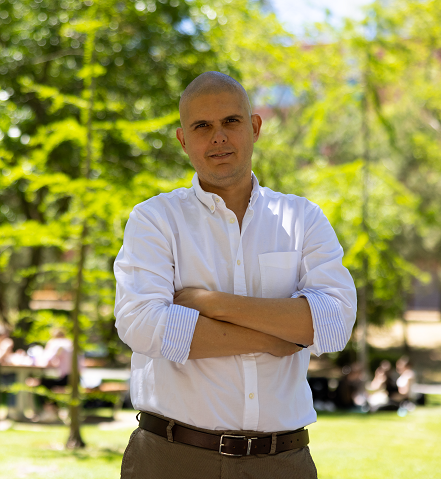

Luis M. Romero-Rodríguez es Profesor Titular de Comunicación Estratégica en la Facultad de Ciencias de la Comunicación de la Universidad Rey Juan Carlos (Madrid, España), y desde mayo de 2022 está acreditado al cuerpo docente de Catedráticos de Universidad por la Agencia Nacional de evaluación del profesorado (ANECA). En la actualidad es profesor responsable del Máster Universitario en Comunicación de la Salud de la URJC y profesor de su programa de Doctorado en Ciencias Sociales y Jurídicas, en la línea de investigación Comunicación. Asimismo, es profesor invitado en varios programas de postgrado en la Universidad de Especialidades Espíritu Santo (Ecuador), la Universidad Autónoma de Barcelona, y la Universidad Nebrija (España), siendo colaborador externo de su programa de Doctorado en Comunicación Digital y Medios.
EDUCATION
Doctor en Comunicación por las universidades de Huelva, Sevilla, Málaga y Cádiz (2014), premio extraordinario de Doctorado por la Universidad de Huelva (2015) y Máster en Comunicación Social por la Universidad de Almería (España). Ha realizado postgrados en Derecho y Políticas Internacionales por la Universidad Central de Venezuela y en Docencia Universitaria por la Universidad Nueva Esparta (Venezuela). Me licencié en Comunicación Social, mención Comunicaciones Corporativas y en Derecho por la Universidad Santa María (Venezuela).
RESEARCH, TEACHING, or OTHER INTERESTS
Communication, General Social Sciences, Health (social science), Cultural Studies
Scopus Publications
Scholar Citations
Scholar h-index
Scholar i10-index
Scopus Publications
Luis M. Romero-Rodríguez and Bárbara Castillo-Abdul
Springer Science and Business Media LLC
, Santiago Tejedor Calvo, Laura Cervi, , Luis M. Romero-Rodríguez, and
University of La Laguna
Religious tourism is an important economic and cultural driver for many destinations and is one of the fastest-growing sectors within the global tourism market. Based on a meta-analysis and review of emerging literature from the period 2019-2023 in the Social Sciences Citation Index (SSCI) of the Web of Science (WoS), this study analyses, from a quantitative-qualitative approach, the state-of-the-art research on this sub-category of tourism from a corpus of 500 documents. The most relevant results show that the COVID- 19 pandemic affected scientific production, with China, the United States, and Spain being the three countries that have published the most on the subject. Research on tourism to Christian and Islamic destinations appears most frequently. However, destinations linked to Hinduism tend to be over-represented with respect to numbers of people of this creed, which may be due to tourism specialising in meditation and wellness.
Santiago Tejedor and Luis M. Romero-Rodríguez
MDPI AG
The Hospital Web Quality Multicriteria Analysis Model (HWQ) is constructed, designed, and validated in this research. For this purpose, we examined the web quality analysis models specialized in hospitals and health centers through a literature review and the most current taxonomies to analyze digital media. Based on the benchmarking and walkthrough methods, the analysis model was built and validated by a panel of experts (X = 3.54, CVI = 0.88, Score Σ = 45.58). To test its applicability and reliability, the model was pilot-tested on the websites of the ten public and private hospitals with the best reputation in Spain in 2022, according to the Merco Sanitario ranking. The results showed very similar web structures divided by specific proposals or sections of some centers. In this regard, this study identifies a general communication proposal in hospitals that does not adapt to the guidelines of screen-mediated communication, as well as a lack of personalization and disruptive storytelling ideation. In addition, the work concludes that Spanish hospitals, for the moment, have not opted for formats and technological developments derived from the possibilities of gamified content, 360° immersion, Virtual Reality (V.R), or Augmented Reality (A.R).
Santiago Tejedor-Calvo, David Rull-Ribo, Jesús Martínez, and Luis M. Romero-Rodríguez
Escuela Militar de Cadetes Jose Maria Cordova
Diferentes ejércitos del mundo han apostado por convertir sus sitios web en el centro de su estrategia comunicativa digital. Este trabajo examina y compara los sitios web de 14 unidades militares de élite de los cinco continentes para elaborar una taxonomía a partir de dimensiones e indicadores estructurados de usabilidad, contenidos, interactividad y accesibilidad. Para ello, a través de un análisis de contenido cuanti-cualitativo, que consta de 14 dimensiones temáticas, 36 indicadores y 69 variables, se ha desarrollado una etnografía digital cualitativa. El estudio identifica, entre otros aspectos, la importancia del componente dialógico y multiformato en el ciberespacio. Además, concluye que, en general, los ejércitos analizados apenas han incorporado tipologías de contenidos derivados de la gamificación, la inmersión y la virtualidad, entre otros.
Tomás Fontaines-Ruiz, Luis M. Romero-Rodríguez, Luis F. Reyes-Pérez, and Samuel Reyes-Hernández
Hipatia Press
El consumo de información en redes sociales se ha convertido en un comportamiento prevalente entre personas con enfermedades ortopédicas, que aprovechan el efecto de apomediación de plataformas para satisfacer sus necesidades informativas, descuidando los riesgos asociados. En este contexto, el objetivo de esta investigación es evaluar la calidad y el valor educativo del contenido relacionado con el dolor lumbar en español, difundido en YouTube. Esta evaluación emplea una metodología de análisis de contenido codificada a través de tres instrumentos ad hoc previamente validados. Se llevó a cabo un estudio descriptivo-evaluativo en una muestra final de 70 videos. Los resultados indican que la información examinada presenta un bajo valor educativo, muestra deficiencias en el diseño educativo técnico, carece de precisión científica y claridad en el mensaje, y revela una autoridad epistemológica disminuida entre los creadores de contenido. Estos factores contribuyen a la generación potencial de confusión, interpretación errónea y difusión de información inapropiada relacionada con el manejo del dolor lumbar.
Carlos Fernández-Rodríguez and Luis M. Romero-Rodríguez
Intellect
Nowadays, the spectator lives surrounded by television series in which increasingly complex, depressing and denouncing themes proliferate. About this, the Netflix hit Squid Game (2021) is a clear representation of a mass culture increasingly virtuous in staging, as well as more horrifying, preachy and sensationalist. Based on the observation of the phenomenon that the series has meant, narrative content analysis has been carried out in which we have sought to find evidence of how mainstream culture continues to popularize and stylize audio-visual abjection in the context of the third golden age of television and the fascination with the plots of torture porn or postmodern cinema of cruelty. The results show that Squid Game is a faithful product of its time: as a current prestige series, it is dark, depressing, pessimistic and has an artistic aura without neglecting entertainment and explores human complexity in themes such as suicide, genocide and violence.
Santiago Tejedor, Luis M. Romero-Rodríguez, and Mónica Gracia-Villar
Bastas Publications
The current media ecosystem, marked by immediacy and social networks dynamics, has created a fertile field for disinformation. Faced with its exponential growth, since 2014, research has focused on combating false content in the media. From a descriptive approach, this study has analyzed 200 documents on fact-checking and fake news published between 2014 and 2022 in scientific journals indexed in Scopus. This study has found that Europe and the United States are leading the way in the number of journals and authors publishing on the subject. The United States universities are the ones that host the most significant number of authors working on fact-checking, while the methodologies used, mostly <i>ad hoc</i> due to the novelty of the topic, allow to reflect on the need to promote work focused on the design, testing, and evaluation of prototypes or real experiences within the field. The most common contributions analyzed include typologies of false content and media manipulation mechanisms, models for evaluating and detecting disinformation, proposals to combat false content and strengthen verification mechanisms, studies on the role of social media in the spread of disinformation, efforts to develop media literacy among the public and journalists, case studies of fact-checkers, identification of factors that influence the belief in fake news, and analysis of the relationship between disinformation, verification, politics, and democracy. It is concluded that it is essential to develop research that connects the academy with the industry to raise awareness of the need to address these issues among the different actors in the media scenario.
Bárbara Castillo-Abdul, Eglée Ortega Fernandez, and Luis M. Romero-Rodriguez
Emerald
PurposeThis study aims to analyze the content on corporate social responsibility (CSR) of Gucci, Prada and Ermenegildo Zegna on the social networks Instagram, Facebook and TikTok in order to examine the focus of the publications of these luxury brands, what type of content is more frequent and which ones generate more interaction and engagement.Design/methodology/approachAn interpretive content analysis of a sample of 92 posts on CSR published between December 2021 and June 2022 is used. For this purpose, an analysis sheet validated through theoretical constructs and pilot testing is used.FindingsMost of the social responsibility content of the fashion brands analyzed is linked to the use of sustainable materials, the protection of natural spaces and, in the particular case of Prada, the protection of the oceans. The posts that achieve the highest interactions are videos and photo reels. Although the strategies that significantly increase brands' reach on social networks are collaborations and joint posts with other fashion brands, as is the case of Gucci with NorthFace and Prada with Adidas. Also, one of the main findings of this research has been to identify that brands may be using TikTok – perhaps experimentally – to reach stakeholders in Asian countries, especially China, where other platforms such as Instagram or Facebook may have a more limited reach.Originality/valueThis research shows that the social responsibility activities of luxury fashion brands leverage the content marketing strategy in social networks. It also demonstrates the importance of the Asian market (mainly Chinese) in the outreach strategies of brands, as is the case of Gucci and Prada, which bet on CSR activities for the protection of the Asian tiger in the framework of the year of the tiger in the Chinese horoscope, as well as the publication of certain content on TikTok.
Carlos Fernández-Rodríguez, Luis M. Romero-Rodríguez, and Bárbara Castillo-Abdul
Universidad Autonoma del Estado de Mexico
Esta investigación examina el grado de alienación política que los espectadores consideran tener respecto a las producciones audiovisuales. Para ello, se aplicó una encuesta a 998 millennials y centennials en España y México, los dos países hispanohablantes que más OTT[1] consumen. Los resultados muestran que los jóvenes consideran legítimo quejarse en redes sociales a una productora audiovisual cuando una serie o película refleja una visión que no les gusta, lo que posiblemente fomenta un escenario de "dictadura de la audiencia" sobre los creadores de contenidos audiovisuales, que afecta a la libertad creativa y a la libertad de expresión. En este sentido, parece que los jóvenes que tienen el poder discursivo en las redes sociales para cambiar y censurar producciones ven plausible utilizar este canal como denuncia o queja. [1] The acronym OTT stands for "Over The Top". In the world of technology and communication, this term is used to refer to "free transmission", i.e., content that does not require an operator for its distribution. The way in which this content is distributed is through the Internet via applications (AIMC, 2021).
Bárbara Castillo-Abdul, Luis Miguel Romero-Rodríguez, and Carlos Fernández-Rodríguez
University of Minho
This research examines the main common characteristics among the contents of five eco-influencer accounts from different Western countries. A quantitative content analysis was performed on 187 Instagram posts published by eco-influencers from the United Kingdom, United States, Belgium, Spain, and Peru. The topics that eco-influencers deal with the most are promoting veganism, spirituality, environmental and political claims, product advertising (their own and third-party), and personal life, generating the most interactions in the accounts. Carousels win on engagement for eco-influencers on Instagram despite videos being sponsors’ favorite format. Both sponsored content and sponsors themselves are well-received, with over half of all posts featuring them. It seems evident that the social capital of influencers encourages environmental commitment, although there is a particular bias to appreciate the person more than their activist message. In light of the results, this research contributes to the social capital theory of influencers by demonstrating that influencers show personal content and emotional appeals, such as activities with their families, personal reflections, and political statements that give them a high sense of authenticity, but which, blurs the barriers between the public and private spheres.
José Daniel Barquero Cabrero, Bárbara Castillo-Abdul, Juan Andrés Talamás-Carvajal, and Luis M. Romero-Rodríguez
Springer Science and Business Media LLC
AbstractIn the current era of the attention economy, users find themselves in social networks over-saturated with advertising that tends not to catch the public’s attention or have great credibility. In this sense, brands are trying to get closer to their audiences by using non-invasive, user-generated storytelling strategies with a more natural and experience-focused message. This research aims to compare which narrative elements used by the official accounts of 5 Ibero-American nation brands on Instagram and by the users (UGC) of hashtags promoted from those official accounts generate greater organic interaction on that social network (likes and comments). With a correlational view, we seek to compare whether the promotion of countries generates greater interaction between those generated by owned media and by users (UGC). For this purpose, two analysis sheets were designed and validated to perform quantitative, descriptive, and correlational content analysis and were applied, on the one hand, to 5 official profiles of Ibero-American countries (Argentina, Ecuador, Mexico, Panama, and Venezuela) and on the other hand, using the hashtags promoted from these official accounts, the 100 posts of user-generated content (UGC) with greater relevance according to the platform were chosen. The main results show that Reels reach almost five times higher than any other type of posts in UGC accounts, while on the contrary, in corporate accounts, they are the types of content with the least interactions. Unlike what one might think, contests (giveaways) on official accounts generated fewer likes and social responsibility content, and posts featuring influencers and celebrities also failed to achieve significant interactions. Overall, official accounts generate the same amount of likes as UGC but significantly fewer comments. Brands only outperform UGC in likes in individual Photographs or Photo Rolls, while UCG outperforms brands in Reels for both metrics.
Carlos Fernández-Rodríguez, Luis Miguel Romero-Rodríguez, and Belén Puebla-Martínez
Bastas Publications
The current audiovisual landscape via streaming is characterized by images loaded with aesthetics and violence. Therefore, the main objective of this study is to decipher the audience’s feelings about the violent and dystopian plots that saturate the current panorama of audiovisual entertainment through a survey aimed at millennials and centennials in Spain and Mexico, who are the viewers who consume the most streaming platforms of the two countries. The results show that viewers do not feel that these series, contrary to what it might seem, cause them sadness or low spirits, and, likewise, these viewers consume these products without having a specific idea of whether the audiovisual should show cruelty, historical accuracy or the vicissitudes of the world. In conclusion, this research provides a current map of the feelings of the OTT audience about the shocking, bloody, and visceral images that are so present in the routine of young audiences.
Carlos Fernández-Rodríguez, Luis Miguel Romero-Rodríguez, and Belén Puebla-Martínez
Universidad de Piura
Millennials y centennials son dos generaciones muy implicadas con las cuestiones sociales a nivel político y tecnológico. Este interés ha suscitado en muchos de estos individuos, algunos miembros de comunidades "woke", una búsqueda del lenguaje políticamente correcto tanto en las redes como en la ficción audiovisual contemporánea consumida habitualmente en plataformas de streaming. Este estudio tuvo como objetivo analizar el sentimiento psicosocial de eficacia política que tienen los millennials y centennials como usuarios de plataformas de streaming en España y México para determinar su predisposición y justificación para priorizar sus puntos de vista ante la censura y cancelación de contenidos. Los resultados revelan que los centennials tienen un mayor sentimiento de eficacia que los millennials, siendo estos últimos los más preocupados por la censura y la libertad de expresión a la hora de recibir una noticia.
Luis M. Romero-Rodriguez and Bárbara Castillo-Abdul
Emerald
PurposeThis study examines the research that has been conducted on user-generated advertising content in the social marketing strategies of commercial brands to understand the phenomenon, explore academic interest in the topic and identify areas of limited thematic coverage.Design/methodology/approachA systematic review of existing scientific literature in the Web of Science (WoS) and Scopus was carried out using the PRISMA protocol. A co-occurrence matrix was used to review emerging topics on user-generated content (UGC) and influencer marketing, allowing the identification of articles (n = 59) related to the objective of this research.FindingsMost research has analyzed UGC in images or text, but only very few have addressed videos and other digital formats (such as reels, image carousels or podcasts), although there is sufficient work focused on Twitter, Facebook and YouTube. There was no evidence of work exploring the effects, repercussions and possible dangers of uncontrolled brand exposure through Unofficial Brand Ambassadors.Originality/valueThe literature review has allowed finding important areas of future research that the scientific community has not sufficiently addressed. Likewise, this work shows structurally several classifications of UGC, which will facilitate future research to deepen and broaden these categories.
Carlos Fernández-Rodríguez, Luis M. Romero-Rodríguez, and Belén Puebla-Martínez
Royallite Global
Viewers are increasingly used to the link between entertainment and technology in the current media ecosystem. The success of consuming streaming platforms when watching movies and series shows how the audience is more involved in new forms of viewing, at any time, at any moment, and with any content. This research aimed to examine the perception of millennial and centennial audiences in Spain and Mexico, the two Spanish-speaking countries with the highest streaming consumption, about audiovisual content producers for entertainment. Three theories on public perception (spiral of silence, bandwagon effect, and third-person effect) were used as the basis of the research questions to unravel the extent to which younger audiences in these countries consider that production companies are, or are not, ethical in the representation of what may be labeled as "sensitive topics". The results show that centennials are more confident in their critical perceptions of controversial issues in movies and series, while, on the other hand, millennials approach their perceptions with more cautiousness and confusion.
Luis M. Romero-Rodríguez, Bárbara Castillo-Abdul, and Patricia Sánchez-Holgado
Universitat Autonoma de Barcelona
This study presents a taxonomy to analyze the Corporate Visual Identity (CVI) through the theoretical construction of iconographic variables. The instrument was validated by an expert panel and a pilot test that examined the CVI of the 50 leading pharmaceutical companies in Spain. The instrument was organized by graphic elements: iconographic sign, linguistic sign, and plastic sign, and helped to catalog the symbolic components of CVI. In the Spanish case, due to its cultural and social context, pharmaceutical brands prefer typographies with no strokes, simple lines, capital letters, and round and medium strokes.
Arlen Sanz Peralta, Marta Ortiz Ramos, and Luis M. Romero-Rodriguez
Fundacion Universitaria San Pablo CEU
La presente investigación examina la identidad visual de las 72 principales entidades financieras que operan en España a través de un modelo de análisis de contenido iconográfico-simbólico construido ad hoc. Para ello se diseña y valida una ficha de análisis provista de variables teóricas donde cada objeto de muestra responde a las categorías agrupadas por razones de similitud y bajo criterios formales obtenidos del estudio de toda la literatura relacionada con los elementos gráficos fundamentales -signo icónico, lingüístico y plástico- y su aplicación al mundo virtual. Entre los resultados queda demostrado que la legibilidad y modernidad son prioritarias en la mayoría del corpus muestral, con un estilo de tipografía sin remates, trazos simples, caracteres mayúsculos, redondos y de grosor medio. Además, las entidades dan preferencia a otros valores aparte de la profesionalidad y estabilidad, como lo es la cercanía o la confianza, haciendo uso en las composiciones de un rango de calidad de 2-3 colores de combinación cromática donde es apreciable la equidad entre cromáticas frías y cálidas.
Maria Soledad Ramirez-Montoya, Hector G. Ceballos, Sandra Martínez-Pérez, and Luis M. Romero-Rodríguez
MDPI AG
Researchers primarily dedicate their time to teaching in Latin American universities. For this reason, it is essential to determine how teaching time affects (or contributes to) the scientific productivity of researchers working under these conditions. We analyzed the incidence of gender, groups taught at undergraduate and graduate levels, the researcher proficiency level, and the number of thesis students advised, among others, for the impact on the scientific productivity (annual publications) of a group of professors. We analyzed the data using both statistical and regression methods. Contrary to our initial hypothesis, the number of groups taught does not significantly influence research productivity; it is affected by other factors such as belonging to the Mexican Researcher System (SNI) or having a researcher or administrative position at the institution. Our results can help guide the formulation of academic and research policies that contribute to the scientific productivity of Latin American universities.
Luis M. Romero-Rodríguez and Bárbara Castillo-Abdul
Emerald
David Blanco-Herrero, Bárbara Castillo-Abdul, and Luis Miguel Romero Rodríguez
KOME Journal
This research examines the patterns followed by disinformation in Spain through the fact-checking activities of Maldita.es, the leading fact-checking organisation in Spain. We sought to answer three research questions: 1. What are the predominant topics of the hoaxes debunked by Maldita.es? 2. Who is responsible for the creation and dissemination of these hoaxes? and 3. In what formats and platforms are these hoaxes generally distributed? For this purpose, we conducted a quantitative content analysis of 729 hoaxes fact-checked in 2022 by Maldito Bulo. 40.7% of the debunked hoaxes were related to social issues, while 37.2% focused on political affairs. Regarding those responsible for the creation and dissemination, most of the hoaxes came from unidentified sources, although when the identity is known, the most frequent contributors are social media accounts, alternative and partisan pseudo-media and journalists. These results explore the general disinformation scenario in Spain, using fact-checking as an approximation and discussing its implications.
Carlos Fernández-Rodríguez, Luis M. Romero-Rodríguez, and Belén Puebla-Martínez
Informa UK Limited
Bárbara Castillo-Abdul, David Blanco-Herrero, and Luis M. Romero-Rodríguez
Bentham Science Publishers Ltd.
Background: As a result of the confinements of the COVID-19 pandemic and the sedentary lifestyle due to teleworking, there is an increase in weight gain and dietary carelessness in the population, which leads to an increase in offers of fad diets based on recommendations made by digital influencers. Objective: The aim of the study was to examine the characteristics of dietary recommendation videos made by non-health professional prescribers in Spanish and English to understand what patterns are followed by the productions of this type of content and what effects they have on the interaction they receive. Methods: An exploratory walkthrough method analysis was applied to define the variables of a codebook, followed by a content analysis of a sample of 50 videos published between January 2020 and July 2021. Results: Most of the videos are published in the first months of the year, probably aimed at users seeking to reduce the weight gained during Christmas. The productions were characterized by having a very personal tone, informative and with relatively plural information, sometimes addressing the risks of diets or slimming products, and, although recommendations abound, the voices of experts are not frequent. Conclusion: The products and diets addressed in the videos often have a high health risk and do not involve practices recommended by experts, so although sometimes their contraindications or associated risks are pointed out, the promotional component and the search for traffic to the channel seem to be more relevant factors than public health in these videos.
Luis M. Romero-Rodríguez, Bárbara Castillo-Abdul, and Pedro Cuesta-Valiño
Cogitatio
We are living through a time of major political changes due to the rise of populist leaders and the resurgence of extreme ideological movements. The emergence of this phenomenon is due, to a large extent, to the ease with which these political actors can disseminate and spread their messages without any limits through social networks, leaving aside the former “fourth power” of the media as filterers and reinterpreters of information. Generally, the formula used by these leaders and movements is usually based on symbolic social division and polarization through hate speeches that allow demonizing their adversaries while antagonizing the issuers: a discursive “us” against “them” based on verbal violence to dehumanize an “exogroup.” We want to discuss the importance of understanding the process of communicational transfer—which begins with hate speech and evolves into demonization and social polarization—as a strategic basis for creating an ideal scenario for the growth and strengthening of populist discourse, which is reductionist and simplifying in nature.
Javier Gil-Quintana, Antonio Ruiz Galisteo, and Luis M. Romero-Rodríguez
Instituto Universitario de Lisboa (ISCTE-IUL)
In Spain, the COVID-19 pandemic forced absolute confinement from March 15 to July 21, 2020. On the other side of the screen, YouTubers girls and boys, creators of specific content for their peers, took the opportunity to increase their productions. This research examines 73 creations made during the confinement period by six Spanish YouTubers girls categorized as influencers by the number of reproductions and followers of their channels through content analysis to evaluate the interactions, content generated and subjective aspects of projection of the emotional state of these minors. The results show an increase in the number of interactors, positioning the female sector as the most prevalent gender. The contents have been related to the COVID-19 theme, while, in the emotional aspect, the influencers were not affected by the great sadness that hit Spain with the death of thousands of people.